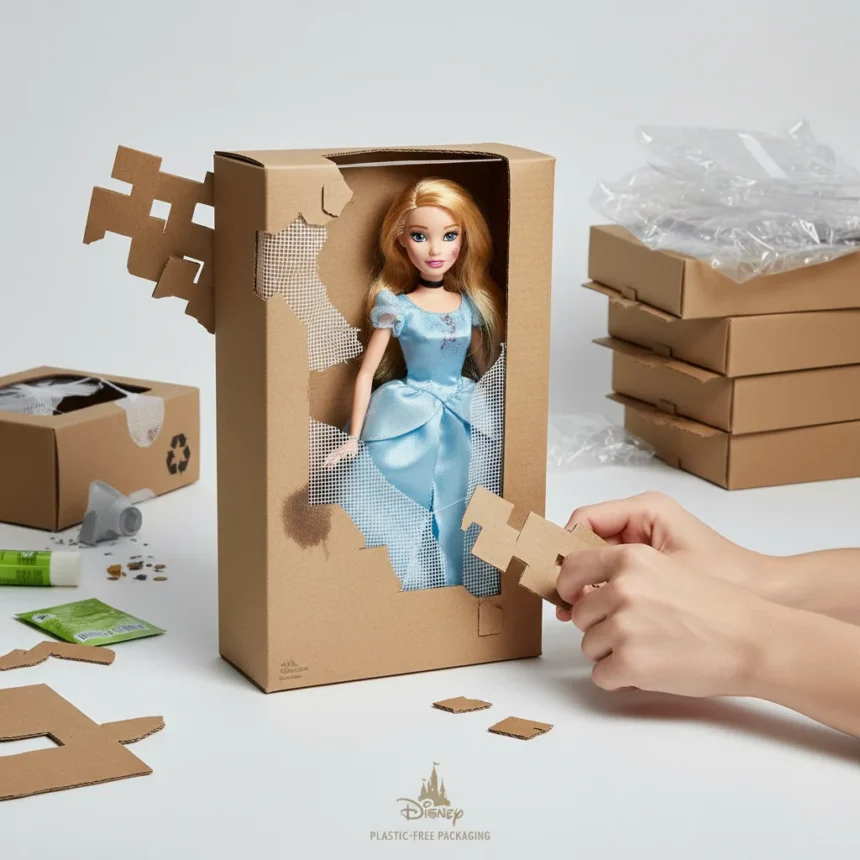
Disney’s plastic-free doll packaging for its Core Classic Princess collection represents one of the toy industry’s most visible sustainability pushes—and it exposes exactly why eliminating plastic from retail packaging remains so difficult. Launched on Earth Day 2021, the redesigned packaging for 15 characters including Ariel, Belle, Jasmine, Moana, and Tiana ditches the transparent plastic window that has been standard for decades, replacing it with a photo of the doll printed directly on sustainably sourced, 100% recyclable paper. The shift avoids over 110,000 pounds of plastic annually compared to 2020 packaging—the weight of roughly 11 elephants. Yet Disney’s own admission reveals the core tension: “The biggest challenge was presentation.”
Key Takeaways
- Disney’s redesigned packaging eliminates 110,000 pounds of plastic per year versus prior doll boxes.
- New boxes use 100% recyclable, sustainably sourced paper with photo visibility instead of clear plastic windows.
- Launched Earth Day 2021 at shopDisney and Disney Stores; expanded globally throughout 2021.
- Boxes are thematically designed to reflect each character’s story and double as reusable play props.
- By late 2025, Walt Disney World stores carried smaller repackaged versions with fewer accessories at the same price.
Why plastic-free doll packaging demanded a rethink
For half a century, toy retailers relied on clear plastic windows because they solved a simple problem: customers could see what they were buying without opening the box. Remove that window and you remove the ability to inspect the doll’s face, outfit details, and accessories before purchase—a genuine concern for gift-buyers and collectors who treat packaging visibility as part of the buying decision. Disney’s solution was to print a high-quality photograph of the doll directly on the box, maintaining visual clarity while eliminating the plastic entirely. The boxes are also easier to open, more durable, and use less material overall than the prior design. But that photograph had to be good enough to replace the real thing, which explains why Disney’s team flagged presentation as the core challenge.
Stefanie Majoras, Vice President of Global Merchandise Sourcing and Supply Chain Optimization at Disney, framed the shift as a holistic rethink: “At Disney, we always start with the story—creating authentic character experiences that resonate with guests and fans. Our packaging is where that story begins. With our Classic Doll packaging, we saw an opportunity to rethink the guest experience through the lens of both sustainability and design. The new Classic Doll packaging reflects a more holistic approach—eliminating plastic, reducing material use, and bringing back direct visibility to the doll”. That phrase “bringing back direct visibility” is telling: the photo had to deliver what the plastic window did, or the packaging fails its core function.
How Disney solved the presentation problem
The redesigned boxes take a thematic approach, with each doll’s box reflecting her story and character arc. Rather than generic white cardboard, the packaging becomes part of the product experience—reusable as a play prop, storage container, or display piece. This transforms the box from disposable waste into an extension of the doll itself, addressing a secondary sustainability concern: if the packaging has secondary value, it is less likely to end up in a landfill immediately. Disney partnered with Fuseneo on the redesign, shifting the entire consumer experience by removing the see-through plastic window that had dominated toy retail for decades. The boxes are also smaller and more compact than their predecessors, reducing shipping weight and material use.

The practical benefits matter too. The new packaging is easier to open—a genuine frustration with clamshell and plastic-windowed boxes that require scissors or knives—and more durable in transit. For retailers, this means fewer damaged goods on shelves. For consumers, it means less wrestling with packaging. Yet none of these improvements would have worked if the photograph on the box failed to convince buyers that the doll inside matched what they expected to see.
The broader sustainability commitment and recent shifts
The plastic-free doll packaging rollout began at shopDisney.com, Disney Store locations, and Walt Disney World Resort in North America on Earth Day 2021, then expanded to Disneyland Resort and global properties later that year. The initiative is part of Disney’s “Disney Planet Possible” commitment to extend sustainability practices across more dolls and products. By late 2025, Walt Disney World stores began carrying smaller repackaged versions with reduced accessories—some sets now include only a sidekick figure rather than the prior extras like additional outfits, props, activity pages, and fold-out backgrounds—while maintaining the same retail price. This evolution suggests Disney continues refining the balance between material reduction and perceived value.



Mattel, the Disney Princess licensee, independently refreshed its own doll packaging in 2024 with new backings featuring clearer graphics (such as tower and tree designs for Rapunzel) and updated logo fonts, though the dolls themselves remained unchanged and no plastic-free claim was made. Disney’s shift represents a more radical departure from industry norms, making the presentation challenge all the more significant—the company had to prove that a photograph could replace what collectors and gift-buyers had relied on for decades.
Does plastic-free packaging actually work for toy retail?
The 110,000-pound annual plastic reduction is substantial, and the environmental math is straightforward. But the real test is whether consumers accept a photograph instead of seeing the actual product through plastic. Disney’s thematic box design and high-quality printing address this, yet the challenge persists for any retailer attempting similar redesigns. Toy packaging serves multiple functions simultaneously: it protects the product, displays it, tells a story, and signals quality. Remove one element—the plastic window—and you must compensate with another. Disney chose photography and narrative design. Others might choose different solutions. The fact that Disney flagged presentation as the biggest obstacle suggests that sustainability in toy retail is not just about material swaps; it is about redesigning the entire consumer experience around a constraint.
Is Disney extending plastic-free packaging to other product lines?
Disney’s announcement referenced extending the plastic-free approach to more dolls and products as part of its Planet Possible commitment, though specific timelines and product categories were not detailed in available sources. The initiative began with the Core Classic Princess collection and has since evolved, as evidenced by the 2024-2025 repackaging updates at Walt Disney World locations.
How does the new packaging compare to Mattel’s 2024 refresh?
Mattel’s 2024 packaging refresh updated graphics and logo fonts for Disney Princess dolls but did not eliminate plastic or introduce plastic-free materials. Disney’s redesign is more radical in its environmental commitment, while Mattel’s approach focused on visual design updates without material changes.



Can other toy retailers replicate Disney’s plastic-free packaging model?
Yes, but the presentation challenge Disney identified is real. Any retailer attempting to remove plastic windows must solve the visibility problem—whether through high-quality photography, alternative materials, or redesigned display methods. The cost of redesigning packaging, retooling production, and managing consumer perception during the transition is substantial, which explains why the industry has relied on plastic windows for so long. Disney’s scale and brand loyalty gave it an advantage in convincing customers to accept a photograph instead of the real thing.
Disney’s plastic-free doll packaging proves that sustainability in toy retail is not just an environmental choice—it is a design challenge. The company eliminated 110,000 pounds of plastic annually by solving a presentation problem that most consumers did not even realize existed. That is the real victory: not just the material reduction, but the proof that alternatives to plastic windows are viable. Whether other toy makers follow Disney’s lead depends on whether they can match the quality of photography and narrative design that made the redesign work.
Edited by the All Things Geek team.
Source: TechRadar