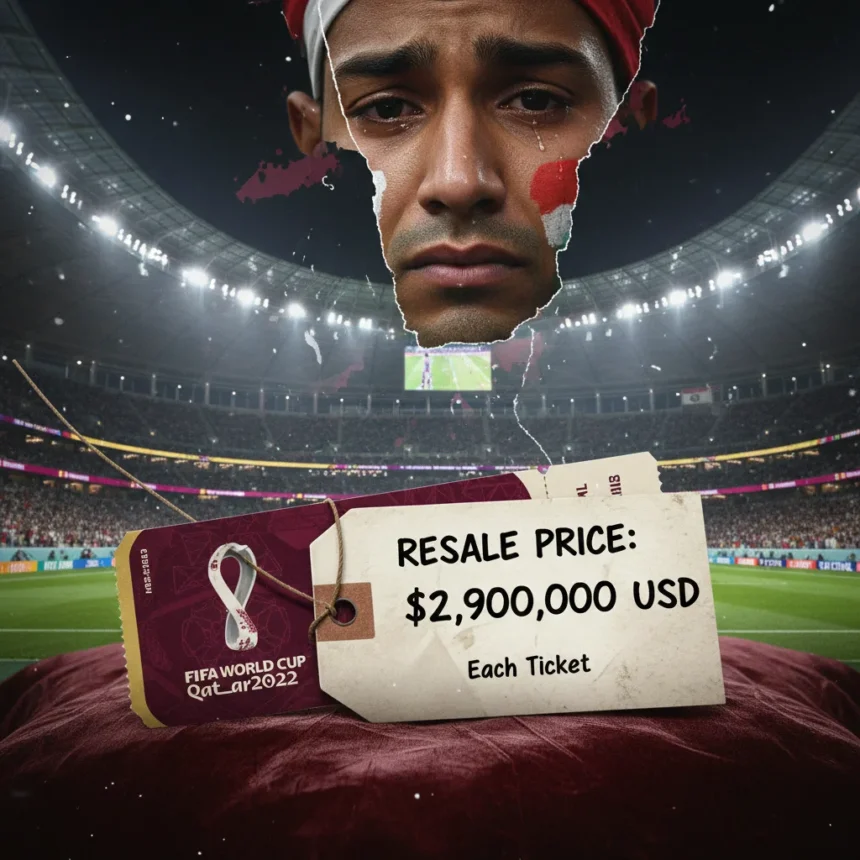
World Cup Final tickets resale prices have reached absurd heights, with four premium hospitality seats listed on Viagogo for $2.9 million USD each—totaling $11.6 million for the set. This secondary market surge during the 2022 FIFA World Cup in Qatar exposes the scalping crisis that grips major sporting events and reveals just how far ticket prices can drift from reality when demand overwhelms supply.
Key Takeaways
- Four World Cup Final tickets listed at $2.9 million each on Viagogo, totaling $11.6 million USD for the set.
- Face value for World Cup Final tickets ranged from $600–$1,600 USD, making resale prices 1,800x higher.
- Secondary market peaked above $100,000 USD per ticket for non-hospitality seats before the Argentina vs France final.
- FIFA officially warned against unauthorized resale, stating FIFA.com ticketsales was the only legitimate source.
- Viagogo listings appeared shortly after semi-finals with seller identity unknown.
How World Cup Final Tickets Resale Prices Spiraled Out of Control
The $2.9 million price tag for World Cup Final tickets represents a staggering disconnect between face value and secondary market demand. Standard allocation priced these seats at $600–$1,600 USD, making the resale markup roughly 1,800 times higher. This explosion occurred because the 2022 Qatar final matched Argentina against France—a historic clash featuring Lionel Messi’s potential final World Cup appearance against Kylian Mbappé’s rising dominance. That narrative alone triggered global bidding wars among ultra-wealthy fans willing to pay whatever scalpers demanded.
Viagogo, the secondary ticketing platform where these listings appeared, became ground zero for the resale frenzy. The platform’s lack of enforcement against inflated pricing allowed sellers to list tickets at fantasy prices shortly after the semi-finals concluded. While FIFA explicitly warned that only authorized sales through FIFA.com were legitimate and that secondary market transactions violated official policy, Viagogo continued operating without meaningful intervention. The platform’s fee structure, reportedly ranging 30–40%, made even moderately priced tickets expensive for buyers, yet sellers still posted asking prices that defied economic logic.
What Else $2.9 Million Can Actually Buy
To contextualize the absurdity, $2.9 million USD unlocks far more tangible luxury than a single seat at a sporting event. A Bugatti Chiron Super Sport—capable of 304 mph with 0-60 mph acceleration in 2.4 seconds—costs $3.9 million, meaning one World Cup Final ticket costs nearly as much as one of the world’s fastest production cars. That single ticket price also approaches the cost of a 5-bedroom luxury penthouse in Manhattan’s Hudson Yards ($2.5 million USD) or a beachfront villa in Miami ($2.8 million USD).

For maritime enthusiasts, $2.9 million buys a 100-foot Sunseeker yacht with capacity for 12 guests, offering months of luxury travel rather than hours at a stadium. Private aviation alternatives include 100 hours of flight time on a Bombardier Global 7500 at approximately $29,000 per hour. A Richard Mille RM 52-05 Tourbillon Pharrell Williams watch—a limited-edition timepiece with a sapphire case—commands the exact $2.9 million price point. Alternatively, buyers could attend 1,450 Super Bowl LVII tickets at $2,000 average resale price, or purchase courtside seats to 290 NBA Finals games. The everyday perspective: $2.9 million equals 5.8 million Big Macs at $0.50 each, or funding 29 Tesla Cybertrucks at $100,000 per unit.
Why FIFA’s Warnings Failed to Stop the Resale Surge
FIFA’s official stance prohibited unauthorized secondary market sales, explicitly stating that FIFA.com ticketsales represented the only legitimate distribution channel. Despite this warning, Viagogo and other resale platforms continued operating without meaningful regulatory consequence. The platform’s business model depends on transaction volume and seller commissions, creating perverse incentives to allow inflated listings rather than enforce price caps or authenticity verification.



The lack of enforcement reflects a broader problem in ticketing: secondary markets operate across jurisdictions with minimal coordination between platforms, event organizers, and national regulators. FIFA could issue warnings, but without legal authority to shut down Viagogo’s listings or prosecute sellers, the declarations remained toothless. Sellers understood that posting a $2.9 million ticket carried zero legal risk—the worst outcome was the listing vanishing when no buyer materialized. The brief window between semi-finals and the final match created urgency that amplified prices; once the final occurred and the event concluded, those inflated listings simply disappeared from the platform, leaving no paper trail of actual sales.
Does Paying $2.9 Million for a World Cup Ticket Ever Make Sense?
No credible financial or experiential argument justifies $2.9 million for a single ticket. Even ultra-wealthy individuals—those with net worth in the hundreds of millions—would recognize this as irrational spending. A $2.9 million ticket buys a view of a match lasting roughly 90 minutes plus extra time, typically 120 minutes maximum. The hourly cost exceeds $1.4 million per hour, making it economically indefensible compared to premium hospitality packages at face value, which deliver similar access at a fraction of the price.
The resale surge reflects speculative behavior rather than genuine fan demand. Scalpers and speculators list tickets at extreme prices hoping a desperate billionaire might impulse-buy without negotiating. Most $2.9 million listings never sell—they vanish from the platform after the event concludes, suggesting they were aspirational asking prices rather than realistic market rates. The psychology of scarcity and FOMO (fear of missing out) drives some wealthy buyers to overpay, but the majority of secondary market transactions likely occurred at lower price points, with the headline-grabbing $2.9 million listings serving as marketing noise rather than actual commerce.
FAQ
What were the original face-value prices for World Cup Final tickets?
Face-value World Cup Final tickets ranged from $600–$1,600 USD depending on seating category, with the $2.9 million resale listings representing premium hospitality seats. This markup illustrates how far secondary markets can diverge from official pricing when demand exceeds supply.



Did FIFA take legal action against Viagogo over these listings?
FIFA issued official warnings stating that only FIFA.com ticketsales represented legitimate distribution and that secondary market resales violated policy. However, the research brief does not specify whether FIFA pursued legal action against Viagogo or individual sellers, suggesting enforcement remained limited to public statements.
Are World Cup Final ticket resale prices still this high?
The $2.9 million listings appeared during the 2022 Qatar tournament in December 2022. Once the final match concluded, these inflated listings vanished from Viagogo. Current resale prices for past World Cup events reflect historical data rather than active secondary market activity.
The $2.9 million World Cup Final ticket resale saga reveals how unchecked secondary markets enable absurd pricing when global attention converges on a single event. For fans actually wanting to attend future World Cups, the lesson is clear: secure tickets through official channels at face value, avoid secondary platforms entirely, or accept that scalping will extract a premium measured in tens or hundreds of thousands, not millions. The handful of ultra-wealthy buyers willing to pay $2.9 million are outliers—most fans simply get priced out entirely.
Edited by the All Things Geek team.
Source: Tom's Guide