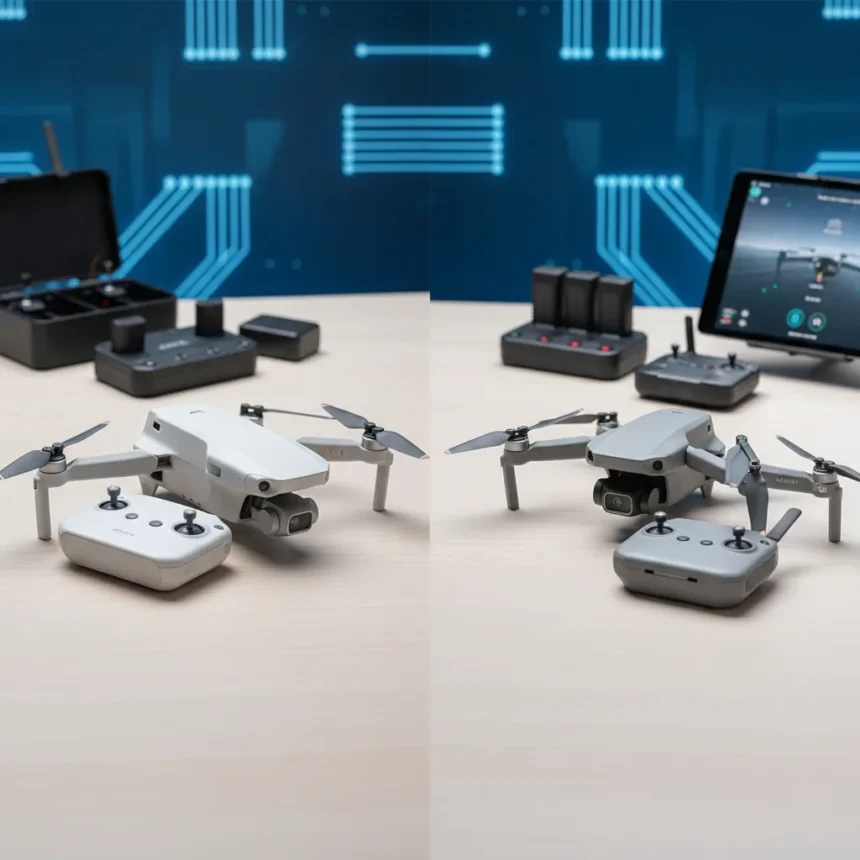
The DJI Lito X1 vs Mini 4K debate centers on whether DJI’s latest beginner drone justifies an upgrade from one of the market’s most accessible entry-level options. DJI has positioned the Lito X1 as its newest beginner-friendly drone, while the Mini 4K remains a proven choice for first-time flyers seeking 4K video capture and sub-250g portability.
Key Takeaways
- DJI Lito X1 is newly released and marketed as DJI’s latest beginner drone with enhanced features over the Mini 4K.
- DJI Mini 4K delivers 4K video, 2x digital zoom, and excellent flight times in a sub-250g design.
- Mini 4K lacks obstacle avoidance but excels as a budget-friendly entry point for beginners.
- The Lito X1’s exact specifications remain unconfirmed in available sources, creating uncertainty about upgrade benefits.
- Emerging competitors like the V-Copter Falcon Mini offer alternative designs at competitive price points.
What makes the DJI Lito X1 vs Mini 4K comparison urgent right now?
DJI’s beginner drone lineup is in flux. With the Lito X1 now available as the company’s latest entry-level option, first-time buyers face a genuine choice: stick with the proven Mini 4K or invest in the newer Lito X1. The timing matters because the sub-250g drone category is heating up. Competitors like the V-Copter Falcon Mini—a three-axis gimbal bi-copter with 4K video, 2.7K vertical capture, and faster acceleration—are now priced at around $299, undercutting both DJI options and forcing the question: what are you actually paying for when you choose DJI?
DJI Mini 4K: The established budget champion
The DJI Mini 4K remains DJI’s most accessible beginner drone, delivering 4K video, 2x digital zoom, generous flight times, and a sub-250g weight that avoids regulatory registration in many regions. For entry-level users who don’t need obstacle avoidance, the Mini 4K represents excellent value. Its design prioritizes ease of use: the DJI Fly app includes clear tutorials and automation features for mid-air maneuvers, making it genuinely approachable for pilots with zero experience.
The Mini 4K’s real strength lies in its balance of capability and simplicity. You get legitimate 4K recording, reasonable flight performance, and a battery life that lets beginners actually practice without constant recharging. The lack of obstacle avoidance is a deliberate cost-cutting choice, not a hidden flaw—DJI made a conscious trade-off between price and safety features.

DJI Lito X1: Promise without clear proof
Here’s the uncomfortable truth: the DJI Lito X1’s exact specifications remain unconfirmed in available sources. TechRadar positions it as the company’s favorite beginner drone with enhanced features, but those enhancements are not yet publicly detailed. Without confirmed specs, comparing it directly to the Mini 4K is speculative. The Lito X1 may represent a meaningful upgrade—better gimbal stabilization, improved battery, enhanced automation—or it could be a modest refresh with marginal real-world gains.
This opacity is unusual for DJI, which typically publishes full specifications immediately upon launch. The lack of available data suggests either an extremely recent release or confusion about the model’s exact positioning within DJI’s beginner lineup. Prospective buyers should demand clarity before committing to an upgrade.



The real competition: alternatives reshaping the beginner market
While DJI dominates beginner drones, the V-Copter Falcon Mini introduces a genuinely different approach. Its bi-copter design, three-axis gimbal, 4K video, and 2.7K vertical capture at $299 represent a credible alternative for buyers willing to explore beyond DJI’s ecosystem. The Falcon Mini’s faster acceleration and quieter flight profile appeal to users prioritizing maneuverability over brand loyalty.
Additionally, DJI’s own leaked Mini SE—reportedly featuring 2.7K video and 12MP stills—suggests the company is preparing an even cheaper entry point, potentially undercutting both the Mini 4K and Lito X1. If the Mini SE launches at a significantly lower price, the Lito X1’s value proposition becomes harder to defend unless it delivers proportionally better features.
Should you upgrade to the DJI Lito X1 from the Mini 4K?
Not yet. The Mini 4K remains the safer choice for beginners because its specifications are proven and transparent. You know exactly what you’re getting: 4K video, reliable flight, excellent tutorials, and genuine budget-friendliness. The Lito X1’s vague positioning creates unnecessary risk. If DJI published detailed specifications showing tangible improvements—better stabilization, longer flight time, enhanced automation—an upgrade might justify itself. Until then, the Mini 4K’s track record and lower entry price make it the smarter recommendation for first-time buyers.
Experienced flyers willing to experiment might consider the V-Copter Falcon Mini’s bi-copter design as a lateral move, offering different capabilities rather than incremental improvements. But for pure beginner safety and value, the Mini 4K’s proven ecosystem and clear feature set remain unmatched in the sub-250g category.



Is the DJI Lito X1 worth the upgrade cost?
Without confirmed specifications and pricing, this question cannot be answered definitively. If the Lito X1 costs significantly more than the Mini 4K, the upgrade must deliver proportional improvements in video quality, stabilization, or automation. Marginal enhancements do not justify paying more for a less-proven product.
What are the key differences between DJI Lito X1 and Mini 4K?
The Mini 4K’s strengths are documented: 4K video, 2x digital zoom, sub-250g weight, generous battery life, and a beginner-friendly interface. The Lito X1’s specific advantages remain unconfirmed in available sources, making a detailed feature comparison impossible. This ambiguity itself is a significant difference—one drone’s specs are transparent, the other’s are not.
The DJI Lito X1 vs Mini 4K choice ultimately hinges on DJI’s willingness to publish clear specifications and pricing. Until then, the Mini 4K’s proven reliability and transparent feature set make it the rational choice for beginners. The Lito X1 may eventually prove superior, but it must earn that credibility through detailed specs and real-world testing, not marketing claims alone.
Where to Buy
No price information | 3 Amazon customer reviews | $299
Edited by the All Things Geek team.
Source: TechRadar