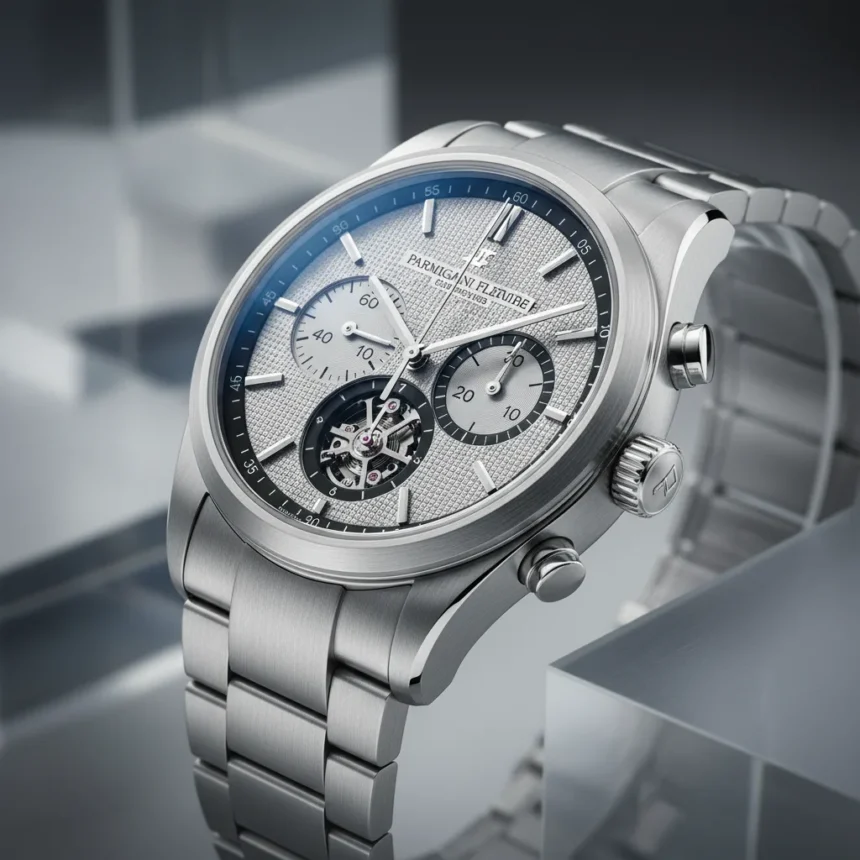
The Parmigiani Fleurier invisible chronograph represents a radical rethinking of how a timing instrument should present itself. Unveiled at Watches & Wonders 2026, the Tonda PF Chronographe Mystérieux appears at first glance as a clean three-hand dress watch—hours, minutes, and seconds—with no visible subdials, pushers, or chronograph elements. Press the monopusher at 7:30 and the watch transforms. Rhodium-plated hands fly back to 12 o’clock and begin measuring elapsed time while rose gold hands emerge from beneath them to display the current time. Release the pusher, press again to stop, and the chronograph freezes. Press once more and the hands reset, vanishing back into the dial’s minimalist surface.
Key Takeaways
- World-first chronograph with alternating hand deployment mechanism, requiring entirely new Calibre PF053 movement.
- Mineral blue dial with hand-guilloché barley-grain pattern hides all chronograph functions until monopusher activation.
- Calibre PF053 features 362 components, 41 jewels, 60-hour power reserve, and integrated column-wheel chronograph.
- Stainless steel case with polished and satin-finished bracelet; part of Parmigiani’s hidden complications collection.
- Celebrated brand’s 30th or 40th anniversary with engineering innovation that prioritizes dial purity over traditional subdial layouts.
How the Parmigiani Fleurier invisible chronograph actually works
The mechanism behind the Parmigiani Fleurier invisible chronograph is the entire point. Unlike traditional chronographs that wear their complexity visibly—subdials, registers, pusher arrangements—this watch performs its function in secret. The brief was straightforward: create a chronograph that materialises only when called upon. At rest, the rose gold hands show the time. Press the monopusher and the rhodium-plated chronograph hands (measuring hours, minutes, and seconds) leap to 12 o’clock and begin their count. The rose gold hands continue circulating beneath them, keeping you oriented to the actual time while you measure an interval. This dual-hand system required Parmigiani to develop an entirely new movement architecture. The Calibre PF053 integrates an automatic winding system with a monopusher column-wheel chronograph, totalling 362 components and 41 jewels. The movement runs at 28,800 vibrations per hour (4 Hz) with a 60-hour power reserve, and measures just 32.4mm x 6.8mm. Every angle of the bridges is hand-bevelled, and the 22-karat rose gold rotor wears both sandblasted and polished surfaces, visible through the caseback.
Dial and case design: minimalism as a feature
The Parmigiani Fleurier invisible chronograph’s mineral blue dial employs a hand-guilloché barley-grain (grain d’orge) pattern that catches light without drawing attention to the absence of subdials. This is deliberate restraint. A traditional chronograph would sprawl across the dial with registers for 30-minute, 60-second, and sometimes 12-hour elapsed time. The Tonda PF Chronographe Mystérieux refuses that visual clutter. Instead, it presents as a refined three-hander suitable for business or black-tie occasions. The case is stainless steel with a polished and satin-finished bracelet secured by a folding clasp. The monopusher sits at approximately 7:30 or 8 o’clock, positioned to avoid the traditional chronograph pusher aesthetic that would signal function. This watch does not announce itself. It does not shout capability. It whispers it only to those who know where to press.
Where the Parmigiani Fleurier invisible chronograph fits in watchmaking
Parmigiani Fleurier has built its reputation on hidden complications. The Tonda PF collection already includes a GMT Rattrapante and Minute Rattrapante—both watches that conceal sophisticated timing mechanisms beneath deceptively simple dials. The invisible chronograph extends this philosophy to its logical extreme. It challenges the assumption that complexity must be visible to be valued. This contrasts sharply with contemporary chronograph design, where brands like Rolex and Omega celebrate their chronograph architecture with prominent subdials and pusher arrangements. The Tonda PF Sport Chronograph, for comparison, wears its timing function openly. But the Chronographe Mystérieux asks: why should a chronograph announce itself at all? Why not let the wearer decide when to reveal its purpose? The watch launched at Watches & Wonders 2026 to mark Parmigiani Fleurier’s significant anniversary milestone, positioning this innovation as a celebration of three decades (or four, depending on which founding date you reference) of watchmaking philosophy centered on understated excellence.

Does the hidden chronograph mechanism actually work in practice?
The real question: does concealing a chronograph function actually improve the user experience, or is it pure theater? In practice, the mechanism works because the hand arrangement is unambiguous once activated. When you press the monopusher, the rhodium-plated hands jump to 12 o’clock and begin their count. The rose gold hands remain visible beneath them, so you never lose track of the actual time. Stop the chronograph and the rhodium-plated hands freeze, displaying elapsed hours, minutes, and seconds in a single, readable display. There are no subdials to scan. No tiny registers to squint at. The entire dial becomes your chronograph readout. Reset and the hands return to their hiding place, restoring the watch to three-hand purity. For a wearer who values aesthetics as much as function, this is compelling. For someone who needs rapid chronograph operation in a professional setting, the single monopusher—rather than the traditional start/stop/reset arrangement—requires deliberate pacing. But that is the trade-off. Elegance demands sacrifice.
FAQ: Parmigiani Fleurier invisible chronograph questions answered
What makes the Parmigiani Fleurier invisible chronograph different from other chronographs?
Most chronographs display their complexity through subdials and pusher arrangements. The Parmigiani Fleurier invisible chronograph hides all timing elements until you activate the monopusher, at which point alternating hand sets reveal the chronograph function while the rose gold hands continue showing current time. No other chronograph uses this dual-hand deployment mechanism.



How long does the Parmigiani Fleurier invisible chronograph run on a single wind?
The Calibre PF053 movement provides a 60-hour power reserve, meaning the watch can run for 2.5 days without winding before requiring manual winding or returning to the wrist.
Is the Parmigiani Fleurier invisible chronograph part of a larger collection?
Yes, it is part of the Tonda PF collection, which has previously included hidden complications like the GMT Rattrapante and Minute Rattrapante. These watches share the philosophy of concealing complex functions beneath minimalist dials.
The Parmigiani Fleurier invisible chronograph succeeds because it solves a problem most watchmakers ignore: the conflict between chronograph capability and dial minimalism. It does not ask you to choose between function and aesthetics. It gives you both, hidden until the moment you need them. For collectors who view a watch as a personal instrument rather than a public statement, this is revolutionary.
Edited by the All Things Geek team.



Source: T3