





720Hz gaming monitors arrived at CES 2025 with fanfare from companies like AU Optronics and TCL CSOT, but experts are questioning whether the extreme refresh rate actually benefits gamers. The technology sounds revolutionary on a spec sheet, yet the practical gaming advantages plateau far below 720Hz, according to display analysts and GPU manufacturers.
Key Takeaways
- 720Hz monitors were demonstrated at CES 2025 by AU Optronics and TCL CSOT but remain prototypes with no consumer pricing or release dates.
- Current top gaming monitors max out at 480-600Hz; professional esports players prefer 240-360Hz monitors for competitive play.
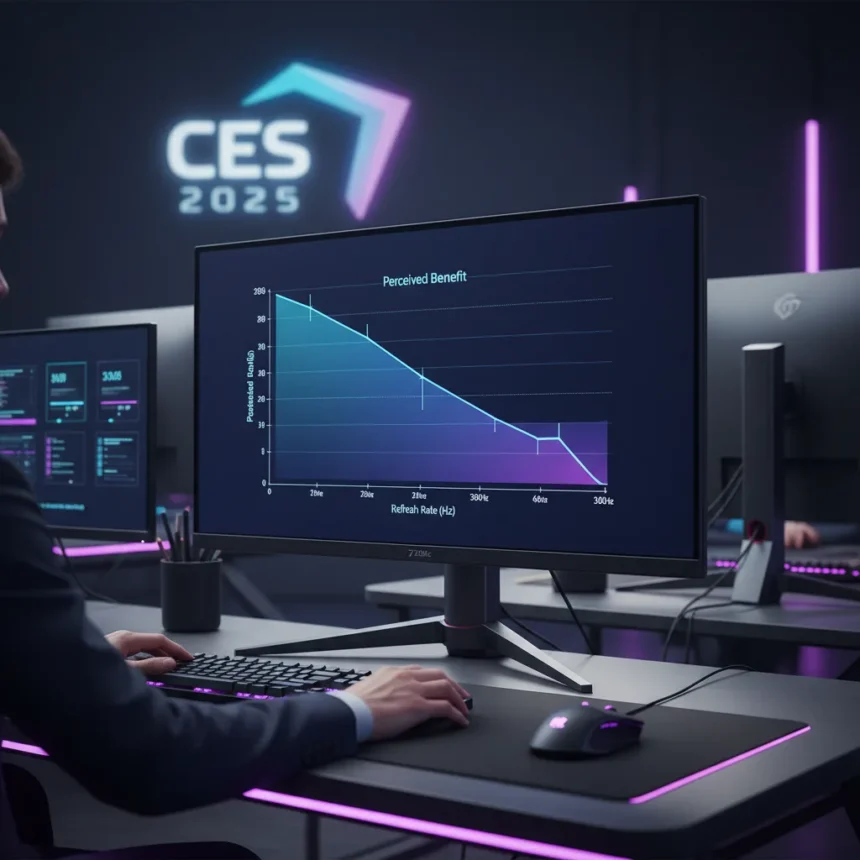
- Human motion perception plateaus around 360Hz in practical gaming scenarios; benefits beyond this threshold are imperceptible to most gamers.
- Achieving 720 FPS consistently requires next-generation GPUs that struggle to deliver those frame rates at 1440p in competitive titles.
- Expert consensus: 720Hz represents marketing spectacle rather than genuine gaming innovation.
The 720Hz Hype vs. Reality
AU Optronics and TCL CSOT showcased 720Hz prototypes at CES 2025, both featuring 27-inch 1440p IPS panels with overdrive technology designed to reduce motion blur. The announcements generated excitement in enthusiast forums, but the gap between specification and real-world utility is enormous. Jacob Freeman, display analyst at Omdia, cuts through the marketing: “At this level, those numbers aren’t for us gamers. It’s more about manufacturers showing off panel capabilities to win contracts with OEMs.” This distinction matters. Monitor makers are flexing engineering prowess to secure business partnerships, not solving actual problems gamers face.
The current generation of gaming monitors tops out at 480-600Hz, with examples like the ASUS ROG Swift PG27AQDP at 480Hz and LG’s 27-inch 1440p OLED at the same refresh rate. These already represent extreme performance. Yet even at these speeds, real-world gaming benefits are marginal compared to 360Hz monitors like the Alienware AW2524H or BenQ Zowie XL2586X, which remain the preferred choice among esports professionals.
Why Your Eyes Stop Caring Around 360Hz
Human visual perception has hard limits. The flicker fusion threshold—the point where the eye perceives individual frames as continuous motion—sits around 60-90Hz for most people. However, motion perception tracking in laboratory conditions can reach 500-1000Hz. The disconnect between these numbers and gaming reality is crucial. Dr. Raymond M. Soneira, founder of DisplayMate, is blunt: “Beyond 360Hz, the visual benefits are imperceptible to 99% of gamers. It’s marketing over substance.” Professional esports players, who have the sharpest visual perception and most invested in competitive advantage, simply aren’t demanding 720Hz. They’re satisfied with 360Hz if the panel delivers low latency and responsive overdrive technology.


The latency equation reveals why diminishing returns kick in hard. A 720Hz monitor has a refresh interval of approximately 1.39 milliseconds, compared to 2.78 milliseconds at 360Hz. On paper, that’s a 50% reduction. In practice, total input lag includes monitor processing time (5-10ms) and GPU render time, which dwarf the refresh interval advantage. An anonymous NVIDIA engineer acknowledged the GPU bottleneck: “Even our next-gen cards struggle to push 720 FPS at 1440p in competitive titles without dropping to low settings.” This is the fundamental problem 720Hz monitors face—the hardware ecosystem cannot feed them.
The GPU Problem Nobody’s Talking About
To actually utilize a 720Hz monitor, you need consistent frame rates exceeding 720 FPS. That requires top-tier GPUs like NVIDIA’s RTX 5090 or AMD’s RX 8900 XTX, neither of which were available as consumer products at the time of CES 2025. Even assuming those cards existed and delivered their theoretical maximums, achieving 720 FPS at 1440p in demanding esports titles like Valorant or CS2 would require heavy visual compromises. Competitive players already run these games at 1080p or lower with reduced settings to hit 240-360 FPS on current hardware. The jump to 720Hz doesn’t change this calculus—it just moves the goalposts further out.



This mirrors a historical pattern. When 144Hz monitors emerged, the leap from 60Hz felt transformative. The jump from 240Hz to 360Hz was noticeable but smaller. Now, from 360Hz to 720Hz, the perceptual gain is virtually nonexistent for most players. Pete Burrows, editor at FlatpanelsHD, observes that professionals aren’t clamoring for this technology: “Pros aren’t begging for 720Hz; they’re happy with 360Hz if the panel has low lag and good overdrive.” That’s not enthusiasm—that’s satisfaction with current solutions.
Power, Heat, and the Unseen Costs
Higher refresh rates demand more power and generate more heat. 720Hz panels may require specialized cooling solutions that add cost, complexity, and potential reliability concerns. The research brief does not specify exact power draw figures, but the trend is clear: as refresh rates climb, thermal management becomes a real engineering challenge. This is another invisible cost manufacturers downplay in marketing materials but that consumers would face in actual products.
What About 540Hz as a Middle Ground?
Between current 480Hz monitors and speculative 720Hz panels sits 540Hz, which some manufacturers are positioning as a more practical high-end option. ViewSonic’s XG273-2K at 520Hz and upcoming models from other brands suggest the industry recognizes a sweet spot somewhere between current flagships and 720Hz excess. These represent a more realistic evolution—incremental improvements without the GPU infrastructure gap that makes 720Hz impractical.
Frequently Asked Questions
When will 720Hz gaming monitors actually be available for purchase?
No consumer pricing or release dates have been announced for 720Hz monitors as of CES 2025. Current prototypes from AU Optronics and TCL CSOT are demonstrations only, with potential OEM integration (for brands like ASUS or MSI) possibly arriving in 2026. Consumer availability, if it happens, remains speculative.



Do I need a 720Hz gaming monitor if I have a high-end GPU?
No. Even with next-generation GPUs, achieving consistent 720 FPS at 1440p in competitive games requires visual settings reductions that most players find unacceptable. A 360Hz monitor paired with a modern high-end GPU delivers better practical value, lower cost, and visually superior results.
Are 360Hz monitors still the best choice for competitive esports?
Yes. Professional esports players consistently choose 240-360Hz monitors for competitive play. These speeds deliver the motion clarity and low latency that matter, without the cost premium or GPU demands of higher refresh rates. A 360Hz monitor remains the practical ceiling for gaming.
The 720Hz gaming monitor story is a reminder that specifications alone don’t define technology value. CES showcases engineering capability, not market demand. 720Hz monitors will likely appear in niche products or OEM integrations, but they won’t reshape gaming because the ecosystem—GPUs, games, and human perception—simply doesn’t need them. For gamers shopping today, 360Hz monitors represent the real sweet spot where performance, price, and practical benefit align.
Where to Buy
$994 on Amazon | LG UltraGear 27GX790B-B:
This article was written with AI assistance and editorially reviewed.
Source: Tom's Guide