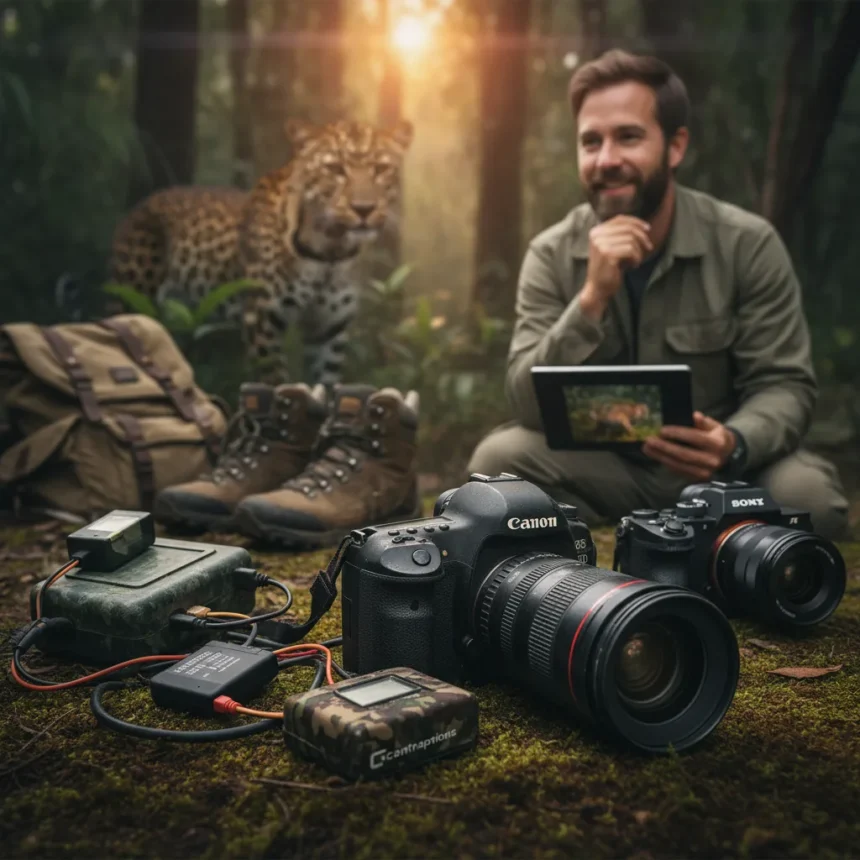
Will Burrard-Lucas, an award-winning wildlife photographer, argues that secondhand DSLRs camera traps deliver superior results compared to modern mirrorless alternatives, challenging the tech industry’s push toward newer, more expensive gear.
Key Takeaways
- Secondhand DSLRs camera traps excel at flash synchronization, a critical weakness in many mirrorless systems
- Burrard-Lucas used a Canon EOS 6D with 35mm lens and three off-camera flashguns for his award-winning Crossing Point project
- Old DSLR sensors require no latest autofocus or fast shooting speeds for stationary wildlife photography
- Camtraptions released its first DSLR camera trap sensor in late 2014, combining affordability with professional image quality
- This approach eliminates the need for expensive trail cameras that produce poor-quality images
Why Secondhand DSLRs Outperform Mirrorless for Camera Traps
The core advantage of secondhand DSLRs camera traps lies in flash reliability. According to Burrard-Lucas, mirrorless cameras struggle with off-camera flash synchronization, the backbone of nocturnal wildlife photography. DSLRs, by contrast, handle external flash systems with proven robustness. This architectural difference matters more than processor speed or autofocus sophistication—two areas where modern mirrorless cameras excel but camera trap work does not require.
For stationary wildlife monitoring, a camera trap does not need fast continuous shooting, advanced animal-detection AI, or the latest sensor technology. It needs reliability, durability, and flash compatibility. A secondhand DSLR from 2010 meets these demands better than a brand-new mirrorless body designed for sports and professional video. The photographer is not chasing subjects; the camera waits for them to arrive.
Burrard-Lucas’s Crossing Point project demonstrated this philosophy in action. He deployed a full-frame Canon EOS 6D paired with a 35mm lens and three off-camera flashguns, capturing wildlife in Kenya’s Masai Mara with image quality that shocked local rangers. The setup cost a fraction of what a new mirrorless system would demand, yet delivered professional-grade results that a cheap trail camera could never match.

The Camtraptions System: Building Camera Traps From Salvage
Camtraptions, the custom camera trap platform Burrard-Lucas champions, pairs secondhand DSLR bodies with specialized trigger hardware. The system includes optional camera housing, a customized PIR motion detector, and a trigger cable—components designed to work smoothly with DSLR architecture. Camtraptions released its first DSLR camera trap sensor at the end of 2014, establishing a blueprint that remains relevant today.
This modular approach transforms secondhand DSLRs into dedicated wildlife monitors without requiring expensive proprietary hardware. A photographer can acquire a used Canon or Nikon body for a fraction of its original price, attach Camtraptions components, and deploy a system that outperforms commercial trail cameras costing thousands of dollars. The economics are compelling: affordability without sacrificing image fidelity.



Challenging the New-Gear Narrative
The camera industry profits from constant hardware cycles. Each year brings faster processors, improved autofocus, higher resolutions, and premium price tags. Yet Burrard-Lucas’s work reveals a truth the marketing departments would rather suppress: latest specs do not determine whether a camera trap succeeds. Reliability, flash compatibility, and robustness do.
Secondhand DSLRs camera traps represent a quiet rebellion against gear obsession. They prove that a photographer’s vision and technical understanding matter far more than owning the latest body. A ten-year-old DSLR in the hands of an expert delivers more compelling wildlife imagery than an expensive mirrorless system operated without purpose. The secondhand market becomes not a compromise but a strategic advantage—access to proven, mature technology at sustainable prices.
How Does a DSLR Camera Trap System Actually Work?
A DSLR camera trap combines a secondhand camera body with motion-detection hardware. The PIR sensor detects heat signatures from approaching animals, triggering the shutter via a cable release. Off-camera flashguns illuminate the subject, and the DSLR captures a high-resolution image. Unlike commercial trail cameras with fixed lenses and tiny sensors, this approach leverages interchangeable optics and full-frame sensors, enabling sharp, detailed photographs even in darkness.
Why Don’t Modern Mirrorless Cameras Work as Well for Camera Traps?
Mirrorless cameras excel at continuous autofocus, fast burst shooting, and video—capabilities irrelevant to stationary wildlife photography. More critically, many struggle with off-camera flash synchronization, a technical limitation rooted in their electronic shutter design. A camera trap does not need speed; it needs flash reliability. Secondhand DSLRs, engineered before the mirrorless revolution, prioritized flash compatibility and mechanical durability over latest performance metrics.



Can You Actually Find Good Secondhand DSLRs Today?
The used camera market remains robust. Burrard-Lucas himself collects secondhand DSLRs specifically for Camtraptions deployment, treating older bodies as reliable tools rather than obsolete hardware. Professional-grade Canon and Nikon full-frame DSLRs from the 2010s remain abundant, affordable, and mechanically sound. The secondhand market transforms equipment scarcity into opportunity—photographers can acquire multiple bodies for experimentation and redundancy without the financial burden of new gear.
The lesson from Burrard-Lucas’s work is straightforward: technology serves purpose, not the reverse. Secondhand DSLRs camera traps succeed because they match tool to task with precision and economy. In a world obsessed with the newest, fastest, and most expensive, an award-winning photographer proves that the best choice is often the one gathering dust in the used market.
Edited by the All Things Geek team.
Source: TechRadar