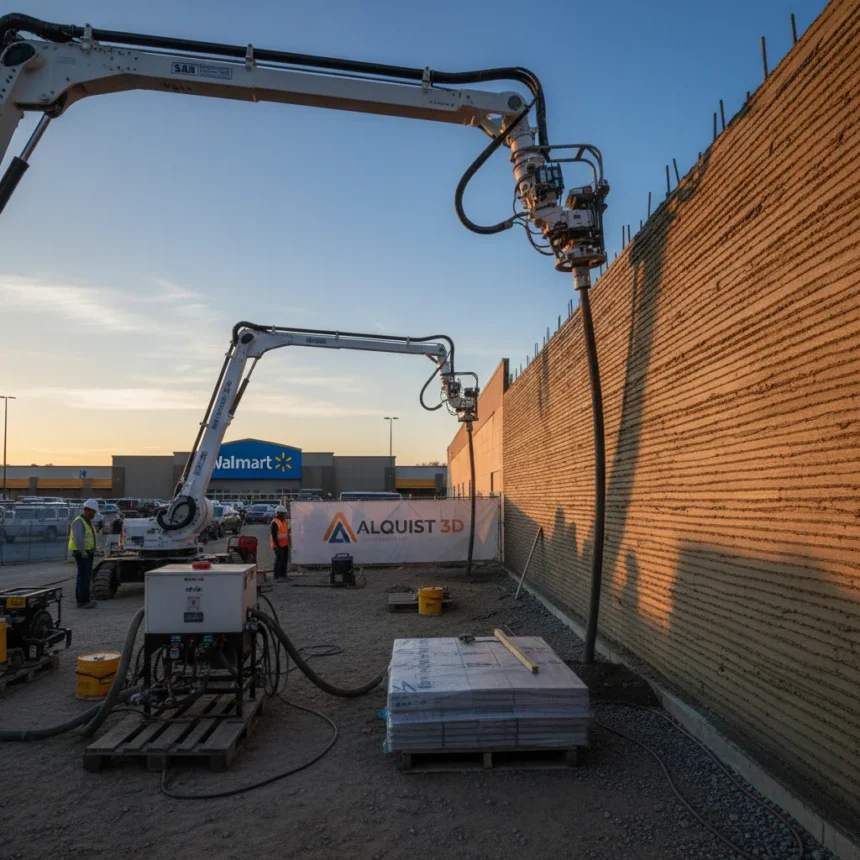
3D concrete printing is no longer a laboratory curiosity. Alquist 3D, a Greeley, Colorado-based firm, announced more than a dozen projects using concrete-printing robots to build Walmart expansions across the United States, marking the moment when this technology shifts from one-off pilots to genuine commercial scale.
Key Takeaways
- Alquist 3D is printing structural walls for 12+ Walmart projects using its A1X robotic arm printer.
- The Huntsville, Alabama Walmart expansion used 3D printing to build 16-foot walls in under two weeks.
- 3D concrete printing achieved roughly 15% cost savings and cut three weeks off the schedule in the Huntsville project.
- The technology reduces on-site waste, speeds mobilization, and delivers consistent quality compared to traditional framing.
- A new leasing model with FMGI and Hugg & Hall is financing nationwide rollout starting in Lamar, Missouri.
From Experimental Pilot to Commercial Reality
For years, 3D concrete printing existed as a proof-of-concept. Alquist proved the concept works at scale in Huntsville, Alabama, where the firm printed 5,000 square feet of structural walls for a Walmart Supercenter’s online grocery expansion. The walls, standing 16 feet tall, were completed in just over a week—a speed that would be nearly impossible with traditional framing. That project became one of the largest free-standing 3D-printed commercial structures in the United States, and it caught Walmart’s attention.
The Huntsville success demonstrated something crucial: 3D concrete printing could handle real-world retail timelines and budgets. The project achieved approximately 15% cost savings over traditional construction methods while cutting three weeks off the schedule, despite material costs remaining higher than conventional approaches. Those numbers matter to retailers operating on thin margins.
How 3D Concrete Printing Actually Works at Walmart Scale
Alquist’s A1X printer is a robotic arm that lays inch-thick layers of concrete at 200 millimeters per second. The technology delivers structural walls faster and with less on-site disruption than traditional methods. What drew construction partners to the approach was the practical advantage: faster mobilization, cleaner job sites, and consistent quality in every print, according to Darin Ross, president and CEO of FMGI, the general contractor managing the new Walmart rollout.

The firm’s earlier Huntsville project used two RIC printers on massive rails, requiring 19 different printer positions to complete the work. The newer model has refined the process significantly. The upcoming Lamar, Missouri Walmart project—the first under a new leasing arrangement—will demonstrate how efficiently Alquist can now deploy this technology. FMGI owns and leases the A1X printers, with Hugg & Hall handling financing and service, creating a scalable model for nationwide projects.
The Larger Shift in Construction Technology
What makes this announcement significant is not just that Walmart is adopting 3D concrete printing—it is that the adoption signals a broader industry transformation. One Alquist official described the Huntsville achievement bluntly: building a complete structure in seven days, something that had never been done before in commercial construction. That speed advantage, combined with reduced waste and flexible design capabilities, addresses genuine pain points in retail expansion.



Traditional construction remains the baseline, but 3D concrete printing now offers a measurable alternative. The Huntsville project also built on an earlier Walmart expansion in Athens, Tennessee, where Alquist printed nearly 8,000 square feet of walls standing 20 feet high, completed in September 2024. Each project has refined the process, and each success makes the next deployment faster.
The new partnership structure matters too. By creating a leasing model where FMGI owns the printers and Hugg & Hall finances and services them, Alquist has removed a major barrier to adoption: capital cost. Retailers no longer need to invest millions in unfamiliar equipment. They can rent the capability, reduce their project timeline, and move on.
What This Means for Retail Construction Going Forward
This is not a marginal improvement. Cutting three weeks off a retail expansion timeline can mean the difference between opening before or after a key shopping season. Reducing costs by 15% on a large project translates to hundreds of thousands of dollars. And cleaner job sites mean less disruption to surrounding operations—critical for a functioning Walmart.
The announcement of more than a dozen projects signals that Walmart is betting on this technology at scale. The first project under the new model launches in Lamar, Missouri in December, with additional projects rolling out nationwide. If these projects execute as planned, they will normalize 3D concrete printing in retail construction and likely attract other major retailers to the same approach.



Is 3D concrete printing ready for mainstream construction?
Yes. The Huntsville and Athens projects proved that Alquist’s technology can handle real commercial timelines and budgets. The shift from experimental to commercial scale—with over a dozen Walmart projects now in motion—confirms the market is moving beyond pilots. Material costs remain elevated, but the speed and quality advantages justify the investment for large-scale retail expansion.
How does 3D concrete printing reduce construction time?
The A1X printer lays inch-thick concrete layers at 200 millimeters per second, eliminating the framing, forming, and pouring steps required in traditional construction. The Huntsville project printed 16-foot walls in under two weeks, a pace that would take traditional methods significantly longer. Faster mobilization and reduced on-site setup also contribute to the overall timeline advantage.
Will other retailers adopt 3D concrete printing?
Walmart’s commitment to more than a dozen projects suggests the technology is now viable for major retailers. The 15% cost savings and three-week schedule reduction are compelling for any company managing large-scale expansions. As the leasing model scales and more contractors gain experience with the equipment, adoption will likely accelerate across the retail sector.
3D concrete printing has crossed a critical threshold. It is no longer a novelty or a pilot program—it is now part of how major retailers build. Alquist’s partnership with Walmart and the new leasing model remove the final barriers to widespread adoption. The next few Walmart projects will either validate this approach or expose flaws, but the industry is watching closely. For construction, that shift from experimental to commercial is everything.
Edited by the All Things Geek team.
Source: Tom's Hardware