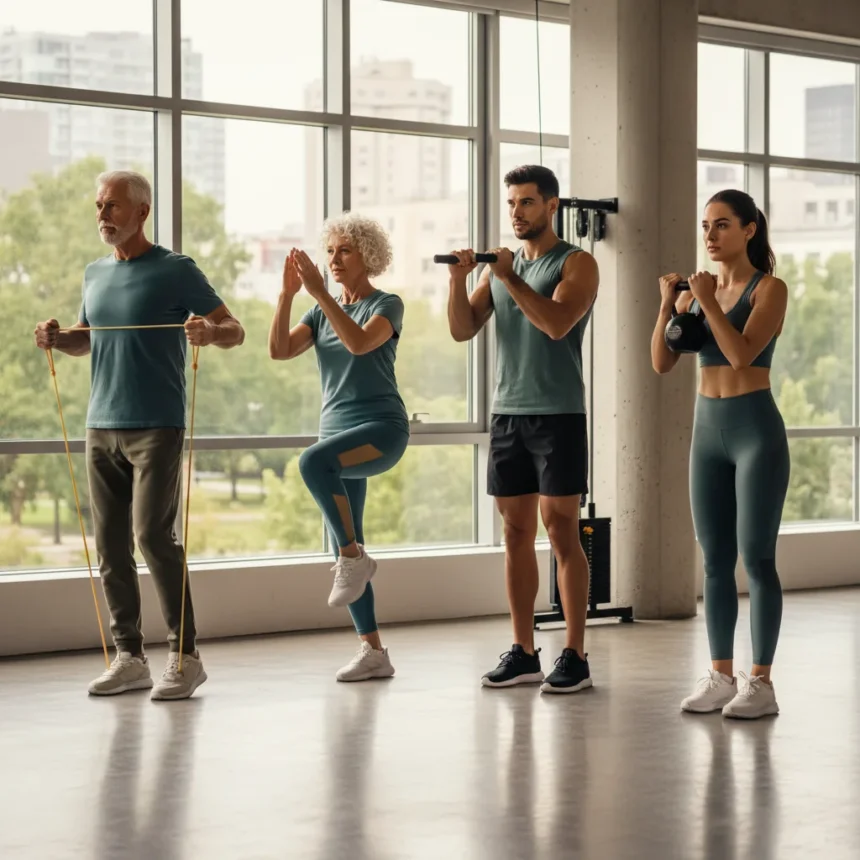
Standing core exercises offer a practical solution for people unable to perform traditional floor-based movements like sit-ups, whether due to age, knee discomfort, or mobility constraints. These exercises build core stability and functional strength while keeping you upright, eliminating the need to get down or up from the floor—a significant advantage for seniors and those with physical limitations.
Key Takeaways
- Standing core exercises strengthen your core without requiring floor contact or sit-ups.
- Four primary movements target rotation resistance, obliques, functional carrying ability, and core stability.
- These routines use minimal equipment: counters, chairs, resistance bands, or light weights.
- Routines typically last 10–12 minutes and suit beginners unfamiliar with core training.
- Standing exercises preserve handgrip strength, which naturally declines with age.
Why standing core exercises matter for accessibility
Floor-based core work like sit-ups, crunches, and standard planks creates barriers for millions. Getting down and up from the floor strains knees, puts pressure on joints, and feels risky for anyone with balance concerns or arthritis. Standing core exercises eliminate these obstacles entirely. You maintain stability throughout, engage your core without floor contact, and build the functional strength that matters in daily life—carrying groceries, maintaining posture, and resisting rotational forces during sports. This accessibility makes standing movements ideal for aging populations and anyone returning to fitness after injury.
The 4 standing core exercises that work
Four movements form the foundation of effective standing core training. Each targets different aspects of core strength and function, and all require minimal or no equipment.
The incline plank performed at a counter or chair is the ideal starting point, especially for those unfamiliar with core training. Place your hands on a sturdy counter or chair edge, step your feet back into a plank position, and hold. This works your ability to resist rotation and strengthens the muscles between your hips and rib cage, including your back. A side plank variation intensifies the challenge while maintaining the same accessibility.

The resistance band or cable anti-rotation press directly targets rotational strength. Stand lateral to an anchor point with feet shoulder-width apart, hold a resistance band or cable handle at chest height, and press your hands straight out from your sternum while resisting the band’s or cable’s pull to rotate your torso. This exercise works your entire core, with special emphasis on your obliques—crucial for sports like golf, tennis, and pickleball that demand rotational power.
The farmer’s carry builds functional carrying strength and handgrip—both abilities that decline with age. Hold a weight in one or both hands, stand tall, and walk a challenging distance while maintaining upright posture. This simple movement translates directly to real-world tasks and preserves the hand strength necessary for independence.



The seated knee lift, adapted for standing context, works your lower core and hip flexors. Sit tall on a sturdy chair edge, extend your arms forward for balance, lift one knee toward your chest as high as comfortable, then lower with control before alternating legs. Keep your back straight throughout to maximize core engagement without spinal stress.
How standing core exercises compare to traditional floor work
Traditional core training assumes everyone can safely get on the floor and perform repetitive crunching movements. Standing core exercises reject this assumption. Floor-based sit-ups and crunches concentrate stress on the lower back and neck, require flexibility to perform safely, and create a genuine barrier for people with knee or hip problems. Standing alternatives distribute the workload across your entire core, preserve joint safety, and build functional strength that applies to movement patterns you actually use. You’re not training an isolated muscle group; you’re training your core as it functions in real life.
Building a routine that fits your schedule
Effective standing core routines require just 10–12 minutes and need no gym membership or specialized equipment. Most beginners can perform each exercise for 30–45 seconds, rest 15–20 seconds, and repeat for 2–3 rounds. A counter, chair, or resistance band transforms your living room into a complete core-training environment. Progress by increasing hold times, adding resistance, or extending walking distances in the farmer’s carry. The simplicity of this approach removes excuses—you can train anywhere, anytime, without preparation or recovery time.
Key benefits beyond core strength
Standing core exercises deliver more than abdominal strength. They improve your resistance to rotation, critical for injury prevention in daily life and sports. They build the oblique muscles that stabilize your spine during twisting movements. They preserve handgrip strength, which is a strong predictor of overall health and independence in aging populations. And they enhance your posture, since core stability directly supports upright alignment. These benefits compound over weeks and months, translating into noticeable improvements in how you move, carry, and feel.



Is standing core training safe for everyone?
Standing core exercises are generally safe and accessible, but beginners, those returning from injury, or anyone with joint concerns should consult a qualified healthcare provider or physical therapist before starting. Start with lighter variations like the incline plank at a high counter, reduce range of motion in knee lifts, or decrease resistance band tension. Progress gradually, listening to your body. If any movement causes sharp pain (rather than muscle fatigue), stop and modify or skip that exercise.
Can I build serious core strength with standing exercises alone?
Yes. Standing core exercises build genuine core strength because they demand stability and control against real resistance or bodyweight. The incline plank, anti-rotation press, and farmer’s carry all create measurable core activation. You’re not settling for a watered-down alternative—you’re choosing a training method that works for your body and lifestyle. Consistency matters far more than exercise selection, so a standing routine you actually do beats a floor routine you avoid.
How long does it take to see results from standing core exercises?
Most people notice improved posture and core stability within 2–3 weeks of consistent practice. Visible abdominal definition and significant strength gains typically emerge within 4–6 weeks, though individual timelines vary based on starting fitness level, consistency, and diet. The key is regularity—three sessions per week of 10–12 minutes beats sporadic longer workouts.
Standing core exercises solve a real problem: they make core training accessible to people who thought sit-ups were their only option. Whether you’re managing knee pain, navigating the physical realities of aging, or simply prefer training without getting on the floor, these four movements deliver genuine strength and functional improvement. Stop waiting for the perfect floor space or the motivation to do crunches. Stand up, engage your core, and build the strength that matters.
Edited by the All Things Geek team.
Source: Tom's Guide