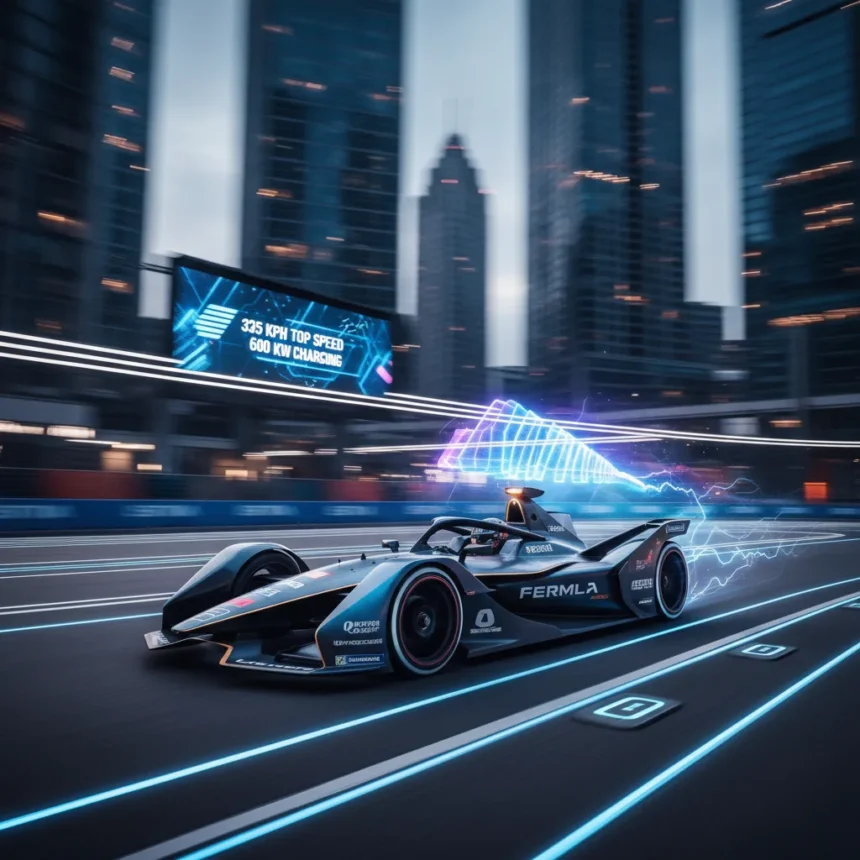
The Formula E GEN4 car is a single-seater race car debuting in the 2026/27 ABB FIA Formula E World Championship season, engineered to deliver 600kW maximum power and exceed 335kph top speed, making it the fastest and most powerful electric racing vehicle Formula E has ever built.
Key Takeaways
- GEN4 reaches 335kph top speed and accelerates 0-200kph in 4.4 seconds, 1.5 seconds faster than GEN3 Evo.
- Maximum power of 600kW in qualifying and ATTACK MODE, 71% more than GEN3 Evo’s 350kW.
- All-wheel drive system is unique among single-seater race cars.
- Regenerative braking reaches 700kW with 55kWh battery capacity, 43% larger than GEN3.
- First on-track debut occurred April 21, 2026, at Circuit Paul Ricard, France.
How Formula E GEN4 car shatters electric racing limits
The GEN4 car obliterates what electric motorsport looked possible just five years ago. Formula E CEO Jeff Dodds called the car “a statement of intent,” noting that “we are now delivering performance levels that were thought impossible for electric vehicles”. On track at Paul Ricard, the GEN4 proved the hype was justified. Qualifying laps run roughly 10 seconds faster than GEN3, while race configurations on street circuits gain at least 5 seconds per lap.
The acceleration figures alone tell the story. The GEN4 launches from 0-100kph in approximately 1.8 seconds and reaches 200kph in 4.4 seconds. That’s not just faster than its predecessor—it’s faster than most road supercars. The GEN3 Evo, which dominated the previous generation, took 5.9 seconds to hit 200kph. The GEN4 cuts that time by a third.
What makes this performance sustainable is the engineering underneath. The car packs a 55kWh battery, 43% larger than GEN3, yet recovers over 40% of energy through regenerative braking. Regenerative braking itself hits 700kW, compared to GEN3’s 600kW. The system is so efficient that even with higher speeds and bigger power draws, the car still manages energy recovery rates matching its predecessor.

All-wheel drive changes the game for single-seaters
The GEN4 is the only single-seater race car in the world with permanent all-wheel drive. This isn’t a gimmick—it’s a necessity. With 600kW available in qualifying, rear-wheel drive alone would spin the wheels uselessly. AWD distributes that power across all four tyres, enabling the car to actually use its performance on track.
The all-wheel drive system works alongside a full electrical braking system, active differential, traction control, and anti-locking system. Every component is designed to manage the immense power and energy flowing through the car. This level of integration is what separates a spec race car from a road prototype—every system talks to every other system, optimizing performance in real time.



The two aero configurations further illustrate the engineering sophistication. High downforce setup for qualifying maximizes grip when drivers are chasing single-lap pace. Low downforce for racing prioritizes energy efficiency over corner speed, letting drivers manage battery consumption across race distance.
What GEN4 means for road EV technology
Formula E has always positioned itself as a development lab for road electric vehicles. The GEN4 car pushes three technologies that will trickle down to consumer EVs: high-efficiency motors, regenerative braking systems, and thermal management under extreme conditions.
The 600kW charging capability is particularly relevant. Today’s fastest road chargers max out around 350kW. The GEN4 demonstrates that 600kW charging is mechanically feasible, thermally manageable, and safe. That’s the kind of real-world validation that infrastructure planners and battery manufacturers need to see before rolling out ultra-fast charging networks globally.
Regenerative braking at 700kW also signals where road EVs are heading. Current models recover energy during braking, but nothing at this intensity. The GEN4 proves that managing such high regen rates without overheating batteries or destabilizing the car is solvable. That knowledge will filter into next-generation road cars within two to three years.



How GEN4 dominates every predecessor
Formula E has raced four generations of cars since 2014. The GEN4 beats all of them. GEN1 topped out at 225kph with 200kW max power and only 15% energy recovery. GEN2 improved to 280kph and 250kW, but still recovered just 25% of energy. GEN3 brought 320kph and 350kW maximum power with over 40% energy recovery. The GEN4 surpasses each in every metric—speed, power, efficiency, acceleration, and regeneration.
This generational leap is steeper than any before it. The jump from GEN3 to GEN4 in maximum power (350kW to 600kW) represents a 71% increase. Acceleration gains of 1.5 seconds over 200kph are enormous in a sport where races are decided by tenths of seconds. The car is not incrementally better—it’s a fundamental reset of what electric racing can achieve.
When does GEN4 racing start?
The GEN4 car debuted on track on April 21, 2026, at Circuit Paul Ricard in Le Castellet, France. Racing competition begins in the 2026/27 ABB FIA Formula E World Championship season. That means the car is no longer theoretical—it has lapped a real circuit and delivered the promised performance numbers.
What are the GEN4 car’s exact specifications?
The GEN4 measures 5540mm long, 1790mm wide, and 1113mm tall, with a 3080mm wheelbase. It weighs 954kg without a driver. The car runs grooved all-weather tyres plus full-wet options for rain. These dimensions and weights are tightly controlled by the FIA, which defines all technical specifications to maintain competitive balance among manufacturers.
Will GEN4 technology appear in road cars?
Formula E’s history suggests yes, but not immediately. Motor efficiency gains, regenerative braking algorithms, and thermal management strategies from GEN3 have already influenced road EV development. GEN4’s 600kW charging capability and all-wheel drive coordination will likely influence premium electric vehicles within 3-5 years, particularly from manufacturers actively competing in Formula E.
How much faster is GEN4 than GEN3?
On qualifying laps, the GEN4 is roughly 10 seconds faster per lap than GEN3. On street circuits during races, the advantage is at least 5 seconds per lap. These gains come from higher power, better acceleration, superior energy management, and the all-wheel drive system working in concert.
The Formula E GEN4 car proves that electric racing is not a compromise—it’s the future. With 600kW power, 700kW regeneration, and all-wheel drive coordination, the car delivers performance that would have seemed impossible a decade ago. When racing begins in 2026/27, expect every lap to feel like a statement: electric vehicles are not the slow alternative to petrol. They are the next evolution of speed itself.
Edited by the All Things Geek team.
Source: T3