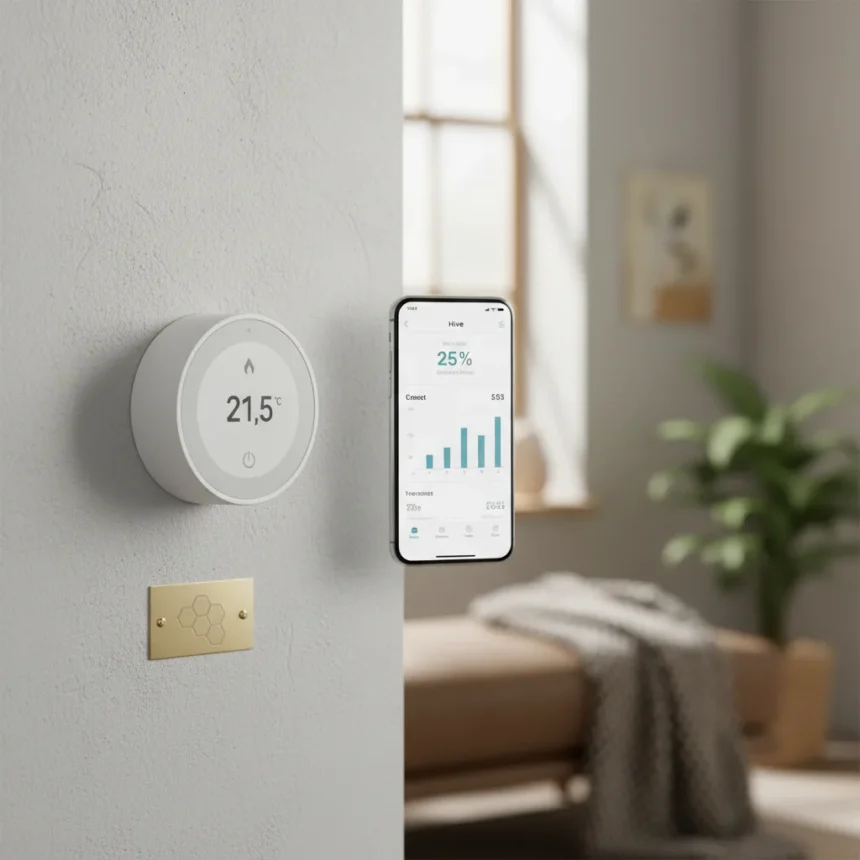
The Hive Thermostat review reveals a smart heating system that prioritizes simplicity and cost awareness over automatic learning. Unlike competitors that study your routines, Hive puts you in direct control through a smartphone app and wall-mounted display, with built-in energy tracking to show exactly what your heating costs.
Key Takeaways
- Hive Thermostat offers remote control, scheduling, and geofencing via intuitive iOS/Android app
- Energy cost tracking requires Hive Plus subscription (£3.99/month or £39.90/year in UK)
- Geo-fencing automatically turns heating off when you leave and on when you return, with radius adjustable from 100m to 50km
- Compatible with Alexa, Google Assistant, HomeKit, and smart radiator valves to avoid heating empty rooms
- Hive Thermostat Mini offers a more affordable, compact alternative praised for bill savings in T3 Awards 2022
Why Hive Thermostat Review Matters Right Now
Energy costs have become a genuine household concern. The Hive Thermostat review matters because this device tackles that anxiety head-on with transparent spending data and flexible controls. Rather than hoping a thermostat learns your patterns, Hive hands you the tools to cut waste immediately—geofencing that stops heating empty homes, schedules tailored to your life, and radiator valves that prevent warming unused rooms.
The Hive Thermostat Mini earned recognition in T3 Awards 2022 specifically for helping users save on energy bills during a period of significant price hikes. That award signals real-world impact, not just marketing promises.
Hive Thermostat’s Core Features and Control
The Hive Thermostat review shows a device built on three control layers: the physical thermostat itself, a smartphone app, and voice commands through Alexa or Google Assistant. You adjust temperature remotely, set heating schedules, and activate quick boosts without touching the unit. The wireless design means you can mount it on a wall or place it on a shelf, and a battery-powered Mini version offers a smaller, simpler footprint for those who want less visual clutter.


What sets Hive apart in a Hive Thermostat review is integration with smart radiator valves. Rather than heating your entire home uniformly, these valves let you turn off heat to unused rooms, directing energy where it matters. That’s a direct answer to the cost-of-living squeeze—why heat a guest bedroom or home office nobody uses?
The app goes beyond heating. It manages hot water schedules, lighting controls, sensors, and even EV charging if you have an electric vehicle. HomeKit support arrived in 2020 via the Hive Hub, so Apple users can control their thermostat from the Home app alongside other connected devices.



Energy Tracking: The Cost-Awareness Angle
A Hive Thermostat review cannot ignore its signature feature: detailed energy cost tracking. The system logs your heating consumption over time and translates it into actual spending. This is where Hive Plus subscription enters the picture—without it, you lose access to cost breakdowns, budget alerts, anomaly detection, and away mode. At £3.99 per month or £39.90 annually in the UK, that subscription unlocks features that some users feel should be included in the base price.
But if you’re serious about understanding where heating money goes, the data justifies the cost. You see patterns: which hours cost the most, how weather affects consumption, whether your heating is drifting into inefficiency. That visibility alone changes behavior—people adjust schedules and radiator valve settings once they see the numbers.
Hive Thermostat vs. Nest: Which Smart Thermostat Wins?
Any Hive Thermostat review must address the obvious competitor: Google Nest Learning Thermostat. Nest learns your routines automatically over weeks, uses weather forecasts to anticipate heating needs, and displays time and weather on its screen. It feels more polished and requires less active management—Nest does the thinking for you.
Hive takes the opposite approach. It demands more from you but gives you more control. Nest’s learning happens in the background; Hive’s insights come from transparent spending data you can act on immediately. Nest uses built-in presence sensors plus phone location; Hive relies on phone geofencing alone, adjusting the detection radius from 100m to 50km depending on your needs. Tado offers similar geofencing to Hive with weather awareness, but neither matches Nest’s aesthetic polish or the automatic learning that appeals to set-it-and-forget-it users.



The Hive Thermostat Mini adds another dimension. It’s simpler and cheaper than both full Hive and Nest, making it ideal for renters or anyone reluctant to commit to complex smart home infrastructure.
Installation and Compatibility
A Hive Thermostat review should address setup. The device works with standard boilers and radiators across the UK and is widely available through the app and website. Installation is described as simple via the app and Hive Hub, though the research brief does not detail step-by-step instructions. The wireless design eliminates messy rewiring—a major advantage over some wired alternatives.
Voice control works with Alexa and Google Assistant, and IFTTT integration lets you create custom automation events. If you use Apple HomeKit, the Hive Hub bridges that gap. Compatibility is broad, though you’ll need the hub for HomeKit support, which adds to the total cost.
Should You Buy the Hive Thermostat?
A Hive Thermostat review concludes that this system suits people who want transparency and control over automatic convenience. If you’re willing to check your app, tweak schedules, and monitor spending, Hive rewards that engagement with genuine cost savings. The geofencing and radiator valve integration are genuine differentiators that Nest doesn’t match as directly. However, if you prefer a thermostat that learns your habits without input, Nest’s approach feels less demanding.
The subscription cost stings—Hive Plus is not optional if you want the cost tracking that defines the device’s value proposition. Budget that into your decision. For renters or minimalists, the Hive Thermostat Mini sidesteps complexity while preserving the core benefits.
Does Hive Thermostat work with HomeKit?
Yes. Hive added HomeKit support in 2020 via the Hive Hub, allowing you to control your thermostat from the Apple Home app alongside other HomeKit devices. You’ll need the hub as a bridge—the thermostat alone cannot connect directly to HomeKit.
What’s the difference between Hive Thermostat and Hive Thermostat Mini?
The Mini is smaller, more affordable, and simpler to set up, making it ideal for renters or smaller homes. The full Hive Thermostat offers the same core controls and energy tracking but with a larger display and more design presence. Both access the same app features and subscription benefits.
How much does Hive Plus subscription cost?
Hive Plus costs £3.99 per month or £39.90 per year in the UK. It unlocks energy cost tracking, budget alerts, anomaly detection, and away mode—features essential to the device’s value proposition for cost-conscious users.
The Hive Thermostat review ultimately asks: do you want a thermostat that thinks for you, or one that shows you the data and lets you decide? Hive answers the latter question with clarity and control, making it a strong choice for anyone serious about cutting heating costs through active management and smart radiator integration.
Where to Buy
Edited by the All Things Geek team.
Source: T3