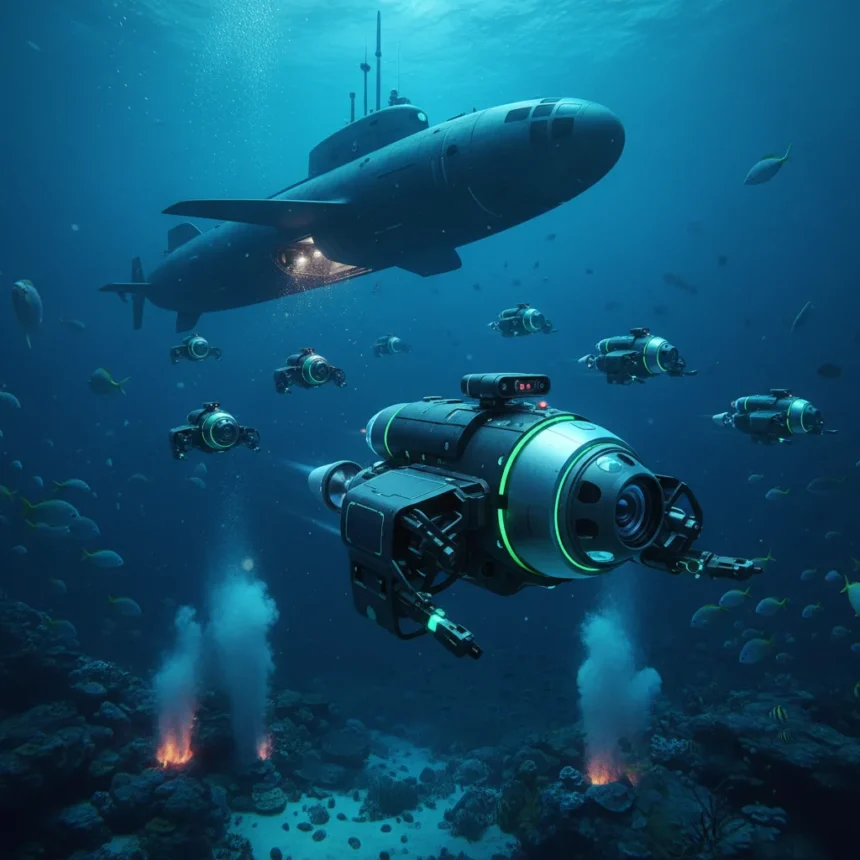
DARPA’s autonomous underwater drones are about to get smaller, cheaper, and faster to build. On April 23, 2026, the Defense Advanced Research Projects Agency released a solicitation for the Deep Thoughts program, a two-year push to reshape how the U.S. develops uncrewed undersea systems. The goal is audacious: compress design, production, and testing timelines from years to months or weeks, while shrinking the size and cost of systems that currently dominate deep-ocean operations.
Key Takeaways
- DARPA’s Deep Thoughts program launches November 2026 with a two-year, fast-paced design-build-test cycle.
- Autonomous underwater drones must achieve full-ocean depths at a fraction of current size and cost.
- Program prioritizes advanced materials, manufacturing, and structural innovation over incremental improvements.
- Multiple prototype awards expected via other transaction agreements; abstracts due May 21, 2026.
- Strategic intent extends beyond ocean science to provide U.S. military advantage in undersea access.
Why DARPA Is Shrinking Deep-Ocean Drones Now
The Pentagon’s shift toward autonomous underwater drones reflects a broader military strategy: reduce human risk, accelerate response times, and scale access to contested ocean depths. Deep Thoughts differs fundamentally from DARPA’s prior undersea efforts. The Manta Ray program, launched in 2020, focused on long-duration, energy-efficient gliding vehicles tested by Northrop Grumman in 2024. Manta Ray emphasized endurance and stealth. Deep Thoughts prioritizes speed—both in development and deployment. The program will leverage advancements in materials, manufacturing, and next-generation structural and mechanical design technologies to dramatically reduce the size, cost, and development time of deep-ocean systems. That compression matters. If DARPA can shrink a full-ocean-depth autonomous underwater drone to a fraction of its current size, the U.S. can deploy from submarines, surface ships, and aircraft with flexibility that larger systems cannot match.
What DARPA Wants Autonomous Underwater Drones to Do
Proposed research should investigate innovative approaches that enable revolutionary advances in uncrewed access to the full-ocean depths at a fraction of the size of current state-of-the-art AUV systems. DARPA is asking industry to rethink pressure vessel design, materials science, and manufacturing from first principles. The technical solicitation covers AUV and pressure vessel designs, novel materials and alloys, structural geometries, advanced manufacturing, embedded subsystems and payloads, mission engineering, and a multi-level secure digital engineering ecosystem. This is not a request for incremental tweaks to existing designs. DARPA wants revolutionary approaches. The program will compress the development cycle for deep-ocean autonomous systems from initial concepts to disruptive, mission-relevant, full-ocean depth AUVs by program completion. That language—disruptive, mission-relevant—signals that prototypes must work, not just exist.
The Timeline and What’s at Stake
Industry abstracts are due May 21, 2026. DARPA expects to award multiple contracts via other transaction agreements (OTAs), a flexible procurement mechanism that bypasses traditional federal acquisition rules and accelerates prototype development. The program starts November 2026 and runs for two years, involving fast-paced iterative design-build-test-learn cycles. No budget was disclosed, but OTA awards typically range from tens of millions to hundreds of millions depending on scope. The strategic intent is clear: provide responsive, scalable deep-ocean access for U.S. advantage, beyond just ocean science. That phrase—beyond just ocean science—hints at military applications. DARPA does not fund pure research. It funds capability that matters to warfighting.

How Deep Thoughts Compares to Earlier DARPA Undersea Programs
DARPA’s history with autonomous underwater vehicles stretches back decades. In 1988, the agency launched a test-bed program for autonomous vehicles meeting Navy missions. More recently, the Blue Wolf program tackled integrated UUVs for challenging speed-range combinations. Manta Ray represented a shift toward energy efficiency and long-endurance gliding. Deep Thoughts represents a different bet entirely: that rapid prototyping, advanced materials, and novel manufacturing can solve the depth-size-cost triangle that has constrained undersea systems for decades. Manta Ray keeps humans out of harm’s way through long-duration autonomous missions. Deep Thoughts aims to keep humans out of the loop entirely by enabling deployment from any platform, anywhere, at a fraction of today’s cost and timeline.
Why Timing Matters for the U.S. Military
Autonomous underwater drones are no longer niche technology. China has invested heavily in unmanned undersea systems. Russia operates advanced autonomous vehicles in contested waters. The U.S. needs to move faster. A two-year program to field full-ocean-depth autonomous underwater drones—compact enough to deploy from any platform—would be a significant strategic edge. DARPA’s willingness to use OTAs and compress timelines from years to months signals urgency. The Pentagon is not interested in perfect. It is interested in deployable, affordable, and fast. That is what Deep Thoughts promises. Whether industry can deliver is the real test.



Can Industry Actually Build What DARPA Wants?
The challenge is real. Full-ocean depths mean extreme pressure—over 36,000 pounds per square inch at the deepest points. Current deep-diving autonomous underwater drones are large, expensive, and take years to develop because every component must survive those forces. DARPA is betting that novel materials, advanced manufacturing (think 3D printing of titanium pressure vessels), and fresh structural designs can change the equation. It is a bet worth making. If even one contractor cracks the code, the implications for undersea warfare, ocean science, and intelligence gathering are profound. If none do, DARPA will have learned valuable lessons for the next iteration.
What Happens After Abstracts Are Due?
May 21, 2026, is the abstract deadline. Contractors with credible concepts will be invited to submit full proposals. DARPA typically funds multiple performers to encourage competition and increase the odds of success. Awards will likely favor teams combining aerospace expertise (pressure vessel design, materials), manufacturing innovation, and software engineering. Companies that have worked on prior DARPA programs have an advantage—they understand the agency’s expectations for rapid iteration and mission focus. Startups with novel manufacturing or materials breakthroughs could also compete, especially if they partner with established defense contractors for integration and testing.
Is autonomous underwater drone development really moving this fast?
Yes, but with caveats. DARPA’s two-year timeline assumes contractors have access to relevant expertise and can iterate quickly without lengthy regulatory delays. Prototype autonomous underwater drones will be tested in controlled environments first, then in open water. Full operational deployment would come later. The compressed timeline applies to development and initial prototyping, not to fielding thousands of units or integrating them into fleet operations.
How does Deep Thoughts differ from Manta Ray?
Manta Ray prioritizes long-duration, energy-efficient missions with gliding and hovering capabilities, tested over years of development. Deep Thoughts prioritizes rapid development and deployment of compact, affordable systems that can access full ocean depths from diverse platforms. Manta Ray is about endurance; Deep Thoughts is about speed and scalability.



Will autonomous underwater drones replace crewed submarines?
Not entirely. Autonomous underwater drones excel at surveillance, payload delivery, and hazardous missions. Crewed submarines offer flexibility, decision-making, and strategic deterrence that unmanned systems cannot yet match. Deep Thoughts is about expanding options, not replacing existing capabilities. The U.S. Navy will likely use autonomous underwater drones alongside crewed and larger unmanned platforms, each suited to different missions.
DARPA’s Deep Thoughts program represents a calculated gamble that speed and innovation can overcome the engineering constraints that have long made deep-ocean autonomous systems expensive and slow to develop. If the program succeeds, the U.S. gains a new tool for undersea dominance. If it fails, DARPA will have valuable data for the next attempt. Either way, the race to build cheap, fast autonomous underwater drones is now officially on.
Edited by the All Things Geek team.
Source: Tom's Hardware