





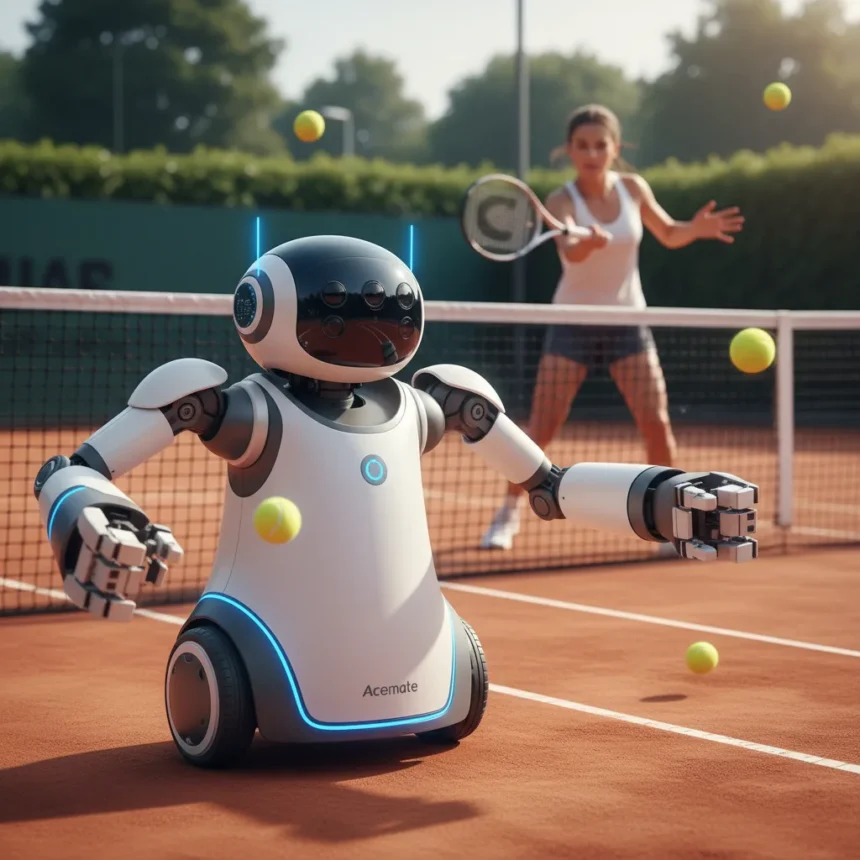
The Acemate tennis robot is an AI-powered machine designed by SwitchBot, launched via Kickstarter in May 2025, that moves around the court to play realistic rallies with solo players, priced at $2,499 USD (or $1,599 during pre-order). Unlike traditional ball machines that feed predictable shots from a fixed position, the Acemate actually moves to where you hit the ball, catches it, and fires back with human-like forehands, backhands, topspin, slices, and lobs. Time Magazine named it one of the best inventions of 2025, recognizing what reviewers have discovered: tennis no longer has to be a sport you play with another person.
Key Takeaways
- Acemate uses binocular 4K cameras and AI to track balls with centimeter-level accuracy and predict shots in real time
- Mecanum wheels allow full-court movement up to 16 feet per second on hard court, clay, or any surface
- Catches approximately 90% of return shots and serves up to 80 mph with variable speed and angle control
- Companion app provides AI coaching feedback, drill customization, and performance stats like swing timing and shot placement
- Pre-orders began in May 2025; shipping started November 2025
How the Acemate tennis robot actually works
The Acemate tennis robot combines hardware and AI in ways that make it genuinely different from everything that came before it. Two 4K cameras mounted on the unit create binocular vision—essentially robot eyes—that track the ball’s position and trajectory with centimeter-level precision. An on-board AI chip trained on thousands of hours of court footage predicts where the ball will bounce and how you’ll likely hit it next, allowing the robot to position itself before you even strike. This isn’t a static feeder that waits for you to come to it. Four metal-core Mecanum wheels with rubber treads let the Acemate move across the entire court at speeds up to 16 feet per second, meaning it can chase down your shots, position itself for the next rally, and keep play flowing.
Once the robot collects a ball in its built-in catch net, a firing mechanism in the base returns shots with surprising variety. You get forehands and backhands, topspin and slices, lobs and backspins, all at adjustable angles and speeds. Serves reach up to 80 mph, and you can customize speed, height, and placement through the companion app. A coach reviewing footage on YouTube noted using the Acemate daily with students, suggesting the robot’s consistency makes it reliable for skill development.
Why the Acemate beats traditional ball machines
Static ball machines have dominated tennis for decades, but they have a fatal flaw: they never move. You hit a shot, jog to retrieve the ball, reset, and hit again. The Acemate eliminates that cycle. Because it moves to you, catches your shots, and fires back, you’re actually playing tennis—not just practicing strokes in isolation. The robot’s AI means it doesn’t just feed the same predictable pattern. It adapts. If you hit a slice down the line, the Acemate can move to that corner and return a different shot type, forcing you to react rather than anticipate. Traditional machines can’t do that. They can’t read your game and adjust their strategy. The Acemate can. Reviewers from Tom’s Guide reported feeling genuinely challenged, describing the experience as humbling because the robot actually teaches you something about your technique rather than simply wearing you out.



Human partners offer unpredictability too, but they come with their own problems. They cancel plans. They play at different levels. You might be intermediate and they’re advanced, or vice versa. The Acemate rates players from NTRP 1.0 to 6.0 (just short of pro level) and matches your skill, meaning it’s always available, never tired, and always at your level. One reviewer from Rage Studios expressed genuine awe, saying the experience felt like stepping into the future.
The AI coaching features that actually matter
The companion app transforms the Acemate from a ball-hitting machine into a coaching tool. You can customize entire drills—serve mode for practicing returns, rally mode for extended play—and the app tracks everything: shot placement, ball speed, net clearance, accuracy, footwork, and form. More importantly, the AI provides coaching feedback. It can flag issues like swing timing, wrist drop, or poor positioning, the kind of mechanical problems that human partners might notice but can’t always articulate clearly. The app also tracks your progress over time, so you can see whether your consistency is improving or whether you’re still struggling with backhands in specific court zones. This transforms solo practice from mindless repetition into deliberate, measurable improvement.



Realistic expectations: what the Acemate can and cannot do
The Acemate catches approximately 90% of return shots in testing, which is genuinely impressive but not perfect. Some shots will sail past it or take weird bounces that no robot could predict. That’s not a flaw—it’s physics. The unit requires a rechargeable battery and no extra sensors or wearables, so setup is straightforward: roll it onto the court and start playing. It works on hard courts, clay, and other surfaces. A pickleball version is in development, suggesting the platform may expand. The main limitation is practical rather than technical: you need court access and enough space for the robot to move. It’s not a device for apartment dwellers or players without regular court time.
Pricing and when you can actually buy one
The Acemate is available now for pre-order on acematetennis.com, with shipping that began in November 2025. The full retail price is $2,499 USD. If you backed the Kickstarter campaign in May 2025, you secured the device at $1,599 USD. That’s a $900 difference, which is significant, though the Kickstarter window has closed. For new buyers, $2,499 is expensive—roughly equivalent to a year of unlimited court time at most clubs—but if you play regularly, the cost amortizes quickly when you consider you’re getting unlimited, tireless, skill-matched practice partners forever.
Is the Acemate tennis robot worth buying?
The Acemate makes sense if you play tennis regularly but struggle to find partners, live somewhere with limited club availability, or want to improve without the scheduling headaches of coordinating with humans. It’s overkill if you play casually once a month. The robot’s real value isn’t in hitting balls at you—any machine can do that. It’s in the AI adaptation, the movement, the coaching feedback, and the fact that it actually plays tennis with you rather than at you. That’s genuinely new.
Can the Acemate robot play against advanced players?
Yes. The Acemate is rated for NTRP players from 1.0 to 6.0, which covers everyone from beginners to near-professional level. It serves up to 80 mph and adjusts shot variety, speed, and placement based on your skill setting. Advanced players will find it challenging, though it’s not designed to replicate professional-level competition—just to provide realistic, adaptive practice.


What surfaces does the Acemate work on?
The Acemate’s Mecanum wheels with rubber treads are designed to work on hard courts, clay, and other standard tennis surfaces. Movement speed reaches 16 feet per second on hard court. Performance on less common surfaces hasn’t been detailed, so check the official site for specifics if you play on unusual court types.
The Acemate represents a genuine shift in how solo tennis players can train. It’s not a gimmick or a luxury toy—it’s a practical tool that addresses a real problem: tennis is hard to practice alone. For anyone serious about improving their game without the friction of coordinating with human partners, this robot changes the equation. It’s expensive, it requires court access, and it won’t replace tournaments or match play. But for deliberate, measurable improvement on your own schedule? It’s the most realistic option available right now.
Where to Buy
1 Amazon customer review | £132.57 | £173.92
Edited by the All Things Geek team.
Source: T3




