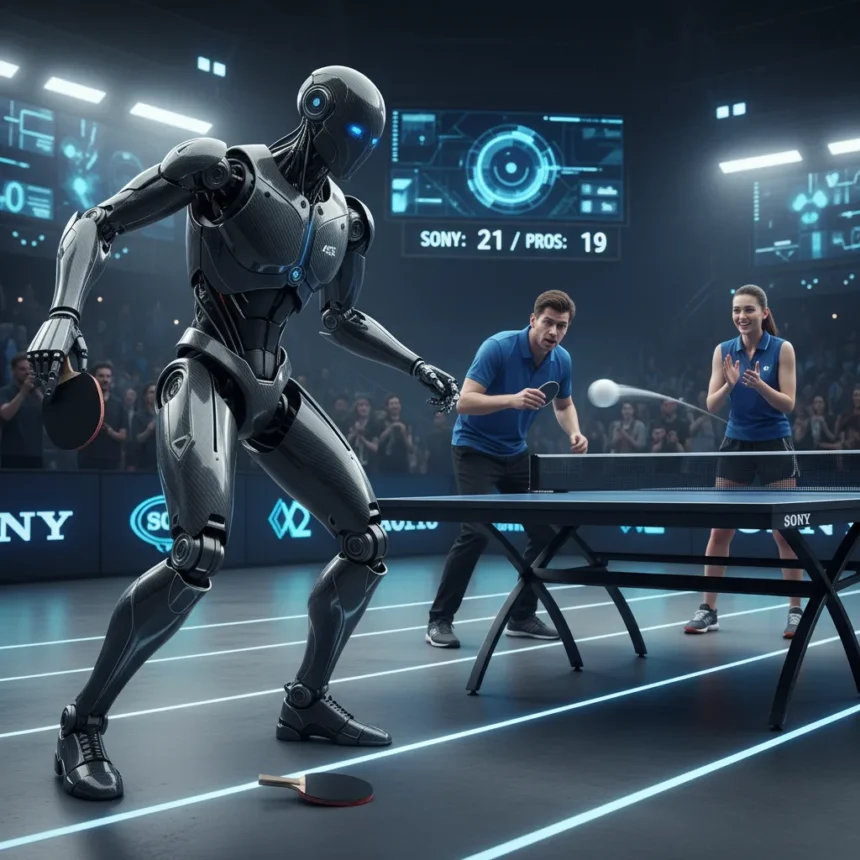
Sony’s Project Ace robot is an autonomous table tennis system developed by Sony AI that competes at expert level against professional human players, unveiled Thursday, April 23, 2026, and represents a watershed moment for real-world sports robotics.
Key Takeaways
- Sony unveiled Project Ace on April 23, 2026, an autonomous table tennis robot competing at expert level against professional players.
- The system integrates reinforcement learning with a 9,000 RPM spin-tracking perception system for high-speed sensing and decision-making.
- Project Ace demonstrates autonomous robot capability beyond simulation, marking a potential turning point for enterprise robotics applications.
- Google’s DeepMind achieved competitive table tennis in August 2024, but Project Ace positions itself as expert-level, surpassing professional play.
- The unveiling sparked strong reactions from observers, with one calling the performance “mind-blowing” [title].
What Makes Sony’s Project Ace Different
Sony’s Project Ace stands apart from prior AI sports systems because it operates autonomously in real-world conditions against professional opponents under official international rules, not in controlled simulation environments. The robot’s architecture combines reinforcement learning—a machine learning approach where systems improve through trial and error—with specialized hardware that tracks ball spin at 9,000 RPM, enabling it to perceive the game state, make tactical decisions, and execute shots in milliseconds. This tight feedback loop between perception and action is what allows Project Ace to compete at a level that reportedly exceeds professional human players.
Previous AI table tennis systems, including Google DeepMind’s 2024 effort, achieved competitive performance but operated in more constrained settings. Project Ace’s advancement lies not just in winning matches but in doing so through genuine autonomous decision-making rather than pre-programmed responses. The system must adapt to variable spin, speed, and placement in real time—the exact challenges that make table tennis a demanding sport for humans.
Why This Robotics Breakthrough Matters Beyond Sports
The significance of Project Ace extends far beyond table tennis. Sony AI has positioned the robot as a demonstration of broader autonomous capabilities applicable to enterprise and industrial settings. A robot that can master a fast-paced, unpredictable sport like table tennis has solved fundamental problems in real-time perception, decision-making under uncertainty, and physical precision—skills that translate directly to manufacturing, logistics, and service robotics.



The shift from simulation to real-world performance is the critical inflection point. For years, AI excelled in controlled digital environments while struggling with physical robots in messy reality. Project Ace suggests that gap is narrowing. When a machine can read spin, adjust strategy, and execute within milliseconds against a human expert, it demonstrates the kind of adaptability that enterprises need for autonomous systems to become genuinely useful rather than novelty demonstrations.
How Project Ace Compares to Other Robotics Milestones
Robotics progress is not uniform across domains. While Project Ace excels at a specialized sport, other recent breakthroughs highlight different capabilities. Chinese humanoid robot Lightning, for instance, won a Beijing half-marathon in 50 minutes 26 seconds, outpacing the human world record by nearly 7 minutes—demonstrating endurance and locomotion over distance. Project Ace, by contrast, showcases precision and reactive speed in a confined space. Neither approach is objectively superior; they represent different frontiers in what autonomous systems can accomplish.



Google’s DeepMind table tennis AI, unveiled in August 2024, was an important stepping stone but operated within narrower parameters. The progression from DeepMind’s competitive system to Project Ace’s expert-level play shows the acceleration in the field. Each generation pushes the boundary of what’s possible, and Sony’s April 2026 unveiling suggests the pace of advancement is accelerating rather than plateauing.
What Project Ace Reveals About AI’s Practical Limits
Despite the excitement, Project Ace is a specialized system optimized for one domain—table tennis. It does not represent general-purpose robotics or a robot that can smoothly transition between unrelated tasks. The 9,000 RPM spin-tracking system is purpose-built for ping pong; it would not help the robot play chess, assemble electronics, or navigate an unfamiliar building. This specificity is not a weakness but a reality check: breakthrough AI systems tend to be narrow and deep rather than broad and shallow.
The robot’s success also depends on controlled conditions—a regulation table, standardized rules, and a predictable opponent. Real-world enterprise robotics must handle far messier environments: variable lighting, unexpected obstacles, imprecise inputs, and tasks that require common sense. Project Ace’s expert-level play is genuine progress, but it should not be mistaken for artificial general intelligence or a robot that can think its way through arbitrary problems.
Is Project Ace available to buy or use?
No pricing, commercial availability, or launch timeline has been announced for Project Ace. Sony has unveiled the system as a demonstration of AI robotics capability but has not indicated whether it will be sold to consumers, enterprises, or research institutions. The focus appears to be on showcasing the technology‘s potential rather than immediate commercialization.


How does Project Ace beat professional table tennis players?
Project Ace combines reinforcement learning with a 9,000 RPM spin-tracking perception system that allows it to sense ball spin, speed, and placement in real time, then decide on and execute shots faster than human reflexes allow. The robot processes game state continuously and adapts its strategy based on the opponent’s play, much like a human expert would, but with inhuman speed and consistency.
What does Project Ace’s success mean for the future of robotics?
Project Ace demonstrates that autonomous systems can now operate reliably in unpredictable real-world scenarios, not just in controlled simulations. This breakthrough suggests that enterprise robotics—from manufacturing to logistics—could soon benefit from similar advances in perception and decision-making. However, the robot remains specialized to table tennis; broader applications will require systems that generalize across multiple tasks and environments.
Sony’s Project Ace is a genuine milestone, not because it plays ping pong better than humans, but because it proves that real-time autonomous decision-making in physical space is now feasible at expert level. For robotics researchers and enterprises betting on automation, that shift from simulation to reality is the turning point that matters. The next question is whether Sony and other companies can translate this narrow breakthrough into systems that work across the messy, unpredictable tasks that businesses actually need robots to solve.
Edited by the All Things Geek team.
Source: TechRadar