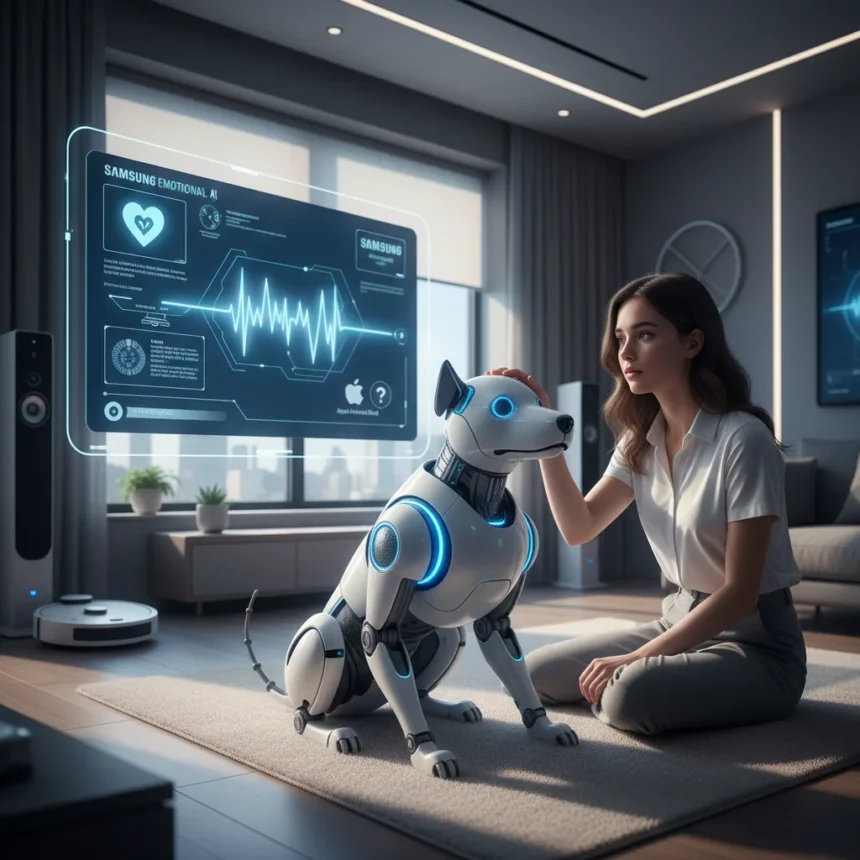
AI home assistants are becoming less abstract and more physical. Samsung’s announcement of a pet-focused robot patent, building on its Ballie smart home companion, signals that the next generation of home AI will move beyond speakers and screens into embodied robots that manage both tasks and emotions.
Key Takeaways
- Samsung patented a pet robot designed to reduce anxiety and clean up messes when owners are away
- Ballie, Samsung’s existing smart home companion, positions the company as a competitor in the robot assistant space
- Apple is developing a tabletop robot powered by Siri, expected around 2027, with motorized tracking and gesture recognition
- Honor is teasing a Robot Phone concept with a deployable camera gimbal and emotional AI personality
- No commercial release date exists for any of these AI home assistant products yet
Samsung’s Pet Robot Patent: Addressing Emotional Needs
Samsung’s 24-page patent describes a robot explicitly designed to tackle pet loneliness. According to the patent filing, the company frames the problem clearly: “When left alone indoors, a pet may feel emotionally anxious due to loneliness and missing its owner. Accordingly, continuous research efforts have been made to methods for taking care of pets not to experience emotional anxiety even when they are not with their owner”. This is not just engineering—it is a statement about what Samsung believes AI should do: manage emotional states, not just automate tasks.
The pet robot would play with animals, keep them engaged, and handle cleanup duties like removing dog waste. This combination of entertainment and maintenance suggests Samsung sees home robots as multi-functional caretakers rather than single-purpose devices. Whether the patent translates into a real product remains unclear. Samsung has not announced a release date or commercialization timeline.
Ballie and the Broader Vision for AI Home Assistants
Ballie, Samsung’s second-generation smart home companion, frames the larger ambition: positioning a single robot as “one assistant to rule your entire home”. The concept appeals to a market fatigued by managing multiple apps and devices. But the reality of AI home assistants today is fragmented. Samsung has prior robotics experience, which gives it credibility in this space. Yet neither Ballie nor the pet robot has proven itself in real homes at scale.

The gap between patent and product is vast. A robot that claims to manage an entire home must handle security, energy efficiency, entertainment, pet care, and emergency response—simultaneously. Current AI assistants struggle with context switching and multi-step reasoning. Ballie’s actual capabilities remain vague beyond announcements, and the pet robot exists only on paper.
Apple and Honor Are Pushing Harder on Physical AI
Samsung is not alone in this race. Apple is developing a tabletop home robot powered by an upgraded Siri, expected around 2027. The design is strikingly different—lamp-like with motorized tracking that lets it swivel and follow movements. Apple’s robot is also capable of dancing, suggesting a more personality-driven approach than pure utility. This is part of Apple’s broader strategy to compete with ChatGPT and Google Gemini by embedding AI into hardware across smart displays and cameras.



Honor’s approach is even more audacious. The company is teasing a Robot Phone concept—a phone with a deployable camera arm and gimbal that acts as an emotional AI companion. The device would sense, adapt, and evolve based on user interaction, featuring a WALL-E-like personality with subject tracking and visual AI responses. Honor’s vision treats the phone itself as the robot, whereas Samsung and Apple are designing separate physical devices. This conceptual difference matters: Honor collapses the assistant into something you already carry, while Samsung and Apple ask you to adopt a new device entirely.
All three products remain in development or teaser stages with no confirmed consumer release. The market for physical AI home assistants does not yet exist at scale.
The Unproven Promise of Emotional AI
What ties these approaches together is an implicit belief: AI assistants should manage not just tasks but feelings. Samsung’s pet robot targets pet anxiety. Apple’s dancing robot suggests companionship. Honor’s emotional AI claims adaptability and personality evolution. None of these products have shipped, so none have proven this premise works in practice.
The risk is obvious. A robot that fails to reduce pet anxiety or misreads human emotional cues becomes a frustrating, expensive toy rather than a trusted assistant. Samsung’s patent language around pet loneliness sounds thoughtful, but patents are often promotional in tone. Real-world effectiveness is another matter entirely.


Why the Pet Robot Matters More Than You Think
Samsung’s pet robot patent is not just about dogs and cats. It reveals the company’s belief that AI home assistants should address specific, emotional use cases rather than generic home management. A robot that plays with pets and cleans up messes is solving a real problem for pet owners who work long hours. This specificity is smarter than Ballie’s vague promise to “rule your entire home.”
But specificity also means Samsung must prove the robot works at scale. Can it reliably distinguish between a toy and a pet? Does it actually reduce anxiety, or does it create new problems? These questions matter for credibility. Right now, Samsung is asking consumers to trust a vision based on a patent and promises.
Is Samsung’s approach to AI home assistants better than Apple’s?
Not necessarily. Apple’s Siri robot focuses on presence and responsiveness—a device that tracks you and responds to gestures. Samsung’s approach emphasizes specific emotional outcomes like pet care. Apple’s strategy is broader; Samsung’s is deeper. Both have merit, and both remain unproven. The winner will likely be whichever company ships first with a product that actually works.
What makes Honor’s Robot Phone different from Samsung’s Ballie?
Honor’s Robot Phone integrates the AI assistant into the device itself via a deployable camera gimbal, whereas Ballie is a separate robot. Honor’s approach assumes the phone should be the center of your smart home ecosystem; Samsung assumes you need a dedicated physical assistant. This is a fundamental disagreement about form factor and user behavior.
When will Samsung’s pet robot actually launch?
Samsung has not announced a release date or commercialization timeline for the pet robot. The company is currently at the patent stage, which means the product is still in development. Expect years, not months, before any consumer version becomes available—if it launches at all.
The future of AI home assistants belongs to whoever ships a product that people actually want to live with. Samsung’s pet robot patent is interesting precisely because it targets a specific emotional need rather than generic home management. But patents are not products, and promises are not proof. Until Samsung, Apple, and Honor release working robots into real homes, the question of which company owns the future of AI assistants remains unanswered. What is clear is that the next wave of AI will be embodied, emotional, and deeply personal—or it will fail.
Where to Buy
This article was written with AI assistance and editorially reviewed.
Source: T3