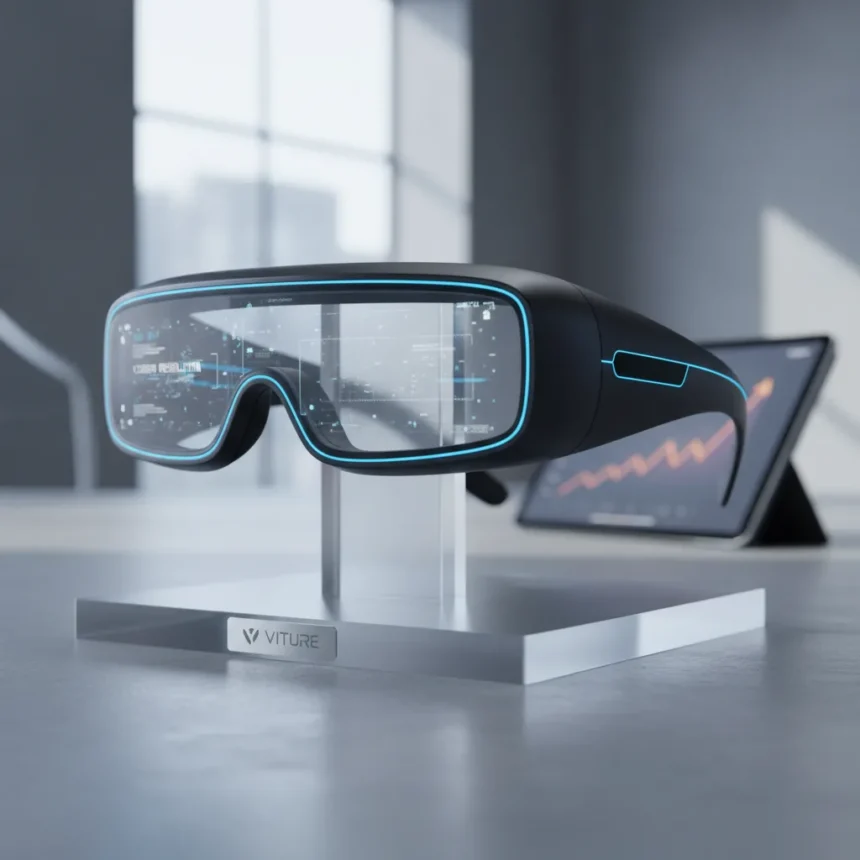
The Viture Beast AR glasses deliver the sharpest, most vivid display ever built into a wearable headset. Launched in October 2025 at $549, these glasses feature a 1200p resolution display with a 120Hz refresh rate, 58-degree field of view, and a 9-level electrochromic dimming system. After extensive real-world testing across 10,000 miles of travel, the Viture Beast has set a new benchmark for AR glass displays that makes competing models feel dated.
Key Takeaways
- Viture Beast offers 1200p resolution and 120Hz refresh rate, the sharpest AR display available
- Price of $549 undercuts the Xreal One Pro by $50 while delivering superior display quality
- 9-level dimming system far exceeds competitors’ 3-level options for laptop and outdoor use
- Comfortable for hours of continuous wear at 98 grams with curved stems and cushioned nose pads
- 6DoF tracking via app support coming later; native 3DoF tracking improved via firmware updates
Viture Beast AR glasses Display Quality Dominates the Market
The Viture Beast AR glasses stand apart because of their display sharpness and color accuracy. The 1200p resolution (enabled post-launch via firmware update) paired with the 120Hz refresh rate creates a picture quality that steps ahead of anything else available. The 58-degree field of view, slightly reduced from initial 60-degree claims to ensure consistent sharpness across the entire panel, delivers a balance between immersion and clarity that competitors have struggled to match. Where the Xreal One Pro ($599) offers similar specs on paper, the Viture Beast’s superior color tuning and refresh smoothness give it a measurable edge in real-world use.
The electrochromic dimming system with nine distinct levels transforms how these glasses adapt to different environments. A 4-hour train journey becomes productive because the dimmer settings allow seamless transitions between ambient light and on-screen content without the harsh contrast that plagues other AR glasses. This versatility extends to laptop work, where the transparent mode lets you see your keyboard while displaying a secondary screen, solving a major pain point for remote workers.
Comfort and Build Quality Set Premium Expectations
At 98 grams, the Viture Beast AR glasses weigh less than many smartphone models, yet they feel substantial and well-engineered. The curved stems are designed specifically to sit comfortably on ears for extended periods, and the cushioned nose pads distribute weight evenly across the bridge. Unlike earlier Viture models that used a magnetic connector, the Beast switched to USB-C for charging and data, which introduces minor tugging issues when the cable is moved at certain angles, but the trade-off enables faster connectivity.

Wearability testing across long journeys confirms these glasses remain comfortable for hours without strain. The prism placement allows the device to sit slightly lower on the nose, improving the fit and reducing pressure points. The top of the display can warm during extended use, but the face itself stays cool, a thoughtful thermal design choice that prevents fatigue during all-day wear.
Tracking and Software Features Evolve Post-Launch
The Viture Beast AR glasses ship with native 3-degree-of-freedom (3DoF) tracking, which initially showed wobbling in early demonstrations but was resolved via firmware updates. Full 6-degree-of-freedom (6DoF) tracking will arrive later through the front camera or the Spacewalker app, enabling more advanced spatial interaction. This phased rollout means early buyers get a working device now, with promised enhancements that expand functionality over time.



On-device menus let you customize screen sizes, switch between ultrawide and vertical orientations, and adjust settings like brightness and color temperature without tethering to a computer. Multi-window support on both PC and iPhone allows you to display multiple applications simultaneously, turning the glasses into a genuine productivity tool rather than just a media viewer.
How Viture Beast Compares to Xreal One Pro
The Xreal One Pro costs $50 more at $599 and includes native 6DoF tracking via an eye camera and the X1 spatial chip. However, the Viture Beast AR glasses win on display brightness, field of view (58 degrees versus lower on Xreal), and dimming flexibility with nine levels instead of three. The Beast also undercuts Xreal’s price while delivering superior picture quality, making it the stronger choice for display-focused users who prioritize sharpness and color accuracy over native 6DoF tracking. On moving transport like trains, Xreal’s native tracking stability has a slight edge, but the Viture Beast’s firmware improvements have narrowed that gap considerably.
Is the Viture Beast Worth $549?
Yes, if you prioritize display quality and long-term comfort. The Viture Beast AR glasses represent the clearest, most vivid AR glasses available at any price point. For professionals using these as a second monitor or content creators who demand sharp visuals, the $549 price is justified. If you need advanced 6DoF tracking out of the box, the Xreal One Pro remains a viable alternative, but you will sacrifice display quality for that feature.
When will the Viture Beast AR glasses get full 6DoF tracking?
Full 6DoF tracking will arrive via the Spacewalker app or the front camera module after launch, but no specific date has been announced. Early buyers will have 3DoF native tracking (now stable following firmware fixes) and can upgrade to 6DoF when the app launches.



How do Viture Beast AR glasses compare to older Viture models?
The Beast is the flagship model in Viture’s October 2025 lineup, which includes the entry-level Luma, the Luma Pro, and the business-focused Luma Ultra. The Beast offers the sharpest display and most advanced features. Older Viture models used a magnetic charging connector, which users preferred for durability, while the Beast switched to USB-C for faster connectivity.
Can you use Viture Beast AR glasses for productivity work?
Absolutely. Multi-window support, multiple screen size options, and the 9-level dimming system make the Viture Beast AR glasses a genuine productivity device. The transparent mode lets you see your physical keyboard while viewing digital content, solving the visibility problem that plagued earlier AR glasses. Extended comfort (hours without strain) means you can actually use these for a full work session.
The Viture Beast AR glasses have raised the bar for what AR displays can achieve. If you have been waiting for AR glasses that truly replace a monitor rather than supplement one, this is the device that finally delivers. The 1200p sharpness, premium comfort, and aggressive pricing make them the obvious choice for anyone serious about AR as a productivity tool.
Where to Buy
$549 at Amazon | pick up a pair for $549
Edited by the All Things Geek team.
Source: Tom's Guide