






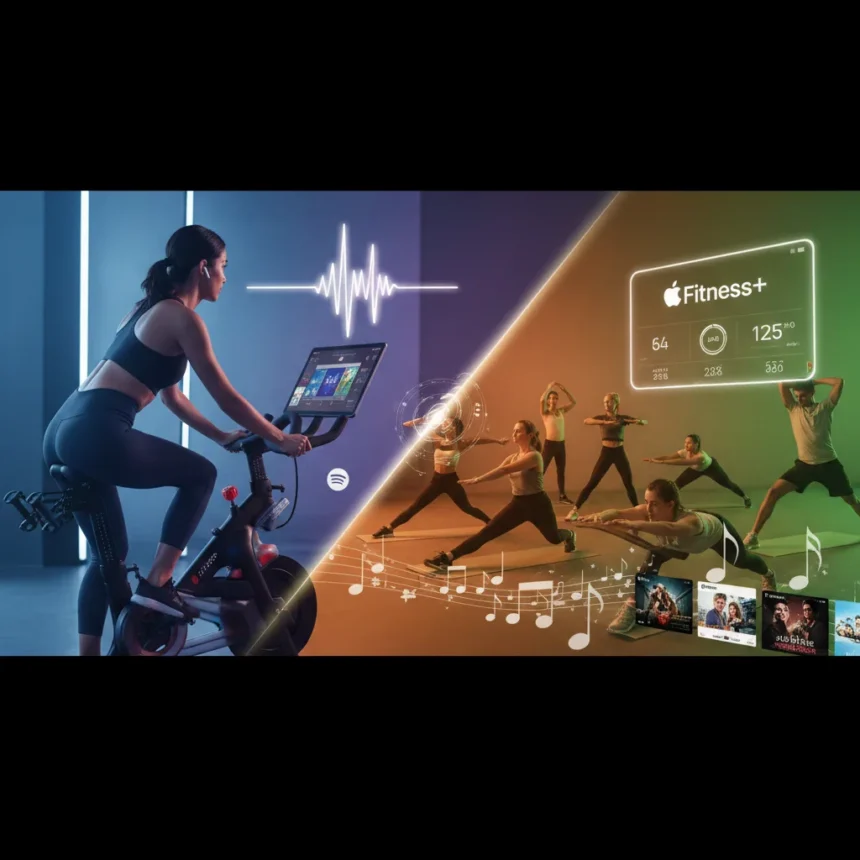
Peloton on Spotify represents a fundamental shift in how fitness content reaches consumers, bundling over 1,400 workout classes directly into the world’s largest music streaming platform. This integration positions Peloton as an unlikely but credible competitor to Apple Fitness+, a service that has dominated the premium fitness app space by leveraging Apple’s ecosystem lock-in. The partnership signals that standalone fitness apps no longer control the market—music platforms do.
Key Takeaways
- Peloton integrated 1,400+ workout classes into Spotify, reaching Spotify’s global user base without requiring a separate app.
- Apple Fitness+ costs $9.99/month or $79.99/year and works exclusively on Apple devices with Activity Rings integration.
- Peloton App One costs $12.99/month or $129/year; App+ with live classes costs $24/month or $240/year.
- Peloton on Spotify combines workouts with music playlists, a feature advantage over Apple’s separate Music service.
- Peloton CEO called Apple’s fitness entry a legitimization of fitness content by a $2 trillion company.
Why Peloton on Spotify Threatens Apple Fitness+
Peloton on Spotify bypasses the friction that has protected Apple Fitness+ for years. Apple’s service requires an Apple device—iPhone, iPad, Apple Watch, or Mac. You cannot use it on Android, Roku, Fire TV, or Chromecast. Peloton, by contrast, supports Amazon Fire TV, Chromecast, Android TV, and Roku TV through its dedicated app, and now reaches Spotify’s 600-million-plus user base without requiring any download at all. The Spotify integration eliminates the primary barrier to entry: device compatibility.
The music integration is where Peloton on Spotify genuinely outmaneuvers Apple Fitness+. Both services emphasize music-driven workouts, with classes labeled by genre and tracklist previews available. But Apple requires users to export playlists from Fitness+ to Apple Music as a separate step. Peloton on Spotify merges the two experiences—you are already on Spotify listening to music, and now your workout is soundtracked by the same platform. This seamless integration removes a cognitive and operational barrier that matters to casual users.
How Peloton on Spotify Compares to Apple Fitness+
The pricing gap is real but not decisive. Apple Fitness+ costs $9.99 per month or $79.99 annually, making it the cheaper option for annual subscribers. Peloton App One, the entry tier for non-hardware users, costs $12.99 monthly or $129 yearly—roughly $50 more per year. However, Peloton App+ with live interactive classes costs $24 monthly or $240 annually, nearly three times Apple’s price. The question is not which is cheaper, but which offers more value for different user types.


Apple Fitness+ specializes in guided workouts: HIIT, core, rowing, dance, pilates, kickboxing, and mindful cooldowns, plus Time to Walk and Time to Run audio experiences. These classes are pre-recorded and tightly integrated with Apple Watch, which tracks your metrics and syncs to Activity Rings. This ecosystem integration is Apple’s true competitive advantage—if you own an Apple Watch, Fitness+ becomes the natural choice because it closes the loop between workout and health tracking. Peloton offers broader workout variety: cardio, outdoor running, walking, boxing, barre, and stretching, but without the Apple Watch integration that makes Fitness+ feel native to the Apple ecosystem.
Peloton’s live classes and community leaderboards are features Apple Fitness+ does not offer. If you value real-time instruction and social accountability, Peloton’s live model appeals more than Apple’s pre-recorded library. But live classes come at a premium—Peloton App+ costs double Fitness+. Peloton on Spotify, however, launches with pre-recorded classes, meaning users do not immediately gain access to live workouts through Spotify alone.



What This Means for the Fitness App Market
Peloton CEO’s comment that Apple’s entry into fitness content represents legitimization from a $2 trillion company reveals the real story here. For years, Peloton fought perception that it was a luxury niche product. Apple Fitness+ validated the entire category—fitness streaming is not a fad, it is a category worth Apple’s attention. But that same validation opened the door for competitors to reach Apple’s users through other channels. Spotify is that channel.
The partnership also signals that distribution, not content, is the bottleneck in fitness streaming. Peloton has excellent instructors and a library of 1,400 classes. What it lacked was reach. Spotify has 600 million users and the daily habit engagement that comes with music streaming. By embedding Peloton classes into Spotify, both companies solve each other’s problem: Peloton gains distribution, Spotify gains fitness content that keeps users engaged longer. This model—inserting premium content into existing platforms—could reshape how fitness apps compete. Why download another app when your music service offers workouts?
Apple Fitness+ remains defensible for Apple ecosystem users. The Activity Rings integration, Apple Watch metrics, and pre-recorded instruction create a cohesive experience that Spotify cannot replicate without owning hardware. But for Android users, Roku TV owners, and anyone already embedded in Spotify’s ecosystem, Peloton on Spotify is now the path of least resistance. Apple’s ecosystem lock-in, once insurmountable, now faces a competitor that does not require you to leave the platform you already use daily.
Does Peloton on Spotify Replace Peloton App?
No. Peloton on Spotify launches with pre-recorded classes from Peloton’s library, but does not include live classes, leaderboards, or community features that define the Peloton App experience. Users seeking live instruction and social accountability still need the standalone Peloton App, which starts at $12.99 monthly for App One or $24 monthly for App+ with live classes. Spotify integration is an entry point, not a replacement.



Should You Switch from Apple Fitness+ to Peloton on Spotify?
If you own an Apple Watch and use Apple Music, no. Apple Fitness+ remains superior for ecosystem users because Activity Rings integration and health tracking create a closed loop that Spotify cannot match. If you are an Android user, a Roku TV owner, or someone already paying for Spotify, Peloton on Spotify is worth trying before subscribing to Peloton App. The barrier to entry is zero—you are already there. If you value live classes and community, Peloton App+ at $24 monthly is still the more complete experience.
What Workout Classes Does Peloton on Spotify Include?
Peloton on Spotify includes cardio, outdoor running, walking, boxing, barre, and stretching classes from Peloton’s 1,400-class library. These are pre-recorded sessions, not live classes. If you want live interactive workouts with leaderboards and instructor feedback, those remain exclusive to the Peloton App and require a paid subscription.
The real shift happening here is not that Peloton defeated Apple Fitness+—it did not. It is that the fitness app market is no longer about standalone apps. It is about distribution. Peloton on Spotify proves that the future of fitness streaming belongs to the platform that owns your daily habit, whether that is Apple, Spotify, or whoever else can embed fitness into an existing ecosystem. Apple Fitness+ will continue thriving for Apple users. But for everyone else, Peloton on Spotify just made fitness streaming frictionless.
This article was written with AI assistance and editorially reviewed.
Source: T3