






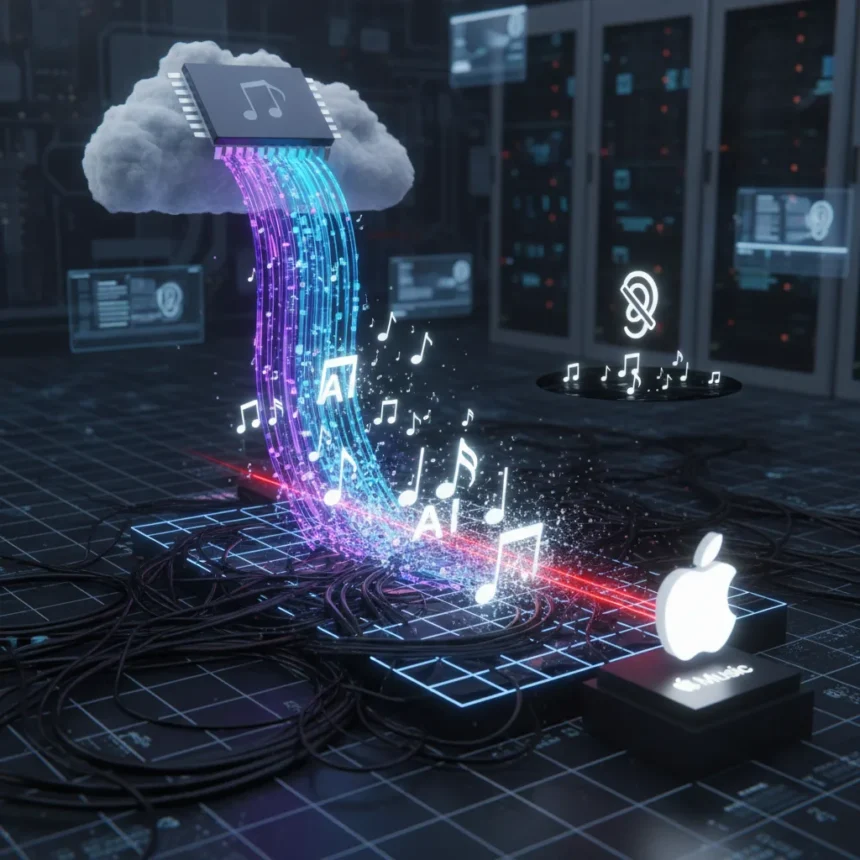
AI music uploads streaming platforms represent one of the music industry’s fastest-growing headaches. Over one-third of tracks delivered to Apple Music are 100% AI-generated, according to Apple Music executive Oliver Schusser, yet the actual listener engagement tells a starkly different story.
Key Takeaways
- Over 33% of tracks uploaded to Apple Music are fully AI-generated, yet account for below 0.5% of actual listening
- Apple Music demonetized 2 billion fraudulent streams in 2025, worth approximately $17 million in royalties
- Deezer receives 60,000 AI-generated tracks daily, representing 39% of all uploads to that platform
- Apple doubled fraud penalties to 10-50% of royalties as of 2026, up from the previous 5-25% range
- Transparency Tags now flag AI-assisted content, but enforcement relies on voluntary label compliance
The AI music uploads streaming disconnect
The numbers reveal a curious paradox. While AI music uploads streaming platforms at unprecedented volumes, listeners are actively avoiding them. On Apple Music, despite one-third of submissions being 100% AI-generated, AI music represents below 0.5% of actual usage. Deezer reports an even starker gap: approximately 44% of new music uploaded daily is AI-generated, yet only 1-3% of streams come from AI music. This gap suggests that despite the ease of generating tracks with tools like Suno and Udio, consumers fundamentally lack interest in faceless, algorithmically produced content.
The volume is staggering. Deezer alone receives approximately 60,000 AI-generated tracks daily, representing 39% of all uploads to that platform. Across all streaming services, approximately 107,000 new tracks are uploaded daily. The acceleration is real: Deezer confirmed 10,000 fully AI tracks in January, 20,000 in April, and 30,000 more recently. Yet none of this volume translates to listener enthusiasm.
Apple’s aggressive enforcement against AI music uploads streaming
Apple Music is not waiting for the problem to self-correct. The platform has deployed in-house technology to analyze music submissions and identify AI-generated content, including which AI model was used. More significantly, Apple doubled down on penalties in 2026. As of that year, Apple raised penalties to 10-50% of would-be royalties from accounts linked to fraudulent activity, up from the previous 5-25% range implemented since 2022.


The scale of fraud Apple detected justifies the escalation. Apple Music identified and demonetized approximately 2 billion fraudulent streams throughout 2025. Those 2 billion streams translated to approximately $17 million in royalties that would have been paid out. Real-time monitoring systems analyze streaming patterns, geographic distribution of plays, listening duration, skip rates, and dozens of other behavioral signals. Fraudsters continuously adapt tactics, employing residential proxies to mask bot origins, mimicking human listening patterns with variable playback behavior, and distributing streams across multiple fake artist profiles.
Schusser acknowledged the cat-and-mouse dynamic: “We have developed — and we’ve never talked about this — but we’ve developed technology in-house that would allow us to exactly see what music people are delivering us, including identifying what AI [model] it is and all that.” This capability represents a significant technical advantage over competitors still developing detection systems.



Transparency Tags and the voluntary compliance problem
Apple introduced Transparency Tags to identify content created with AI assistance, not necessarily 100% AI-generated tracks. Two categories exist: a “Track” tag showing if AI contributed to a material portion of audio recording, and a “Composition” tag highlighting AI use in music composition and AI-generated lyrics. The system sounds comprehensive until you examine the enforcement mechanism.
Responsibility for applying tags relies entirely on labels and distributors prior to content submission to Apple. This voluntary compliance model creates an obvious loophole. Labels and distributors have financial incentives to avoid tagging, since tagged content may face algorithmic demotion, editorial exclusion, or listener avoidance. Deezer flags and marks AI-generated tracks on its platform, excludes them from editorial playlists, and does not recommend them in its algorithm, but Deezer’s approach is the exception, not the standard across the industry.
The effectiveness of Transparency Tags may be further limited by user behavior. Listeners may skip any tagged AI content regardless of the extent of AI involvement, penalizing genuinely hybrid human-AI collaborations alongside purely synthetic tracks. This creates a perverse incentive: creators using AI responsibly as a tool might face the same listener friction as those uploading fully synthetic slop.
Why listeners reject AI music uploads streaming platforms
Interest in music discovery is rooted in cultural relevance, artists themselves, and human-led curation and promotion. Faceless AI tracks lack the same reach or relevance. A listener discovers an artist through social media, word-of-mouth, or editorial recommendation. An AI-generated track has none of these vectors. It exists in a vacuum, competing against millions of other synthetic tracks for algorithmic placement.



This consumer indifference is the industry’s best defense. No amount of fraud detection or penalty enforcement can match the simple fact that people do not want to listen to AI-generated music. Spotify, YouTube Music, and other digital streaming platforms receive the same AI-generated music through music distributors that upload simultaneously across all platforms, yet the listening data remains consistent: AI music is ignored at scale.
Does Apple Music’s approach work better than competitors?
Apple’s enforcement posture is more aggressive than most competitors. Deezer flagged up to 85% of streams generated by fully AI-produced music as fraudulent in 2025, depending on the month, suggesting even stricter detection than Apple. However, Deezer is smaller than Apple Music, Spotify, or YouTube Music, limiting the real-world impact of its enforcement. The larger platforms are still developing comparable detection capabilities, making Apple’s proprietary technology a competitive advantage in the short term.
The collaboration approach also matters. Apple collaborates with distributors, chart providers, and industry partners to share intelligence about suspicious activity. This ecosystem-wide coordination makes it harder for fraudsters to game multiple platforms simultaneously, unlike the current situation where distributors upload the same synthetic tracks across all services at once.
What happens to the $17 million in demonetized royalties?
Apple demonetized approximately $17 million in royalties tied to 2 billion fraudulent streams in 2025. These funds do not return to legitimate artists or rights holders. They simply disappear from the payout pool, reducing total royalty distributions. In theory, this creates a financial incentive for the industry to police itself more rigorously, but in practice, most labels and distributors lack the detection capability to identify fraud before uploading to platforms.
Is AI music fraud getting worse?
Yes. The acceleration of AI-generated uploads—from 10,000 daily in January to 30,000 more recently—demonstrates that synthetic music generation is becoming easier and cheaper. As AI tools improve and costs drop, more bad actors will attempt to game the system. Apple’s doubling of penalties suggests the platform believes enforcement alone cannot solve the problem, and that more aggressive deterrence is necessary.
Will Transparency Tags stop AI music fraud?
Unlikely. Tags only work if labels and distributors apply them honestly, and they have no incentive to do so. A label uploading AI-generated music as a quick revenue grab will simply skip the tagging step and hope Apple‘s detection systems miss it. For Transparency Tags to succeed, the industry would need to implement mandatory third-party verification or blockchain-based provenance tracking—neither of which currently exists at scale.
The real story is not about AI music itself, but about the economic incentives that drive fraud. As long as streaming royalties exist and detection technology lags behind generation tools, bad actors will upload synthetic tracks. Apple’s enforcement is a necessary response, but it is a symptom of a deeper problem: the streaming model’s vulnerability to fraud at scale. The industry’s best defense remains listener indifference. People do not want AI-generated music, and no amount of fraud can change that fundamental truth.
This article was written with AI assistance and editorially reviewed.
Source: TechRadar