






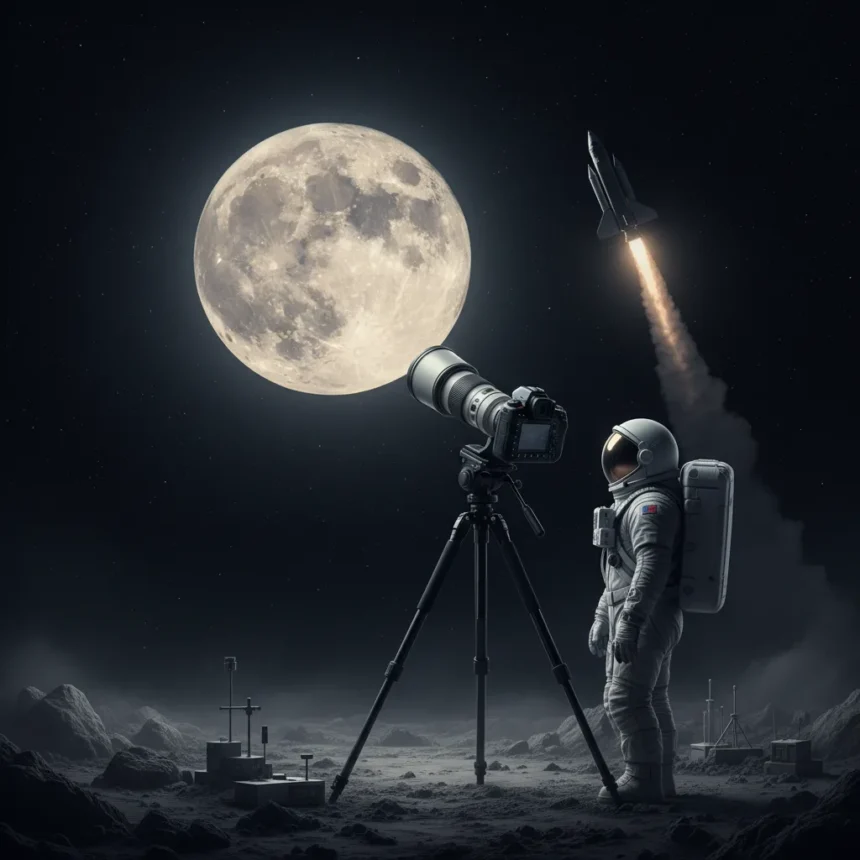
Nikon D5 moon photography became the centerpiece of NASA’s Artemis II mission when the space agency selected the 10-year-old DSLR as its primary camera for the crewed lunar flyby in 2026. The choice shocked many in the photography world—why would NASA pick a 2016-era camera when flagship mirrorless models exist? The answer reveals a fundamental truth about extreme environments: reliability beats raw specifications every time.
Key Takeaways
- Nikon D5 is the primary camera aboard Artemis II, chosen for proven durability in extreme conditions over newer models.
- The D5 features 20.8MP sensor, ISO up to 3,280,000, and exceptional radiation resistance required for space missions.
- Nikon Z9 mirrorless (45.7MP) was added at crew request for testing but remains secondary to the proven D5 design.
- Artemis II carries 32 total cameras and devices; the D5 demonstrates that mission-critical gear prioritizes heritage over hype.
- Amateur astrophotographers using the same D5 discover the learning curve: exposure for bright subjects like the moon eliminates visible stars.
Why NASA Rejected Newer Cameras for Nikon D5 Moon Photography
NASA’s decision to fly the Nikon D5 moon photography camera—rather than the D6, D7, or Canon EOS R1—comes down to a single principle: space is unforgiving. The D5 has logged thousands of hours in orbit, on the International Space Station, and in extreme thermal environments where temperatures swing from minus 150 degrees Celsius to plus 120 degrees. Newer cameras lack this flight heritage. The D5’s proven track record in radiation-heavy environments, its mechanical shutter reliability, and its simplified manual controls make it irreplaceable for fast-paced mission documentation when software glitches could mean mission failure.
The Orion spacecraft carries 32 cameras and devices total—15 mounted on the exterior hull and 17 handheld by crew for engineering, navigation, and lunar science. Among these, the Nikon D5 moon photography system stands as the workhorse. Its 20.8MP sensor, while conservative compared to modern 45+ megapixel competitors, delivers the dynamic range and high-ISO performance astronauts need when shooting Earth against the black void of space or capturing lunar detail during close approach. At ISO 51,200, the D5 produces usable images that would be noise-filled garbage on many newer sensors—but NASA engineers know exactly how that camera behaves under radiation exposure, and that predictability is worth more than theoretical megapixels.
Nikon D5 Moon Photography Specs: What Makes It Space-Ready
The Nikon D5 moon photography camera specifications read modestly by 2026 standards: 20.8MP FX-format CMOS sensor, native ISO range of 100 to 3,280,000, 51-point autofocus system, and a 2.36-million-dot touchscreen LCD. The real advantage lies in its construction. The magnesium alloy body, titanium shutter, and sealed internal components withstand thermal cycling that would crack modern electronics. The D5’s mechanical shutter operates independently of software, meaning astronauts can shoot even if the camera’s electronics fail partially—a critical redundancy in space.


Paired with the AF-S Nikkor 14-24mm f/2.8G lens, the D5 captured Earth and moon in a single frame during Artemis II’s approach, with exposures at f/4, ISO 51,200, and 1/4-second shutter speed. This combination—fast glass, high ISO, and proven sensor—gives crews the flexibility to shoot in rapidly changing light without relying on autofocus or electronic metering that might malfunction. The Nikon Z9 mirrorless camera, added at crew request with 45.7MP resolution and superior low-light potential, serves as a secondary system. Both cameras use Nikon’s F-mount ecosystem, allowing crews to swap lenses mid-mission if needed.
What Nikon D5 Moon Photography Reveals About Astrophotography
For amateur photographers who borrowed or purchased the same D5 to attempt lunar imaging, the experience proved humbling. Nikon D5 moon photography sounds straightforward—point at the moon, shoot at high ISO, capture detail. Reality is different. Expose for the bright lunar surface, and the stars vanish. The moon reflects enough sunlight that even at f/4 and 1/4 second, the background sky remains black, erasing the starfield that makes lunar photos dramatic. Astronauts solve this through multiple exposures and post-processing, but amateur astrophotographers often lack the technical workflow to stack images or recover shadow detail.



The learning curve also extends to gear. A telescope with a camera adapter, a tracking mount that follows the moon’s movement, and precise focus techniques separate professional lunar images from blurry snapshots. The Nikon D5 moon photography system works because astronauts have training, equipment redundancy, and mission support. Hobbyists have a DSLR and hope. This gap—between the camera’s capability and the photographer’s skill—is where most lunar imaging projects stall.
Nikon D5 vs. Modern Alternatives: Why Heritage Matters in Space
The Nikon Z9 mirrorless represents the cutting edge: 45.7MP resolution, advanced autofocus, and computational photography features. In low-light terrestrial shooting, the Z9 outperforms the D5. But in space, the Z9’s complexity becomes a liability. More megapixels mean larger files, more processing power, more heat dissipation—all problematic on a spacecraft with limited power and thermal management. The Z9’s autofocus system relies on software algorithms that might behave unpredictably under radiation exposure. The D5’s simpler design, proven in previous missions, eliminates these unknowns.
Canon’s EOS R1 offers comparable low-light performance, but NASA has decades of institutional knowledge with Nikon equipment in orbit. Switching camera systems mid-program introduces new failure modes, new training requirements, and new unknowns. This is why the D5, a camera most enthusiasts consider outdated, remains mission-critical. Space exploration rewards predictability over innovation.
The Broader Lesson: When Old Gear Wins
Nikon D5 moon photography’s selection for Artemis II challenges the tech industry’s upgrade treadmill. Every year, manufacturers release faster processors, higher resolutions, and new features—creating pressure to replace perfectly functional equipment. In consumer markets, this drives sales. In space, it kills missions. The D5 will likely remain NASA’s primary lunar camera for years, despite newer models launching annually. This reflects a fundamental truth: proven heritage in extreme conditions beats theoretical performance every time.



For amateur astrophotographers, the lesson is different but equally important. The Nikon D5 moon photography system works because of operator skill, not because the camera is magic. A used D5 costs far less than a new Z9, and in the hands of a patient photographer willing to learn exposure stacking and post-processing, it delivers lunar images comparable to contemporary gear. The camera is the easy part. Mastering astrophotography is the hard part.
Can I use the Nikon D5 for lunar photography?
Yes. The Nikon D5 moon photography capability is proven—astronauts used it successfully aboard Artemis II. For amateur use, expect a learning curve: you will need a sturdy tripod, manual focus technique, and multiple exposures to capture both lunar detail and surrounding stars. The D5’s high ISO performance (up to 3,280,000) and dynamic range make it suitable for lunar work, but success depends on your skill, not the camera.
Why didn’t NASA use the newer Nikon D6 or Z9 as the primary camera?
The Nikon D5 moon photography system was chosen because of its proven track record in space environments. Newer cameras lack flight heritage in radiation-heavy conditions. The D5 has logged thousands of hours in orbit with documented behavior under extreme thermal and radiation stress. NASA prioritizes reliability over latest specifications when astronaut safety and mission success are at stake.
What lenses were used with the Nikon D5 for Artemis II?
The Nikon D5 moon photography setup included the AF-S Nikkor 14-24mm f/2.8G lens (used at 22mm, f/4) and an 80-400mm Nikkor lens for closer lunar detail. The fast aperture and proven optical design made these lenses ideal for the mission’s demanding lighting conditions.
The Nikon D5 moon photography story is not about the camera being superior to modern alternatives—it is about NASA understanding that in space, proven reliability trumps raw specifications. For amateur astrophotographers, the takeaway is simpler: the gear matters less than the skill. Master exposure, focus, and post-processing with whatever camera you own, and you will capture lunar images worthy of the same mission that carried astronauts to the moon.
Where to Buy
This article was written with AI assistance and editorially reviewed.
Source: TechRadar