






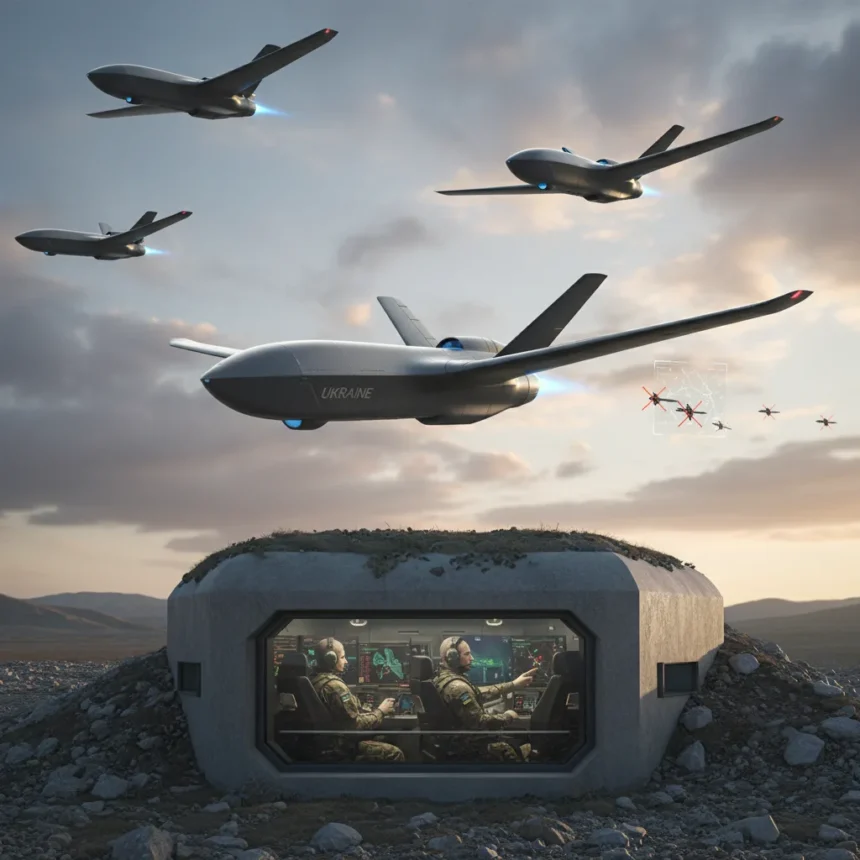
Remotely operated interceptor drones are redefining aerial combat in real time. Ukrainian forces have scaled these bunker-controlled systems to destroy Russian targets from hundreds of kilometers away, eliminating pilot casualties entirely and shifting the nature of air-to-air engagement.
Key Takeaways
- Ukrainian pilot Roman “Hulk” downed two Shahed drones from 500 km away using the STING interceptor on April 4, 2026
- Remotely operated interceptor drones accounted for over 70% of Shahed kills around Kyiv in February 2026
- March 2026 saw Ukrainian forces destroy 2,300+ aerial targets, a 55% monthly increase driven by scaled interceptor systems
- STING and JEDI interceptors exceed 340 km/h, outpacing Shahed drones at 185 km/h
- Operators control systems from bunkers hundreds of kilometers behind front lines with zero crew risk
How Remotely Operated Interceptor Drones Work
Remotely operated interceptor drones combine speed, precision, and standoff control. The STING interceptor, developed by the Wild Hornets volunteer group, is a bullet-shaped system designed to intercept and ram slower targets at speeds exceeding 340 km/h and altitudes up to 3 km. Hornet Vision Ctrl, a digital video and telemetry system, provides HD-quality video feeds and low-latency control across massive distances, enabling operators to maintain safe positions hundreds of kilometers behind active combat zones.
The operational advantage is stark. Instead of risking pilot lives in traditional fighters, Ukraine deploys remotely operated interceptor drones with operators sheltered in bunkers. When Roman “Hulk” from the Bulava unit intercepted two Shahed-type loitering munitions from 500 km away on April 4, 2026, he sat safely indoors, not in a cockpit. This decoupling of operator location from weapon location is the defining shift—air combat no longer requires putting humans in the sky.
Scaling Interceptor Drones Across Ukraine
Ukraine’s air defense efficiency has surged as remotely operated interceptor drones scale. In March 2026, Ukrainian forces destroyed over 2,300 aerial targets, a 55% increase from February, driven largely by low-cost interceptor systems and AI-assisted guidance. Interceptor drones accounted for more than 70% of Shahed kills around Kyiv in February alone, demonstrating that these systems are no longer experimental—they are the primary defense mechanism.


The shift reflects both tactical necessity and technological maturity. Ukraine modified Soviet-era Antonov An-28 turboprop planes to serve as airborne carriers, launching P1-Sun interceptors developed by Skyfall from wing pylons—at least three per wing—replacing earlier machine-gun methods. This platform extends range and reduces cost compared to ground-based air defense. Separately, JEDI Shahed Hunters, low-cost interceptors with speeds up to 350 km/h, radar cueing, thermal imaging, and autonomous targeting, have proven capable of downing Shaheds with a single strike. Overall, Ukrainian air defenses now intercept at least 80% of incoming Russian drones, with potential to reach 90% as remotely operated interceptor drones mature.
The End of Manned Dogfighting
Remotely operated interceptor drones represent a fundamental break from traditional air combat doctrine. Pilots no longer dogfight in person. Operators guide intercepts from bunkers, eliminating crew casualties entirely. This shift is not incremental—it is a redefinition of what air defense means. Russian Shaheds, designed as cheap loitering munitions, now face interceptors that are faster, remotely controlled, and expendable in ways manned aircraft cannot be.



Russia has begun adapting. Shaheds now fly lower to evade radar and use onboard cameras for evasion, but these tactics do not offset the speed and autonomous guidance advantages of modern interceptors. The arms race between loitering munitions and interceptor drones is accelerating, but the asymmetry favors Ukraine’s distributed, remotely operated approach.
Can Remotely Operated Interceptor Drones Scale Globally?
Ukraine’s success with remotely operated interceptor drones raises questions about adoption elsewhere. The systems rely on mature video streaming, low-latency telemetry, and distributed operator networks—capabilities that exist but are not universal. Ground-based air defense remains cheaper and faster for static targets, and remotely operated interceptor drones excel against swarms of slow-moving threats like Shaheds. For air forces facing high-speed fighters, traditional air defense and manned fighters remain relevant. Ukraine’s advantage stems from the specific threat environment: abundant, slow, loitering munitions and the ability to scale volunteer-developed systems rapidly without legacy defense budgets.
FAQ
What is the range of remotely operated interceptor drones?
The confirmed operational range for remotely operated interceptor drones is at least 500 km, demonstrated by Ukrainian pilot Roman “Hulk” on April 4, 2026. Hornet Vision Ctrl telemetry systems enable control from hundreds of kilometers behind front lines, though the exact maximum range depends on signal infrastructure and system design.
How fast are interceptor drones compared to Shahed drones?
STING interceptors exceed 340 km/h, while JEDI Shahed Hunters reach 350 km/h—both far outpace Shahed loitering munitions, which max out at 185 km/h. This speed advantage allows interceptors to close distance and execute intercepts reliably.



Why do operators control drones from bunkers instead of flying them directly?
Operating remotely from bunkers eliminates crew casualties entirely. Pilots no longer risk their lives in the air; instead, they guide systems from safe locations hundreds of kilometers behind combat zones, enabling pilotless air defense with zero human exposure.
The era of manned dogfighting is not ending because remotely operated interceptor drones are perfect—it is ending because they work. Ukraine has proven that distributed, bunker-controlled air defense can scale faster and cheaper than traditional fighters, while keeping operators alive. As other nations face drone swarms and budget constraints, this model will likely spread beyond Ukraine’s wartime necessity into peacetime air defense doctrine worldwide.
This article was written with AI assistance and editorially reviewed.
Source: TechRadar