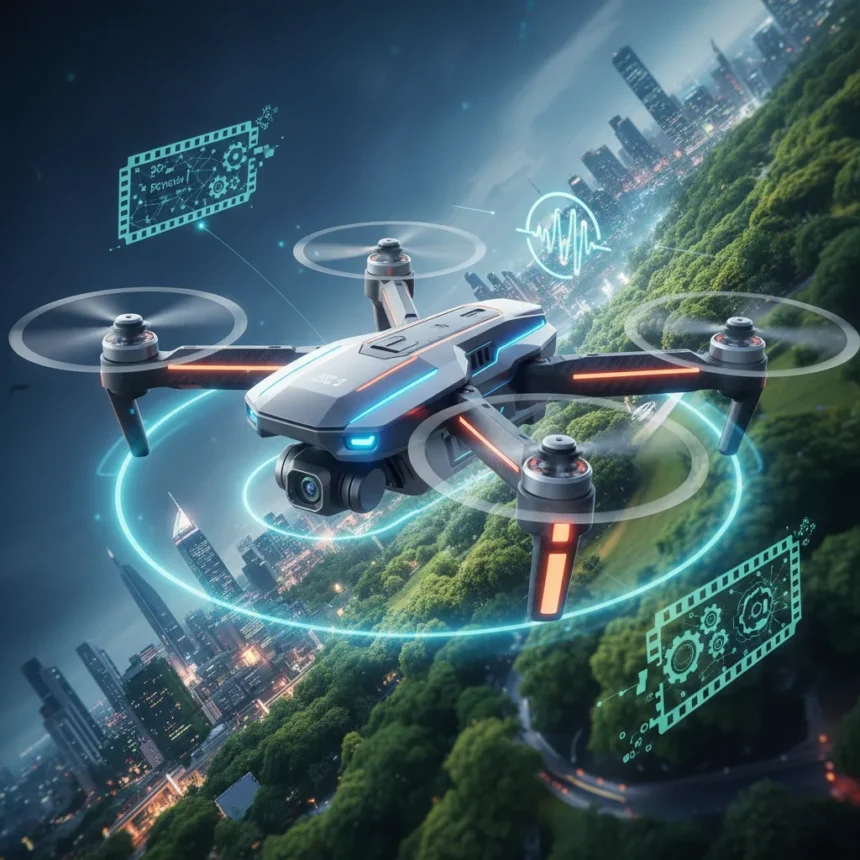
The Antigravity A1 U3 update represents a significant shift in how consumer drones handle safety and content creation. Released in late April, this firmware upgrade introduces voice control, omnidirectional obstacle avoidance, and AI-powered video editing—features that collectively challenge DJI’s market leadership while remaining accessible to everyday users.
Key Takeaways
- Antigravity A1 U3 update adds hands-free voice control for natural language commands like “take off” and “follow me”
- Full 360-degree obstacle avoidance uses LiDAR and cameras to detect collisions in all directions, matching DJI safety standards
- AI editing feature automatically generates highlight reels with mood-based music syncing and auto-cropping—never before combined in one consumer drone
- Firmware update is free for existing A1 U3 owners; base drone costs $499 USD
- Available globally now via Antigravity website and Amazon, with EU and UK stock confirmed
What Makes the Antigravity A1 U3 Update Stand Out
The Antigravity A1 U3 update is a consumer drone firmware upgrade that bundles three previously separated features into one cohesive package. Voice control allows pilots to command the drone hands-free using natural language—”take off,” “follow me,” “return home”—without touching the controller. The obstacle avoidance system uses a multi-sensor array of omnidirectional LiDAR and cameras to detect and avoid collisions in all directions, a capability DJI pioneered but which Antigravity claims to match or exceed at lower cost. The AI editing feature, however, is where Antigravity departs from the formula: it doesn’t just assemble clips into a video, it “understands your flight intent and builds a story around it,” according to the company’s positioning.
This combination matters because it democratizes pro-level capabilities. Most consumer drones force pilots to choose between safety-first models (which lack editing tools) or content creation rigs (which demand manual piloting). The A1 U3 update bridges that gap. The intent-aware AI editing is the standout—it syncs music based on detected mood in footage and auto-crops for multiple aspect ratios, a level of automation that simplifies post-production for creators who lack editing skills.
How Antigravity A1 U3 Update Compares to Competitors
DJI’s Mini and Avata series remain the market standard for consumer obstacle avoidance, but they lack voice control and their native editing tools are less advanced than what the A1 U3 update delivers. The Skydio 2+ offers superior AI tracking and avoidance, but costs significantly more and lacks the voice-command simplicity of Antigravity’s approach. Autel Evo Nano+ provides comparable avoidance but doesn’t combine voice control with AI editing. Antigravity positions the A1 U3 as “DJI safety meets iPhone simplicity”—emphasizing that safety features shouldn’t require a learning curve. The firmware update reinforces this philosophy: existing owners gain pro-level tools without purchasing new hardware.



The timing is strategic. With DJI facing potential US regulatory restrictions, alternatives like Antigravity are gaining attention from buyers seeking feature parity without supply-chain risk. The A1 U3 update arrives as drone regulations tighten globally—FAA remote ID compliance, airspace restrictions—making safety features and ease-of-use genuine selling points rather than marketing fluff. A drone that pilots can control by voice and that automatically avoids obstacles reduces the risk of regulatory violations caused by operator error.
Voice Control and AI Editing: The Practical Reality
Voice control on drones isn’t entirely new—some commercial platforms support it—but integrating it into a $499 consumer model is a meaningful shift. The A1 U3 update accepts natural language commands, meaning pilots don’t memorize button sequences or menu structures. This lowers the barrier for casual users and reduces cognitive load during flight, which directly impacts safety. The obstacle avoidance system uses the same architectural approach as DJI: multi-directional sensors feeding a real-time collision-detection algorithm. Antigravity claims omnidirectional coverage, meaning the drone detects threats from all angles, not just forward and backward.



The AI editing feature deserves scrutiny. DJI’s Fly app includes auto-editing, but it’s basic—it cuts footage to music and applies transitions. The A1 U3 update’s version adds mood detection (identifying energetic vs. calm sections) and syncs music accordingly, then auto-crops for Instagram, TikTok, and YouTube aspect ratios. This is more sophisticated, though not unprecedented in video software; what’s new is bundling it into a drone’s native app. For creators who shoot footage but lack editing skills, this saves hours of post-production work.
Pricing and Availability
The Antigravity A1 U3 base model costs $499 USD and ships with the update pre-installed. Existing owners receive the firmware upgrade free via the Antigravity app, making this a pure feature gain for the installed base. The drone is available now globally through Antigravity’s website and Amazon, with confirmed stock in EU and UK markets. US availability aligns with the firmware release, suggesting Antigravity timed the launch to maximize market impact during the regulatory uncertainty around DJI.
Is the Antigravity A1 U3 Update Worth Upgrading For?
If you own an A1 U3, the firmware update is a no-brainer—it’s free and adds three substantial features. If you’re shopping for a consumer drone, the A1 U3 becomes more compelling than before. Voice control eliminates the controller-learning curve, obstacle avoidance reduces crash risk, and AI editing means you’ll actually finish your videos instead of abandoning them in your camera roll. The $499 price point undercuts DJI Mini models with comparable safety features, and the editing suite is stronger than what DJI’s native tools offer.
The caveat: independent testing of the obstacle avoidance system doesn’t yet exist. Antigravity’s claims of matching or exceeding DJI are credible given the sensor architecture, but real-world performance varies with lighting, weather, and terrain. The AI editing, while genuinely useful, works best with well-composed footage—garbage in, polished garbage out. Still, for casual pilots and content creators on a budget, the update shifts the value proposition decisively in Antigravity’s favor.


Does the voice control work in noisy environments?
The research brief doesn’t specify noise tolerance for the voice control system. Typical drone voice systems use directional microphones to filter wind and ambient noise, but performance degrades in loud settings. Test the feature in your intended flying environment before relying on it for critical commands like “return home.”
Can you use the AI editing features offline?
The brief doesn’t clarify whether AI editing requires cloud processing or runs locally on the drone or mobile device. Assume cloud processing unless Antigravity’s documentation states otherwise, meaning you’ll need internet to generate highlight reels.
How does the update affect battery life?
The research brief contains no information about battery impact from the new features. Voice processing and continuous obstacle avoidance typically consume additional power, but the magnitude depends on implementation. Check Antigravity’s release notes or contact support for specific runtime changes.
The Antigravity A1 U3 update is a rare example of a manufacturer using a firmware release to fundamentally reshape a product’s positioning. By bundling voice control, safety, and AI editing, Antigravity isn’t just adding features—it’s redefining what a $500 consumer drone should do. For buyers tired of DJI’s complexity or concerned about supply-chain risk, this update makes the A1 U3 a genuine alternative worth considering.
Where to Buy
Edited by the All Things Geek team.
Source: T3