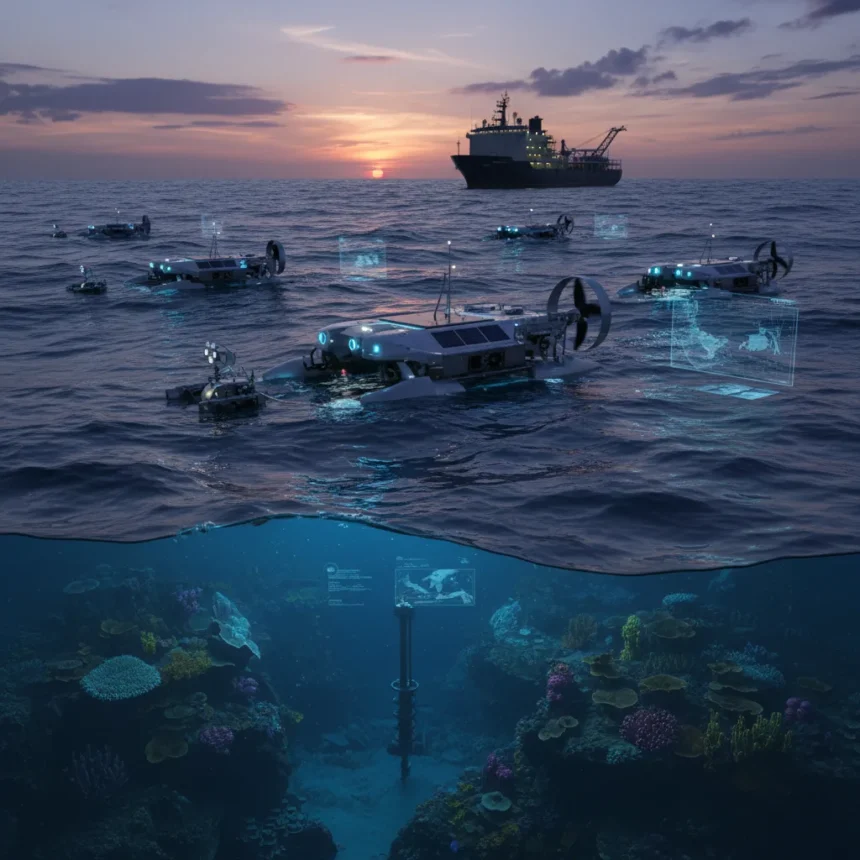
Autonomous ocean robots represent a fundamental shift in how we explore and exploit Earth’s final frontier. A startup drawing on NASA’s space robotics expertise is developing AI-infused autonomous ocean robots designed to replace offshore vessels that cost $100,000 per day to operate. The ocean covers 70 percent of Earth, yet only about 25 percent has been mapped at high resolution, making it what the company describes as the world’s largest untapped frontier for resource exploration, environmental monitoring, and scientific discovery.
Key Takeaways
- Autonomous ocean robots could replace ships costing $100k daily, cutting operational expenses dramatically.
- NASA space robotics technology, including autonomous free-flyers, is being adapted for deep-sea missions.
- Ocean mapping remains incomplete at scale, with only 25 percent mapped at high resolution globally.
- Robots enable 24/7 operations without human crews exposed to hazardous offshore conditions.
- The startup is still in early development and has not yet deployed commercial systems.
Why autonomous ocean robots matter now
The offshore industry faces mounting pressure to reduce costs and eliminate human risk. Traditional offshore vessels require large crews, constant resupply, and operate only during favorable weather. Autonomous ocean robots eliminate these constraints. They can operate continuously, navigate extreme conditions, and complete missions in environments too dangerous or remote for human teams. This shift mirrors the way space agencies moved from crewed missions to robotic exploration—a transition that accelerated discovery while reducing expense and risk.
The timing is critical. As demand for sustainable resource extraction, climate monitoring, and deep-sea science intensifies, the bottleneck is not discovery potential but operational cost. A robot that can map the seafloor, collect environmental data, inspect underwater infrastructure, and explore resource-rich zones at a fraction of current costs unlocks exploration that was previously uneconomical. The startup’s focus on adapting NASA’s autonomous robotics expertise—technology proven in the extreme environment of space—signals confidence that proven autonomous systems can transition to ocean environments.
How NASA space tech is being repurposed for the ocean
The connection between space robotics and ocean robotics is not metaphorical. NASA’s Astrobee robots, autonomous free-flyers used aboard the International Space Station for inventory management and cargo movement, operate without tethers in a hostile environment with no margin for error. The navigation, obstacle avoidance, and autonomous decision-making systems developed for microgravity translate directly to deep-sea robotics, where communication delays, extreme pressure, and unpredictable currents demand similar levels of autonomous intelligence.



The startup’s approach draws on decades of NASA robotics development and partnerships with companies like PickNik Robotics, which received NASA funding to develop MoveIt Pro—software that enables robots to manipulate objects in unstructured, unpredictable environments. These technologies, originally designed for space stations and satellites, are being repackaged for ocean exploration. The advantage is substantial: space robotics teams have already solved the hardest problems—autonomous navigation, real-time decision-making under uncertainty, and operation in environments where human intervention is impossible.
Competing visions for autonomous systems in extreme environments
The space robotics sector offers a useful comparison. Icarus Robotics, founded in 2024, is building free-flying dual-armed robots designed for satellite repair and space station maintenance, with an ISS demonstration planned for 2027. Icarus raised $6.1 million in seed funding and is pursuing teleoperation-to-autonomy as its core strategy—humans control the robot initially, then gradually hand control to autonomous systems as the AI learns the task. This incremental approach mirrors what the ocean robotics startup will likely pursue: start with human operators guiding robots through high-risk missions, then shift to fully autonomous operation as the AI improves.



The ocean robotics venture differs in scope and timeline. While space robotics targets high-value satellite repair and station maintenance—work worth millions per mission—ocean robotics targets the broader market of offshore operations, environmental monitoring, and resource exploration. The cost structure is inverted: space work is expensive because access is rare; ocean work is expensive because it requires large, slow ships. Autonomous robots can compress timelines and eliminate the human cost, making economically marginal missions suddenly viable.
What remains unproven
The startup is still in early development. No prototypes have been deployed, no funding rounds have been announced, and no commercial timelines have been disclosed. The $100,000-per-day ship cost is a useful benchmark for the problem the startup is solving, but actual robot costs, operational efficiency, and real-world reliability remain unknown. Deep-sea environments are unforgiving—pressure, corrosion, communication blackouts, and unpredictable currents present challenges that space robotics did not face. Proving the concept at scale will require successful deployments, not just engineering credibility.
The ocean robotics market is nascent. No dominant competitors have emerged, and the regulatory landscape for autonomous maritime operations is still forming. This is both opportunity and risk: the startup can shape the market, but it must also navigate regulatory uncertainty and prove that space-derived robotics can actually work in the ocean at commercial scale.
Could autonomous ocean robots replace offshore ships entirely?
Full replacement is unlikely in the near term. Some offshore operations—crewed platform maintenance, emergency response, and complex salvage—will require human judgment and physical presence. But autonomous ocean robots can handle routine tasks: mapping, monitoring, inspection, and data collection. These missions represent the majority of offshore vessel utilization and the highest operational costs. Even partial displacement of traditional ships would be transformative, reducing costs by tens of millions annually across the industry.


What’s the timeline for commercial autonomous ocean robots?
The startup has not announced specific timelines. Space robotics companies like Icarus are targeting 2027 for ISS demonstrations, suggesting that comparable ocean robotics systems could be field-tested within 3-5 years. However, ocean environments present unique challenges—deeper pressure, saltwater corrosion, and communication delays—that may require additional development time beyond what space robotics teams have already completed.
How do autonomous ocean robots compare to traditional ROVs and drones?
Traditional remotely operated vehicles (ROVs) and underwater drones require constant human control via tether or radio link. Autonomous ocean robots operate independently, making decisions in real time without waiting for commands. This autonomy eliminates communication delays, enables operation in areas where tethers are impractical, and allows continuous 24/7 missions without crew fatigue. The tradeoff is complexity—autonomous systems must be far more sophisticated than remote-controlled alternatives, which is why space-derived AI and robotics expertise matters.
The convergence of NASA robotics expertise, AI advancement, and offshore industry demand creates a genuine opportunity. Autonomous ocean robots won’t replace all ships, but they will reshape the economics of ocean exploration and resource management. The startup’s success depends on engineering execution and real-world deployment data—not hype. Watch for prototype announcements and early field trials as the true test of whether space robotics can conquer the ocean.
Edited by the All Things Geek team.
Source: TechRadar