






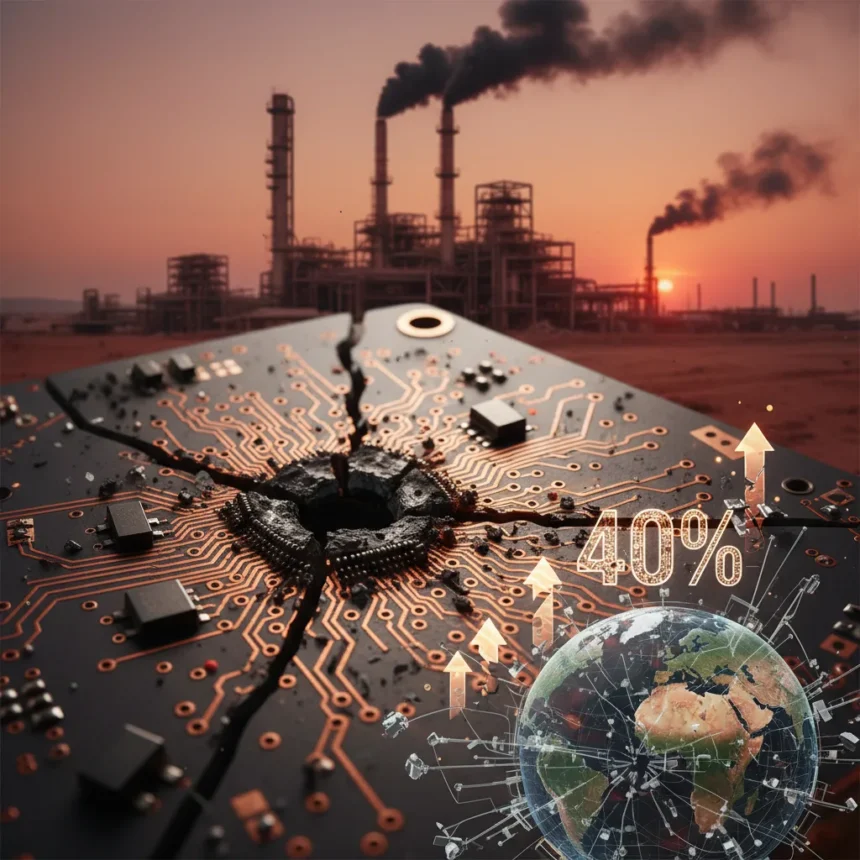
The PCB supply chain disruption deepened dramatically in early April 2026 when Iranian forces struck Saudi Arabia’s Jubail Industrial City petrochemical complex, halting production of high-purity polyphenylene ether (PPE) resin, a critical base material for printed circuit board laminates. SABIC (Saudi Basic Industries Corporation), which operates at the complex and accounts for approximately 70% of the world’s high-purity PPE supply, has been unable to resume output, creating a single-point failure that threatens electronics makers worldwide.
Key Takeaways
- PCB prices surged 40% in April 2026 compared to March after Iranian strike halted SABIC’s resin production
- SABIC supplies roughly 70% of global high-purity PPE, a critical laminate base material with no readily available substitutes
- Copper costs account for approximately 60% of PCB raw material expenses, and conflict threatens to raise prices further
- Epoxy resin wait times stretched from 3 weeks to 15 weeks for major suppliers serving Samsung and AMD
- Cloud providers expect to absorb further price hikes due to sustained AI demand outpacing available supply
How the PCB supply chain disruption unfolded
The timing of this strike could not have been worse. PCB prices were already climbing since late 2025 due to surging demand from AI server buildouts. Manufacturers rushed to secure materials as early as March 2026, anticipating supply tightness. The Iranian attack accelerated what was already a rising trend. Goldman Sachs analysts documented the impact: PCB prices jumped as much as 40% in April 2026 compared to March.
The strike itself targeted a facility that few companies can replicate. High-purity PPE resin is not readily substitutable—manufacturers cannot simply swap in an alternative material without redesigning their laminate formulations. This is why the loss of SABIC’s output creates such acute pressure. No alternative supplier exists at scale to fill the 70% gap.
Why this matters for electronics prices and AI infrastructure
The PCB supply chain disruption extends far beyond circuit board makers. Cloud providers—the hyperscalers building out AI infrastructure—are now facing sustained price pressure on a critical component they cannot avoid. These companies expected some cost inflation due to AI demand outpacing supply, but the geopolitical shock has accelerated timelines. Industry analysts project the trend will persist through the end of 2026 and possibly into 2027, based on Q1 order volumes, pricing, and manufacturing capacity constraints.



Copper, which accounts for roughly 60% of PCB raw material costs, adds another layer of vulnerability. The conflict disrupts Gulf shipping routes, compounding raw material circulation issues and potentially driving copper prices higher. A Chinese PCB supplier to Nvidia, Samsung, and AMD confirmed that multi-layer PCBs cost approximately 1,394 yuan ($204) per square meter, while high-end AI server boards reach around 13,475 yuan. Even modest increases in raw material costs ripple through the entire supply chain.
What comes next for the electronics industry
The global PCB market was already projected to grow 12.5% to $95.8 billion by 2026, per Prismark. That growth now comes with a caveat: prices will rise faster than historical trends, and availability will remain constrained. Epoxy resin wait times have already stretched from the normal 3 weeks to 15 weeks for a South Korean supplier serving Samsung and AMD. Similar delays will propagate across the industry as manufacturers compete for limited inventory.



The PCB supply chain disruption reveals a hard truth about modern electronics manufacturing: resilience is fragile when a single facility supplies 70% of a critical material. SABIC’s Jubail complex was never designed to be a geopolitical flashpoint. Yet here we are. Manufacturers have no choice but to absorb higher costs and accept longer lead times, at least until SABIC resumes production—a timeline that remains uncertain as of the latest reports.
Can manufacturers find workarounds?
The short answer is no, not at scale. High-purity PPE is engineered to strict specifications for PCB laminate performance. Switching to alternative materials requires extensive testing and qualification, a process that takes months or years—time the industry does not have. Some manufacturers may explore stockpiling or negotiating long-term contracts at premium prices, but these are band-aid solutions, not structural fixes.
How long will PCB prices stay elevated?
Industry analysts expect the PCB supply chain disruption to persist through 2026 and into 2027, assuming SABIC does not resume production soon. If the facility remains offline for six months or longer, expect secondary shortages as manufacturers exhaust their safety stock and begin rationing materials. Cloud providers have signaled they will accept further price hikes to secure supply, which means end-user device prices will eventually follow.
Will this affect consumer electronics prices?
Yes, though the timeline varies. Enterprise and data center equipment will feel the impact first and most acutely, since cloud providers prioritize AI infrastructure. Consumer electronics—smartphones, laptops, gaming consoles—will experience slower but steady price increases as manufacturers pass along higher PCB costs. The effect will be most visible in devices requiring high-end PCBs, such as flagship smartphones and gaming laptops.



The PCB supply chain disruption is a reminder that globalized electronics manufacturing has critical weak points. A single geopolitical event can cascade into price hikes affecting millions of devices. Until SABIC resumes production or an alternative supplier emerges at scale, expect elevated prices and longer lead times to remain the new normal for PCBs and the devices that depend on them.
This article was written with AI assistance and editorially reviewed.
Source: Tom's Hardware