Steam Controller kernel drivers remain absent by design, according to Valve programmer Pierre-Loup Griffais and engineer Steve Cardinali in a recent interview with Tom’s Hardware. The pair explained that Valve deliberately chose not to build native kernel drivers for the controller, instead centralizing all advanced functionality—gyroscope, haptics, dual trackpad mapping, and trigger pressure sensitivity—exclusively within Steam’s software ecosystem.
Key Takeaways
- Steam Controller requires Steam client for full functionality; no official kernel drivers exist for native OS support.
- Dual trackpads, grips, accelerometer, and gyroscope inputs are exposed only through Steam’s input system, not natively.
- Linux users can access basic gamepad inputs without Steam, but lose all advanced features and per-game customization.
- Learning curve is intentional; Valve expects users to adapt to trackpads rather than traditional analog sticks.
- Community-built Linux drivers provide limited support without remapping or motion control capabilities.
Why Valve Abandoned Kernel Drivers
Valve’s decision to skip kernel drivers reflects a fundamental architectural choice: lock users into the Steam ecosystem to deliver the best experience. Without native kernel support, Steam Controller cannot function at full capacity outside of Steam. This is not a limitation—it is strategy. Griffais and Cardinali framed the absence of kernel drivers as a deliberate trade-off, prioritizing deep software integration over universal OS-level support.
The controller exposes basic generic gamepad inputs on Linux without Steam—buttons map to standard inputs like BTN_SOUTH for the A button and BTN_EAST for B—but this bare-bones compatibility is intentionally limited. Advanced features like full trigger pressure sensitivity, pad haptics, and motion controls require Steam runtime. Users cannot access the gyroscope or use custom trackpad configurations outside of Steam, forcing dependency on Valve’s client.
Steam Controller kernel drivers vs. community alternatives
Community developers have built workarounds to fill the void. The cvuchener/steamcontroller-linux-kernel project on GitHub provides basic gamepad support without requiring Steam, but it cannot replicate Valve’s software-driven approach. These unofficial drivers map buttons and axes to standard Linux input devices but lack remapping functionality, gyroscope exposure, and haptic feedback—the features that make Steam Controller distinctive.

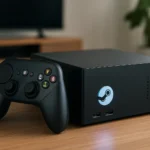
On OSMC forums, users report that native kernel recognition treats the controller as an Xbox-like gamepad after system updates, but this generic mapping requires additional addons to access Steam Controller-specific features and still cannot fully expose the extra inputs. Python-based alternatives exist for non-Steam use cases, but none approach the depth of customization available through Steam’s per-game profile system. Valve’s ecosystem lock-in is not accidental; it is the entire point.
The intentional learning curve
Griffais and Cardinali acknowledged that Steam Controller has a steep learning curve, but they framed this as a feature, not a bug. Users must unlearn muscle memory built on traditional dual analog sticks and adapt to trackpads and grip buttons instead. This is not a flaw to be solved—it is the controller’s defining characteristic. Steam provides per-game profiles to ease the transition, allowing users to load controller configurations tailored to specific titles rather than forcing a one-size-fits-all approach.


The learning curve exists because Valve believes trackpads offer more precision and flexibility than analog sticks, particularly for games demanding fine aim control or complex input schemes. The steep adoption barrier ensures that users committed to the learning process gain access to capabilities that traditional controllers cannot match. For casual players unwilling to invest time in adaptation, Steam Controller remains a poor fit—and Valve accepts this trade-off.
Steam ecosystem dependency as design philosophy
The lack of kernel drivers is inseparable from Valve’s broader Steam-centric strategy. By refusing to build native OS support, Valve ensures that Steam Controller’s full potential is accessible only to users running Steam. This dependency strengthens the Steam ecosystem, drives engagement with Valve’s platform, and gives Valve complete control over the controller’s feature set and update cycle.
Without kernel drivers, users cannot configure Steam Controller through competing software, third-party remapping tools, or alternative gaming launchers. Every advanced feature flows through Steam’s input system, giving Valve the ability to add capabilities, adjust behavior, and push updates without relying on OS vendors or community maintainers. This centralization is the trade-off for the controller’s depth of customization.
Does Steam Controller work without Steam?
Steam Controller can function as a basic gamepad on Linux without Steam, with buttons and axes mapping to standard input devices. However, this stripped-down mode loses all advanced features: no gyroscope access, no trackpad remapping, no haptic feedback, and no per-game profiles. The experience is comparable to a generic controller, eliminating the capabilities that justify the learning curve.


Why doesn’t Valve release kernel drivers for Steam Controller?
Valve chose not to build kernel drivers because doing so would allow users to access Steam Controller’s full feature set outside of Steam. Kernel drivers would enable third-party software, competing platforms, and community tools to leverage the controller’s dual trackpads and motion controls. By centralizing all advanced functionality in Steam’s software layer, Valve maintains exclusive control over the controller experience and ensures Steam remains the only path to full functionality.
Can Linux users access Steam Controller gyroscope without Steam?
No. Community-built Linux drivers expose the controller as a basic gamepad but cannot access the gyroscope or other advanced inputs. The gyroscope is only available through Steam’s input system. Users wanting motion control must run Steam, making the Linux gaming experience on Steam Controller contingent on Valve’s client.
Valve’s decision to abandon kernel drivers reflects a deliberate architectural choice: control the experience by controlling the software layer. For users committed to Steam and willing to learn trackpads, Steam Controller delivers customization and precision unmatched by traditional controllers. For everyone else, the ecosystem lock-in and learning curve make it a niche product. This is not oversight—it is design.
Edited by the All Things Geek team.
Source: Tom's Hardware