





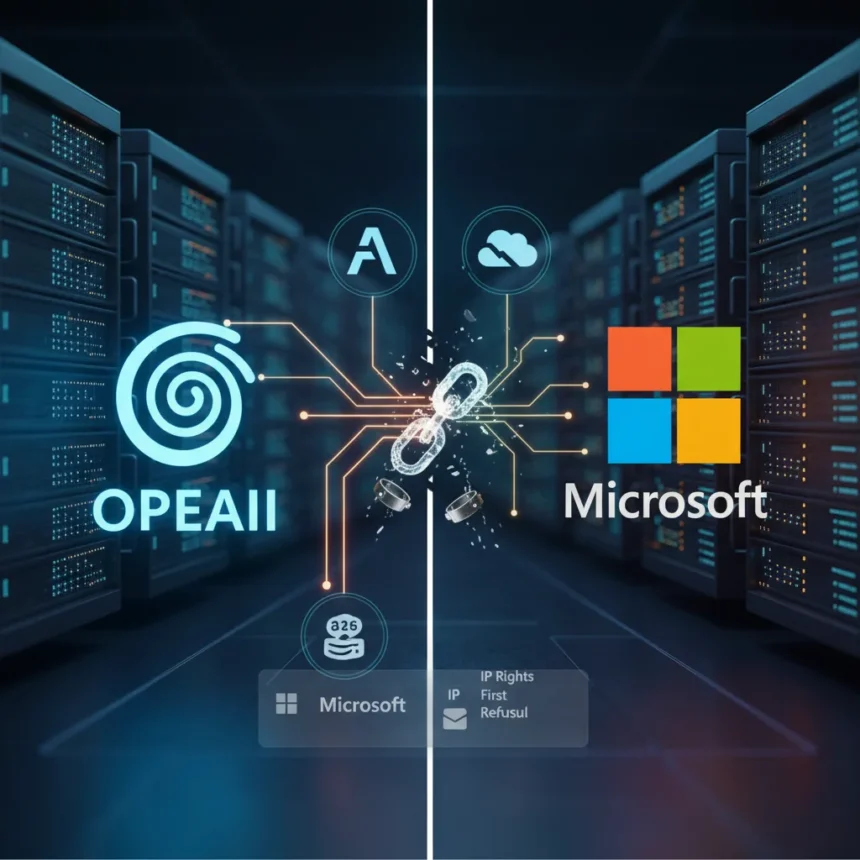
The OpenAI cloud exclusivity deal officially ends, dismantling Azure’s single-provider monopoly for ChatGPT and reshaping one of tech’s most consequential partnerships. For years, OpenAI relied exclusively on Microsoft Azure for cloud computing, a relationship that fueled both companies’ dominance in generative AI. Now that exclusivity is gone, and OpenAI can pursue deals with Amazon, Google, or any other cloud provider it chooses.
Key Takeaways
- OpenAI cloud exclusivity deal ends, freeing OpenAI to partner with Amazon and other cloud providers
- Microsoft no longer pays OpenAI revenue share; OpenAI instead pays Microsoft for cloud services
- Microsoft retains exclusive IP license and first-refusal rights for OpenAI products on Azure
- OpenAI’s frontier models and first-party products continue hosting on Azure
- Partnership restructure reflects OpenAI’s transition to for-profit model and public ambitions
What the OpenAI Cloud Exclusivity Deal Ending Actually Means
The OpenAI cloud exclusivity deal represents a fundamental shift in how OpenAI will distribute its AI models. Previously, Azure held exclusive rights to host ChatGPT and OpenAI’s other products. That exclusivity is now dissolved, effective around February 2026. OpenAI can now sign independent deals with rival cloud providers, starting with Amazon Web Services. This move gives OpenAI genuine multi-cloud flexibility for the first time, reducing dependence on any single infrastructure provider and creating competitive pressure on Azure pricing and capabilities.
The revenue structure has also flipped. Under the old deal, Microsoft paid OpenAI a revenue share from Azure usage. Now the arrangement inverts: OpenAI will pay Microsoft for the cloud services it consumes. This shift reflects OpenAI’s transition toward profitability and its need for capital as it pursues its for-profit restructuring and eventual public offering.
Microsoft’s Remaining Leverage in the Partnership
While the OpenAI cloud exclusivity deal ends, Microsoft did not surrender its strategic position. The company secured first-refusal rights, meaning OpenAI products ship first on Azure unless Microsoft cannot and chooses not to support necessary technical capabilities. Microsoft also maintains an exclusive license to OpenAI’s intellectual property across all models and products, a concession that gives Microsoft independent leverage over OpenAI’s technology. OpenAI’s first-party products, including its frontier models, will continue to be hosted on Azure, ensuring Microsoft retains a privileged position in the relationship.


Microsoft remains a major shareholder in OpenAI and participates in its financial growth. The joint statement from both companies emphasizes the partnership remains strong, with ongoing collaboration in research, engineering, and product development. This framing matters: the OpenAI cloud exclusivity deal ending is not a breakup, but a restructuring that loosens ties while preserving core privileges for Microsoft.
Why the Timing Matters for OpenAI’s Strategic Independence
The OpenAI cloud exclusivity deal ending coincides with OpenAI’s broader shift toward independence. An October 2025 agreement already allowed Microsoft to pursue AGI development independently or with third parties, loosening prior constraints. The cloud deal dissolution accelerates this trend, giving OpenAI the flexibility to source compute from multiple providers, including projects like Stargate, which require infrastructure beyond what Azure alone can provide. OpenAI has signaled it will collaborate with Amazon on AI model distribution, a partnership that was always contemplated under the existing agreements.



For Amazon, the OpenAI cloud exclusivity deal ending represents a genuine opening. AWS can now compete directly for OpenAI’s workloads and offer alternative infrastructure for ChatGPT and future models. This competition benefits OpenAI by reducing costs and expanding technical options. Azure loses its monopoly position, though Microsoft’s IP rights and first-refusal status ensure it remains deeply embedded in OpenAI’s operations.
Does the Partnership Actually Remain Strong?
Microsoft and OpenAI’s joint statement insists the partnership remains strong and central, with unchanged core terms from the October 2025 agreement. Yet the OpenAI cloud exclusivity deal ending signals real friction. The shift from Microsoft paying OpenAI to OpenAI paying Microsoft, combined with the loss of exclusive distribution rights, suggests the relationship has cooled from its peak. OpenAI’s for-profit restructuring and public ambitions require capital and operational independence that exclusive Azure reliance would constrain. Microsoft, meanwhile, has its own AGI ambitions and no longer needs to subsidize OpenAI’s growth.
The partnership survives, but on different terms. Microsoft keeps the IP license and first-refusal rights, which are the most valuable assets in the relationship. OpenAI gains operational freedom. Both companies can pursue independent paths while maintaining collaboration where it serves them both. This is a mature business divorce, not a hostile one.
What happens to existing ChatGPT infrastructure on Azure?
OpenAI’s first-party products, including its frontier models, continue to be hosted on Azure under the new arrangement. Existing ChatGPT infrastructure remains on Azure; the OpenAI cloud exclusivity deal ending does not force immediate migration. Over time, OpenAI may diversify its infrastructure across multiple cloud providers, but Azure maintains primary status for OpenAI’s own products.



Can Microsoft still influence OpenAI’s product direction?
Microsoft retains exclusive IP access and first-refusal rights, giving it leverage over OpenAI’s technology roadmap. However, the OpenAI cloud exclusivity deal ending removes Microsoft’s exclusive distribution rights. Microsoft can no longer block OpenAI from working with competitors, though it can demand first access to new capabilities and technologies.
Why does the OpenAI cloud exclusivity deal ending matter for enterprise customers?
For enterprise customers, the OpenAI cloud exclusivity deal ending introduces real choice. Organizations no longer face lock-in to Azure for ChatGPT access. AWS customers can now run OpenAI models natively on their preferred infrastructure. This competition will likely drive down pricing and improve service terms across cloud providers. The monopoly is broken, and buyers benefit.
The OpenAI cloud exclusivity deal ending marks a turning point in AI infrastructure. Microsoft built its AI dominance on exclusive access to OpenAI’s models. That advantage is now history. The partnership survives, but on equal footing. OpenAI has won its independence, Microsoft keeps its IP rights, and the cloud market has finally opened up to genuine competition in generative AI.
Edited by the All Things Geek team.
Source: Tom's Hardware




