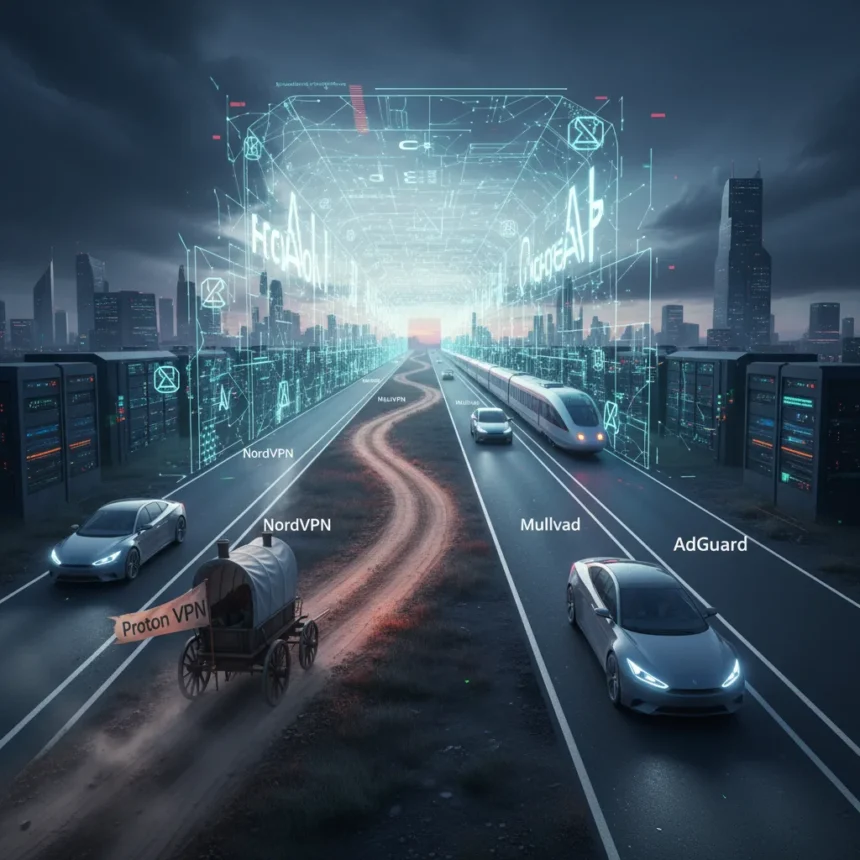
Post-quantum VPN security is no longer a future concern—it is a competitive battleground, and Proton VPN is playing catch-up. While Proton promises post-quantum groundwork as part of its Spring/Summer 2026 roadmap, competitors have already moved encryption forward, leaving users wondering why Proton is not further along.
Key Takeaways
- Proton VPN’s post-quantum roadmap targets Spring/Summer 2026, including WireGuard codebase upgrades and Stealth for Linux.
- NordVPN deployed quantum-resistant NordLynx across all platforms by 2025, optional but widely available.
- Mullvad enabled ML-KEM quantum resistance by default on Windows WireGuard, setting a higher standard.
- AdGuard VPN offers hybrid post-quantum encryption (X25519 + ML-KEM768) as an optional feature across clients.
- Windscribe upgraded to kernel-space WireGuard, improving speed and stability beyond user-space alternatives.
The Competitive Landscape of Post-Quantum VPN Security
Post-quantum VPN security refers to encryption protocols designed to resist attacks from future quantum computers, which could theoretically break current RSA and elliptic curve cryptography. The VPN industry has already begun implementing quantum-resistant algorithms, but adoption varies widely across providers.
NordVPN rolled out quantum-resistant algorithms for its NordLynx protocol on Linux in 2024, then expanded the feature to Windows, iOS, Android, and macOS throughout 2025. While optional due to incompatibility with features like MeshNet, the rollout demonstrates that large VPN providers can move quickly when security demands it. Mullvad went further, enabling ML-KEM (a NIST-proposed standard) by default on Windows WireGuard clients, making quantum resistance the standard rather than an opt-in feature. AdGuard VPN offers a hybrid approach, combining X25519 with ML-KEM768 across all clients, though users must enable it manually due to performance trade-offs.
Proton’s announcement of post-quantum groundwork for 2026 arrives as the industry has already shifted into implementation mode. NymVPN plans full-stack quantum-resistant key exchange rollout in 2025, while Windscribe has tackled a different but related problem: infrastructure stability. By moving from user-space Boringtun to kernel-space WireGuard via its FreshScribe infrastructure, Windscribe eliminated jitter and boosted speeds and stability after phased deployment. This architectural improvement addresses real user pain points that Proton may still be grappling with.


Why Proton’s Roadmap Feels Slow
Proton VPN’s roadmap includes three major components: a WireGuard codebase upgrade, Stealth protocol support for Linux, and new app releases focused on stability and business tools. On paper, these are sensible priorities. In practice, they arrive after competitors have already solved similar problems.
The WireGuard upgrade is necessary—Windscribe’s transition from user-space to kernel-space implementation shows that architectural choices directly affect user experience. But Proton is framing this as future work while Windscribe has already completed the transition and reaped the benefits. The Stealth protocol for Linux is a genuine gap-filler; Stealth helps mask VPN usage in restrictive networks, and Linux support has lagged behind other platforms. Yet this is a feature expansion, not a security overhaul.



The real issue is timing. Proton’s post-quantum groundwork is still in the planning phase for 2026, while NordVPN and Mullvad are already shipping quantum-resistant options. Even if Proton’s eventual implementation is technically superior, the perception of being behind matters in a market where security is the primary selling point.
What Post-Quantum Readiness Actually Means
Post-quantum VPN security is not a single feature—it is a spectrum of preparedness. Some providers, like Mullvad, have already chosen a quantum-resistant algorithm (ML-KEM) and enabled it by default, betting that the performance cost is worth the security gain. Others, like NordVPN and AdGuard, offer quantum resistance as optional, acknowledging that not all users prioritize it equally or accept the battery and speed trade-offs.
Proton’s approach—promising groundwork without announcing a specific algorithm or timeline—suggests the company is still in the research phase. This is not inherently wrong. Choosing the wrong algorithm or implementing it poorly would be worse than moving slowly. But in a market where NordVPN, Mullvad, and AdGuard have already made their bets, Proton’s caution reads as hesitation.
The business tools and stability improvements in Proton’s roadmap matter, especially for enterprise users. But they do not address the core concern: Proton is not leading on post-quantum security. It is following, and following slowly.



Does Proton VPN’s roadmap address quantum computing threats?
Proton’s post-quantum groundwork is a start, but it remains vague. The company has not announced which quantum-resistant algorithm it will use, whether adoption will be optional or default, or how it will handle compatibility with existing Proton features. NordVPN and Mullvad have already answered these questions for their users.
Why do VPN providers make quantum resistance optional?
Quantum-resistant algorithms like ML-KEM carry a performance cost—slower speeds, higher battery drain, and potential incompatibility with other features. NordVPN disabled quantum resistance for MeshNet, while AdGuard notes speed and battery impacts. Providers must balance security with user experience, and not all users accept the trade-off equally.
When will Proton VPN release its post-quantum update?
Proton has targeted Spring/Summer 2026 for its roadmap, which includes post-quantum groundwork, WireGuard upgrades, and Linux Stealth support. No exact release date has been confirmed, and Proton has not specified whether all features will ship simultaneously or roll out in phases.
Proton VPN’s 2026 roadmap is ambitious, but it arrives in a market where the competition has already moved. NordVPN, Mullvad, and AdGuard have deployed post-quantum encryption; Windscribe has solved infrastructure problems Proton may still face. Proton can still build a compelling offering, but it needs to move faster and communicate more clearly about its quantum-resistant strategy. Security is not a feature that users forgive you for being late on.
Edited by the All Things Geek team.
Source: TechRadar