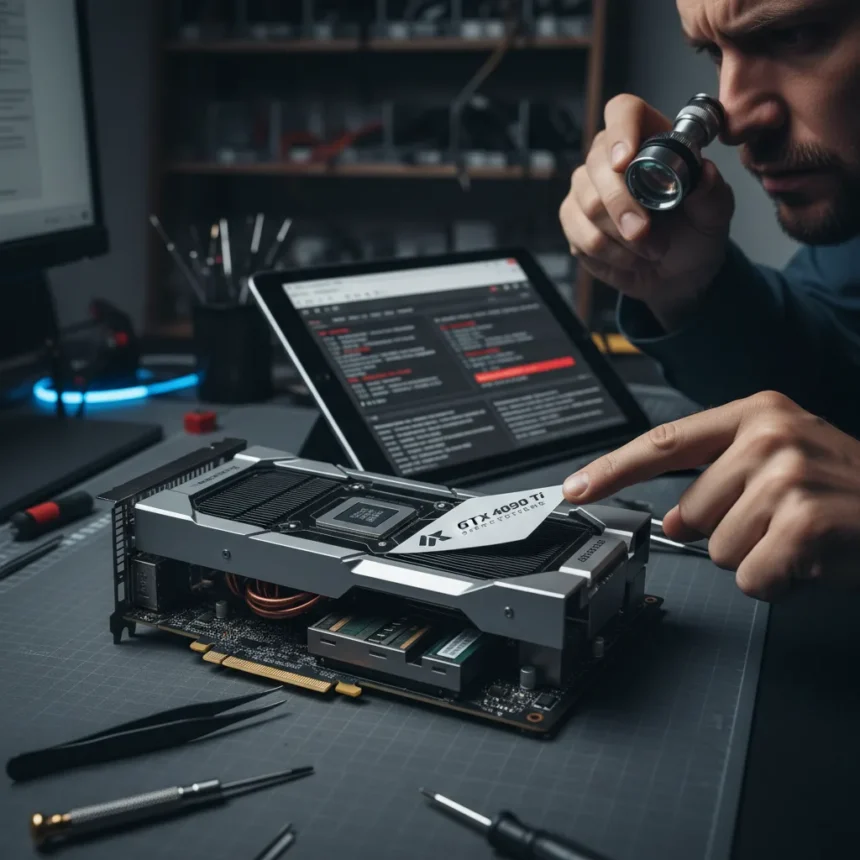
Counterfeit GPU scams have reached a level of sophistication that catches even seasoned repair professionals off guard. A repair expert examining what appeared to be a legitimate Nvidia RTX 4090 initially could not identify it as fake, calling it “the best scam I’ve ever seen” due to how convincingly the external components matched the original. This moment encapsulates a broader crisis in the GPU market, where buyers—especially those hunting for hard-to-find high-end cards—face an expanding ecosystem of fraud that blurs the line between genuine hardware and expertly crafted counterfeits.
Key Takeaways
- A repair expert was initially fooled by a fake RTX 4090, describing it as “the best scam I’ve ever seen.”
- Counterfeit GPU scams typically involve modded lower-end cards like RTX 3090 or RTX 3080 relabeled as RTX 4090 or RTX 5090.
- A Chinese hardware YouTuber received four cards for repair; three were unsalvageable modded fakes.
- Post-RTX 5090 launch scams expanded to include receiving bags of rice, pasta, or printed photos instead of actual GPUs.
- Second-hand market losses have reached $1,900 in documented cases, with eBay listings showing RTX 5090 photos sold at $2,000+ MSRP.
How Fake GPUs Fool Even the Experts
The sophistication of modern counterfeit GPU scams lies in their attention to external detail. Scammers are no longer simply slapping fake labels on random hardware; they are performing surgical modifications on legitimate but lower-tier cards, then disguising them to appear as premium models. What makes this particularly dangerous is that initial visual inspection—the first line of defense for repair shops and resellers—often passes. The fake RTX 4090 that fooled the repair expert had external components so convincingly replicated that it required deeper technical examination to expose the swap. Once opened, the card’s internals revealed it was actually a modded RTX 3090 or RTX 3080, architecturally inferior and incapable of delivering the performance promised to the buyer.
This technique exploits a critical gap in the second-hand GPU market. Buyers purchasing expensive cards outside official retail channels often cannot perform comprehensive testing before payment. Even professional repair technicians, whose job is to diagnose hardware, initially trust their visual assessment. The counterfeit GPU scams operate on this assumption of trust, knowing that by the time a buyer discovers the fraud—if they discover it at all—the transaction is already complete and the scammer is gone.
The Expanding Scope of GPU Fraud Beyond Modded Cards
While modded cards represent the most sophisticated counterfeit GPU scams, the broader landscape of GPU fraud has diversified into absurdity. A Chinese hardware repair YouTuber documented receiving four cards supposedly needing repair; three of the four turned out to be modded fakes that were unsalvageable. But the scams have grown far beyond simple card swaps. Post-RTX 5090 launch, reports emerged of buyers receiving bags of rice, pasta, backpacks, and even printed photographs instead of actual GPUs. These crude scams coexist with the sophisticated modded-card fraud, suggesting that scammers operate across a spectrum of effort and deception.


The RTX 5090 launch created a perfect storm for fraud. With demand far exceeding supply and official MSRP prices starting at $2,000, eBay listings appeared showing RTX 5090 photographs sold at premium prices, targeting desperate buyers willing to skip verification. One documented second-hand market loss reached $1,900, a sum that reflects both the high value of these cards and the willingness of buyers to take risks in pursuit of hard-to-find hardware.
Counterfeit GPU Scams and Related Hardware Fraud
The sophistication of counterfeit GPU scams mirrors broader trends in hardware counterfeiting. A related scam involved a phony “1080 Pro SSD” marketed with claimed read speeds of 15.8GB/s, while actual performance testing revealed only 1.18GB/s—a massive discrepancy that exposed the fake’s true PCIe 3.0 limitations. Like the modded GPU fraud, this SSD scam relied on convincing packaging and specifications that sounded legitimate to casual buyers. The parallel between GPU and storage counterfeits suggests that scammers are applying similar playbooks across different hardware categories, using external authenticity as a Trojan horse for inferior internals.



What distinguishes counterfeit GPU scams from other hardware fraud is the sheer value at stake. A single RTX 4090 or RTX 5090 represents a $1,600 to $2,000+ investment for most buyers. Storage devices, while subject to fraud, typically involve lower absolute losses. The GPU market’s scarcity and high demand create economic incentives that make sophisticated counterfeiting worthwhile for criminal operations.
How to Protect Yourself from Counterfeit GPU Scams
If you are hunting for a second-hand GPU, counterfeit GPU scams demand that you move beyond visual inspection alone. Request detailed performance benchmarks or video demonstrations from the seller before committing funds. If buying from a platform like eBay, use escrow services and never pay via methods that offer no buyer protection. Purchase from established retailers with return policies rather than private sellers when possible, even if it costs more. For high-value cards, consider having a professional technician inspect the hardware before finalizing the transaction—though as the repair expert’s experience shows, even professionals can be initially fooled, so demand stress-testing and performance verification under load.
Avoid listings that seem too good to be true. If an RTX 4090 is priced significantly below market rate, ask why. Scammers price fakes competitively to seem attractive without raising red flags. Similarly, be wary of sellers who refuse to provide detailed photos, benchmark results, or who pressure you to complete the transaction quickly. These are classic pressure tactics used in counterfeit GPU scams to prevent careful inspection.
Why This Matters Right Now
The timing of these counterfeit GPU scams is critical. New GPU launches create artificial scarcity, driving prices up and desperation higher. Buyers who cannot secure cards through official channels turn to second-hand markets, where verification is weak and scammers thrive. The sophistication of modern fakes—reaching a level where repair experts are initially fooled—suggests that the problem is accelerating, not slowing. As long as demand for high-end GPUs outpaces supply, the economic incentive for counterfeit GPU scams will remain strong.



Can you tell a fake RTX 4090 apart from a real one visually?
No. The fake RTX 4090 that fooled the repair expert demonstrates that external appearance alone is insufficient to detect counterfeits. The scam’s sophistication lies in replicating external components convincingly. Only internal inspection and performance testing under load can reliably expose a modded card.
What should I do if I suspect I’ve purchased a counterfeit GPU?
Document everything: take photos, run performance benchmarks, and contact the seller immediately with evidence. If you purchased through eBay or a similar platform with buyer protection, open a case with detailed documentation. If you bought from a private seller, you may have limited recourse, which is why purchasing through official retailers or established resellers is safer despite higher prices.
Are counterfeit GPU scams limited to RTX 4090 and RTX 5090 models?
The documented cases focus on high-end models like the RTX 4090 and RTX 5090 because they command the highest prices. However, counterfeit GPU scams likely target any card in high demand and with significant price premiums in the second-hand market. Lower-end cards are less attractive targets because the profit margin is smaller.
The rise of counterfeit GPU scams that fool repair experts signals a maturation of hardware fraud that should alarm anyone shopping for GPUs outside official channels. The market has reached a point where visual inspection is worthless and trust is weaponized. Until supply stabilizes and prices normalize, buyers must assume that any second-hand GPU is potentially counterfeit until proven otherwise. The repair expert who was initially fooled by the fake RTX 4090 learned this lesson the hard way—do not let it be your lesson too.
Edited by the All Things Geek team.
Source: TechRadar