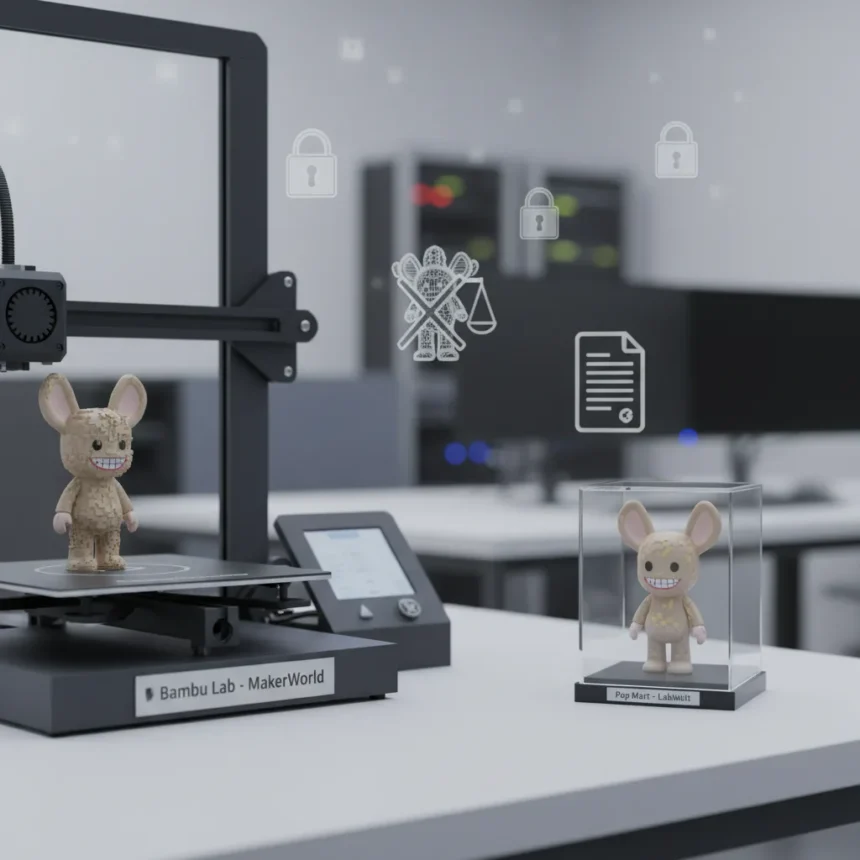
The Bambu Lab IP settlement with Pop Mart marks a turning point for user-generated 3D printing platforms. In mid-March 2026, Bambu Lab and the Chinese toy giant resolved a copyright dispute over unauthorized Labubu fan art models hosted on MakerWorld, the company’s online design repository. The settlement came just weeks before a Shanghai court hearing, forcing the Shenzhen-based 3D printer maker to issue a public apology and purge all contested content from its platform.
Key Takeaways
- Bambu Lab settled a Pop Mart lawsuit over Labubu models on MakerWorld in mid-March 2026, avoiding trial.
- All disputed Pop Mart IP models, including Labubu and Twinkle Twinkle designs, were fully removed from the platform.
- Pop Mart sent warning letters in May and October 2025; the subsidiary filed suit in late February 2026.
- The settlement signals rising IP enforcement pressure on user-generated content platforms in 3D printing.
- Model files continue circulating in enthusiast communities despite platform removal.
How the Bambu Lab IP settlement unfolded
Pop Mart, the Hong Kong-listed designer toy company behind the wildly popular Labubi character, first flagged the problem in May 2025 with a warning letter to Bambu Lab. A second cease-and-desist arrived in October. When Bambu Lab did not act decisively, Pop Mart’s subsidiary filed a lawsuit in late February 2026 through the People’s Court of Shanghai Pudong New Area, with a hearing scheduled for April 2, 2026. The case reopened on March 20, 2026, but negotiations moved faster than litigation. By mid-March, both sides had reached what sources described as a lightning settlement, avoiding a full trial.
Bambu Lab’s founder Tao Ye and Pop Mart founder Wang Ning entered talks to resolve the dispute and explore potential cooperation. The company issued an official apology on Weibo, acknowledging that the issue had caused inconvenience to both Pop Mart and its own users. The settlement terms remain undisclosed—no financial figures or future partnership details have been made public.
What got removed from MakerWorld
MakerWorld hosts over one million user-uploaded 3D models and has become a central hub for the global 3D printing community. Users could download Labubu-inspired files for free and print them at home or for profit, effectively creating counterfeit versions of Pop Mart’s official products. Following the settlement, Bambu Lab completely removed all disputed content. Searches for Labubu on MakerWorld now return zero results.


The removal was thorough but not total. Model files continue circulating in enthusiast communities and private repositories outside MakerWorld, a reality that highlights the limits of platform takedowns in the decentralized 3D printing ecosystem. Once a file is downloaded and shared peer-to-peer, controlling its spread becomes nearly impossible.
Why this settlement matters for 3D printing
The Bambu Lab IP settlement represents a watershed moment for consumer 3D printing. User-generated content platforms have long operated in a gray zone, claiming safe harbor under the Digital Millennium Copyright Act or equivalent international laws. But as 3D printing becomes more accessible—and as designer toy brands like Pop Mart command massive valuations—IP holders are no longer willing to tolerate unauthorized digital reproductions.



This is not Bambu Lab’s first brush with IP enforcement. The settlement signals what industry observers call a countdown to the end of free 3D printing of well-known brand intellectual properties. Other platforms will likely face similar pressure. Companies building user-generated content ecosystems now face a choice: invest in automated content moderation to catch infringing uploads, or risk costly litigation and reputational damage.
Pop Mart’s stock dropped 2.607 percent (3.900 HKD) on March 13, 2026, amid the news, with high short-selling activity recorded on the same day. The market’s reaction suggests investors view the settlement as a win for IP protection but remain cautious about the company’s growth trajectory.
What does this mean for creators and users?
For everyday 3D printing enthusiasts, the settlement creates uncertainty. Users who downloaded Labubu models before the removal now possess files that infringe on Pop Mart’s rights, though enforcement against individual home printers is unlikely. Creators who uploaded fan art models face a harder question: what else on their profile might trigger a takedown notice?
Bambu Lab’s apology acknowledged the inconvenience to users, but the company did not announce new content review policies or creator protections. This leaves the platform’s moderation approach unclear. Will MakerWorld implement AI-powered screening to flag designs that resemble trademarked characters? Will it require creators to certify original work? These details have not been disclosed.



Is the Bambu Lab IP settlement final?
Yes, the dispute has been resolved. Bambu Lab confirmed that all related content has been fully removed and that the two sides have reached a settlement. No appeal or further litigation is expected.
Can I still find Labubu 3D models online?
Models are no longer available on MakerWorld, but copies circulate in private communities and file-sharing networks outside the official platform. Downloading and printing these files for personal use exists in a legal gray area depending on your jurisdiction, though commercial reproduction would clearly infringe Pop Mart’s rights.
Will other brands pursue similar action against 3D printing platforms?
The settlement sets a precedent that brand owners can force takedowns of infringing user-generated content. Other major toy, gaming, and collectible brands will likely monitor MakerWorld and similar platforms more closely, increasing pressure on Bambu Lab and competitors to police their communities more aggressively.
The Bambu Lab IP settlement is a watershed for 3D printing. It proves that even the most permissive user-generated platforms cannot ignore intellectual property claims from major brands. For Bambu Lab, the cost of inaction was higher than the cost of a settlement. For the broader ecosystem, the message is clear: the era of freely printing designer brand replicas is ending.
Edited by the All Things Geek team.
Source: Tom's Hardware