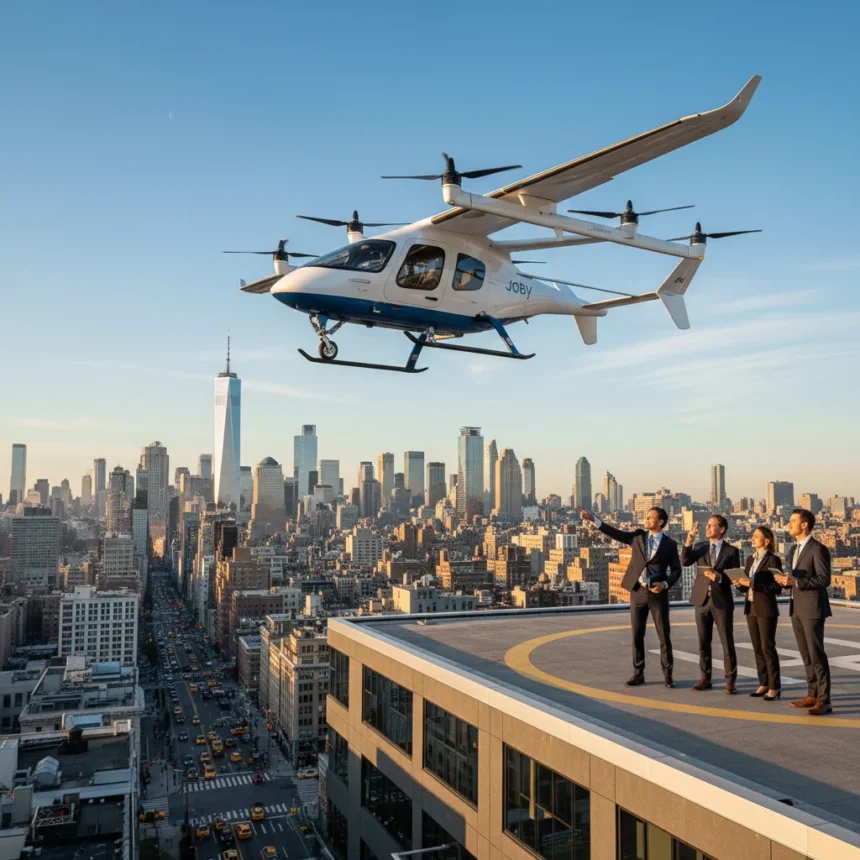
The electric air taxi just became real. Joby Aviation completed the first point-to-point electric air taxi flight in New York City history, a milestone that transforms urban air mobility from speculative future to operational present. The flight, observed firsthand by a reporter, marks the moment when the “Uber of the skies” stopped being a venture capitalist’s pitch and started being something you could actually watch take off from a Manhattan rooftop.
Key Takeaways
- Joby completed NYC’s first point-to-point electric air taxi flight, setting a precedent for commercial urban operations.
- The FAA finalized “powered lift” regulations, the first new civil aircraft category since helicopters in the 1940s.
- The air taxi market is projected to grow from $4.9 billion to $80.3 billion by 2028, with 1,044 vertiports planned.
- Toyota invested $500 million in Joby to accelerate FAA certification and mass production of eVTOL aircraft.
- NYC Council has opposed on-demand air taxi plans, creating regulatory friction despite federal progress.
Why This Flight Matters More Than You Think
For years, electric air taxis existed in renderings and investor decks. Now they exist in the sky above New York City. Joby’s flight is not a prototype demonstration or a closed-course test—it is a genuine point-to-point operation in America’s most congested urban airspace, proof that the regulatory machinery finally works. The FAA’s finalization of “powered lift” regulations removes the last major bureaucratic barrier to commercial air taxi services, establishing the first new civil aircraft category since helicopters emerged in the 1940s.
This regulatory clarity matters because it unlocks capital. Toyota’s $500 million investment in Joby is not charity; it is a bet that the company can move from demonstration flights to mass production before competitors do. The money flows because the path forward is now legally defined. Without that FAA framework, Joby would remain perpetually stuck in the “coming soon” phase that has haunted autonomous vehicles and flying cars for two decades.
The Market Opportunity Is Staggering
Industry analysts project the air taxi market will explode from $4.9 billion last year to $80.3 billion by 2028, with 1,044 vertiports planned for development in that timeframe. Those numbers sound like hype until you consider what they actually represent: a wholesale shift in how people move through cities. If even half those vertiports materialize, electric air taxis will be as common as Uber pickups in major metropolitan areas within five years.

The competitive landscape is heating up. Hyundai’s Supernal SA-2 is designed to cruise at up to 120 mph at 1,500 feet altitude, positioning itself as a premium ride-hailing service competing directly with high-end Uber tiers. Sikorsky, owned by Lockheed Martin, has demonstrated autonomous Black Hawk variants for logistics and rescue missions, though their focus remains on cargo and specialized operations rather than passenger mobility. Joby’s advantage is singular: they got to New York first, and they have the capital to scale.
What Could Still Go Wrong
The path from one historic flight to a functioning urban air mobility network is not guaranteed. New York City Council has opposed or blocked on-demand air taxi plans, creating political friction that could slow or derail operations even as federal regulations clear the way. Local governments control airspace access and landing rights—and not every city council will welcome the noise, safety concerns, and visual disruption that hundreds of daily air taxi flights would bring.



Noise is the silent killer of this entire sector. Joby’s aircraft are electric, which solves emissions, but they still produce rotor noise. Dense urban neighborhoods may accept occasional flights; they will not accept a new layer of constant aerial traffic. The regulatory framework is now in place, but the social license to operate—the actual acceptance of New Yorkers and residents of other cities—remains contested.
Pricing and accessibility are also open questions. The brief does not disclose what Joby intends to charge per flight, but early air taxi services typically price in the $100–$300 range for short urban hops. That is premium transportation, not mass transit. The “Uber of the skies” rhetoric suggests democratized access, but the economics may deliver something closer to helicopter tours for the wealthy.
Is This the Turning Point?
Yes, but with caveats. Joby’s NYC flight represents a genuine inflection point—the moment when regulatory approval, capital investment, and working hardware align. The electric air taxi is no longer theoretical. It is no longer even rare. It is operational in the world’s most scrutinized airspace, under the world’s most stringent aviation authority.
That said, the distance from one flight to a functional transportation network is vast. Regulatory approval is necessary but not sufficient. Local opposition, noise constraints, and the sheer cost of building 1,044 vertiports will slow the rollout considerably. The market may reach $80.3 billion by 2028, but it could just as easily stall if cities refuse to accommodate air taxi infrastructure or if accidents trigger a public backlash.



What is certain is that the waiting is over. The electric air taxi is not coming. It is here.
When will electric air taxis be available to the public?
The research brief does not specify a public launch date for Joby’s service. The company has received FAA approval and completed demonstration flights in New York, but commercial service timelines depend on vertiport construction, local regulatory approval, and aircraft certification. Expect pilot programs in select cities within the next 1–2 years, but widespread availability remains years away.
How much will an electric air taxi ride cost?
Pricing information is not disclosed in the available sources. Early air taxi operators typically charge premium rates for short urban flights, but Joby’s actual pricing strategy has not been publicly announced. Expect costs to decline as the market scales and competition increases.
How does Joby’s electric air taxi compare to Hyundai’s Supernal SA-2?
Both aircraft target urban air mobility, but Hyundai’s Supernal SA-2 operates at up to 120 mph at 1,500 feet altitude and positions itself as a premium ride-hailing service. Joby has the advantage of demonstrated operations in New York and Toyota’s backing, while Supernal brings Hyundai’s automotive manufacturing expertise to the sector. Both are competing for the same market, but Joby has moved faster to operational deployment.
The electric air taxi has transitioned from fantasy to fact. Joby’s New York flight proved the hardware works. The FAA proved the regulations work. Now comes the harder part: proving that cities will embrace them, that people will use them, and that the economics actually pencil out. The sky is no longer the limit—it is the next frontier for urban transportation.
Edited by the All Things Geek team.
Source: TechRadar