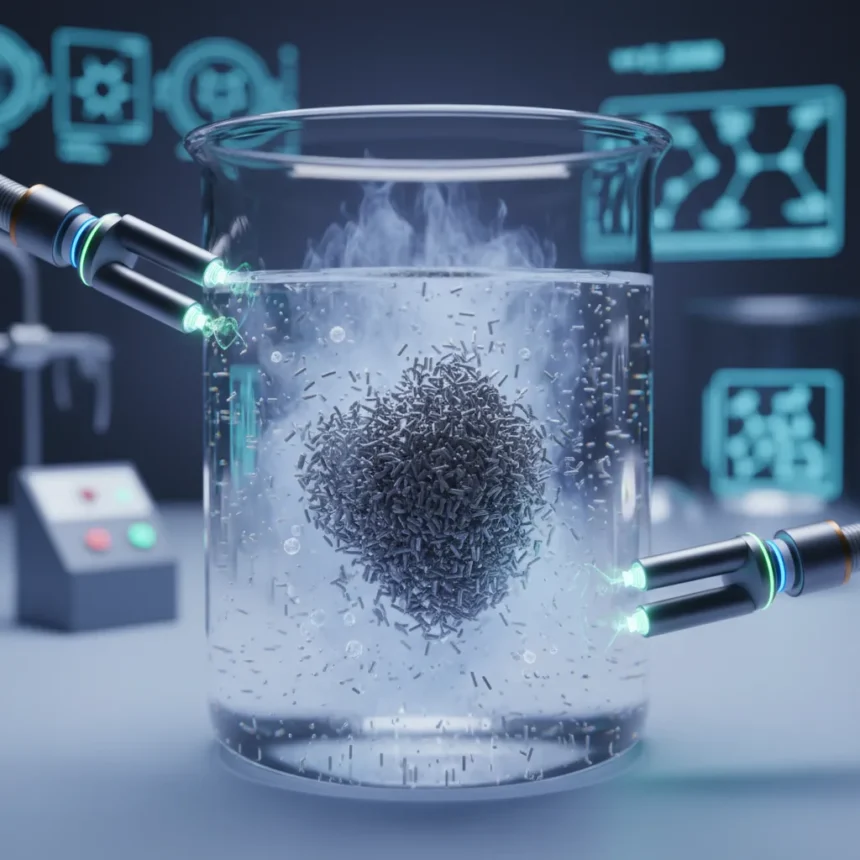
Magnetic microrobots nanoplastics research has reached a critical milestone: scientists have demonstrated that tiny swarming robots can actively hunt down and capture both microplastics and bacteria in contaminated water simultaneously. The breakthrough, published in ACS Nano in May 2024 and led by Martin Pumera and colleagues, shows what lab-controlled conditions can achieve—but the gap between the petri dish and your kitchen tap remains vast.
Key Takeaways
- Magnetic microrobots are 2.8 micrometers in diameter, made from polymer strands linked to magnetic microparticles.
- In lab tests, the robots captured approximately 80% of bacteria and significant amounts of microplastics within 30 minutes.
- Robots self-assemble into swarming planes using rotating magnetic fields, moving collectively like schools of fish.
- Captured contaminants are extracted with magnets, ultrasound detaches bacteria, and UV disinfection makes robots reusable—though efficiency drops on second use.
- Major obstacles remain: scalability, real-world efficiency, and the challenge of deploying invisible robots in actual water systems [summary].
How magnetic microrobots nanoplastics capture works
The process is deceptively simple in theory but mechanically intricate in execution. Positively charged polymer strands are linked to magnetic microparticles, creating spherical robots roughly 2.8 micrometers in diameter—smaller than a red blood cell. When exposed to a rotating magnetic field, these individual robots do not act alone. Instead, they self-assemble into flat, coordinated swarming planes that move collectively through water like schools of fish responding to a single impulse. This collective behavior is the system’s engineering advantage: a swarm covers more ground and captures more contaminants than isolated particles ever could.
In controlled lab conditions using simulated contaminated water, researchers introduced fluorescent polystyrene beads (representing microplastics) and Pseudomonas aeruginosa bacteria. Over 30 minutes, the swarming microrobots achieved approximately 80% bacterial capture and removed a significant amount of microplastics from the solution. The efficiency is striking—but only in a tank. The robots then face a critical separation challenge: they must be collected from the water using a permanent magnet, a process that works in the lab but becomes exponentially harder at scale in real water systems with competing magnetic fields, turbulence, and variable contamination levels.
The reusability problem and efficiency degradation
Reusability is theoretically elegant but practically flawed. After collection via magnet, captured bacteria are detached from the robots using ultrasound, and the robots themselves are disinfected with UV radiation. This allows the same robots to be deployed again—a sustainability advantage over single-use filters. However, the research reveals a critical weakness: on second use, the microrobots capture smaller amounts of contaminants than on their first deployment. Efficiency degrades with each cycle. For a technology aimed at solving drinking water contamination at scale, declining performance per cycle is a fundamental obstacle. The brief does not specify by how much efficiency drops, but any decline signals that these robots cannot simply be cycled indefinitely without replacement or regeneration—a cost and complexity burden that existing water filtration methods do not face.

Why magnetic microrobots nanoplastics matter now
Nanoplastics are invisible. Unlike larger microplastics visible to the naked eye, nanoplastics permeate drinking water supplies globally, and their health effects remain poorly understood but increasingly concerning. Traditional water filtration systems—sand filters, activated carbon, reverse osmosis—were designed to capture particles measured in microns or larger. Nanoplastics slip through. The Pumera team’s approach targets a genuine gap in existing water treatment infrastructure. By combining magnetic targeting with simultaneous bacterial capture, the research addresses two contamination problems at once, which is why the work generated significant attention despite being confined to laboratory conditions.
The comparison to existing solutions reveals why this research matters. Cornell University students developed an autonomous solar-powered robot for beach microplastics, focusing on larger particles (sesame seed size or smaller) using layered filtration on sand and in water. That system operates at the macro and micro scale. The magnetic microrobots target the nano scale—the invisible particles that existing robots and filters cannot reliably address. No other published approach has demonstrated simultaneous swarming, magnetic control, and nanoplastic capture in a single system.



The scalability wall
Here is where optimism collides with reality. The research is lab-stage only, published as a proof-of-concept in May 2024 with no commercial timeline or pathway to market. Scaling from a controlled tank to municipal water systems introduces variables the petri dish does not: competing magnetic fields from infrastructure, turbulent flow rates that disrupt swarming behavior, real-world contaminant mixtures far more complex than fluorescent polystyrene beads, and the need to separate and regenerate millions of microrobots continuously. The permanent magnet collection method that works elegantly in a lab becomes a nightmare at scale. How do you efficiently extract trillions of 2.8-micrometer robots from a flowing water treatment plant without losing them downstream or contaminating treated water with magnetic residue?
The research brief acknowledges major challenges in efficiency and scalability, which is journalistic honesty the paper itself likely hedges more carefully [summary]. Until those challenges are solved—and they are substantial—magnetic microrobots remain a laboratory curiosity, not a solution for your tap water.
What happens to the robots after capture?
Once collected with a permanent magnet, the microrobots undergo a multi-step disinfection process. Ultrasound detaches captured bacteria from the robot surface, and UV radiation disinfects the robots themselves, preparing them for reuse. This closed-loop approach theoretically eliminates biohazard disposal and reduces the volume of contaminated waste. In practice, the degrading efficiency on reuse means robots cannot cycle indefinitely—they will eventually require replacement or intensive regeneration, introducing costs and complexity that undermine the sustainability argument.
Could magnetic microrobots nanoplastics systems reach homes?
Not in the near term. The research is published, peer-reviewed, and scientifically sound—but it is not a product. There is no prototype, no commercial timeline, no partnership with water utilities, and no path from lab to scale. The efficiency decline on reuse, the scalability challenges, and the engineering hurdles of deploying invisible robots in real water systems remain unsolved. If this technology reaches municipal water treatment in the next decade, it will be after years of additional research, pilot testing, and engineering breakthroughs that the current paper does not address.



Is this the first attempt at robot-based water purification?
No. Cornell University students designed an autonomous solar-powered robot to collect microplastics from beaches, targeting sesame seed-size or smaller particles using layered filtration. That system focuses on macro and micro scale removal from sand and water environments. The magnetic microrobots differ fundamentally in scale (targeting nanoplastics), mechanism (swarming magnetic fields versus mechanical filtration), and application (water treatment versus beach cleanup). Neither system is commercially available, but they represent different approaches to the same contamination problem.
How long before magnetic microrobots could treat drinking water at scale?
The honest answer is: nobody knows. The research is six months old as of publication and remains in the laboratory. Major obstacles—efficiency degradation, scalability engineering, and real-world deployment—are acknowledged but unsolved. Optimistic timelines from academic labs often prove wildly optimistic once commercialization begins. A realistic estimate would be five to ten years of additional research before a pilot system reaches a municipal water treatment facility, and another five to ten years of refinement before widespread adoption becomes feasible. That is assuming the efficiency and scalability problems are solved, which is not guaranteed.
The magnetic microrobots nanoplastics research is genuine progress on a real problem. Invisible plastic particles in drinking water are a significant threat, and existing filtration methods cannot reliably remove them. The Pumera team’s swarming approach is clever and shows promise in controlled conditions. But promise in the lab is not the same as viability in the real world. Until the efficiency degradation is solved, the scalability challenges are engineered away, and a commercial pathway emerges, these microrobots remain a fascinating laboratory demonstration—not a solution for contaminated water supplies.
Edited by the All Things Geek team.
Source: TechRadar