






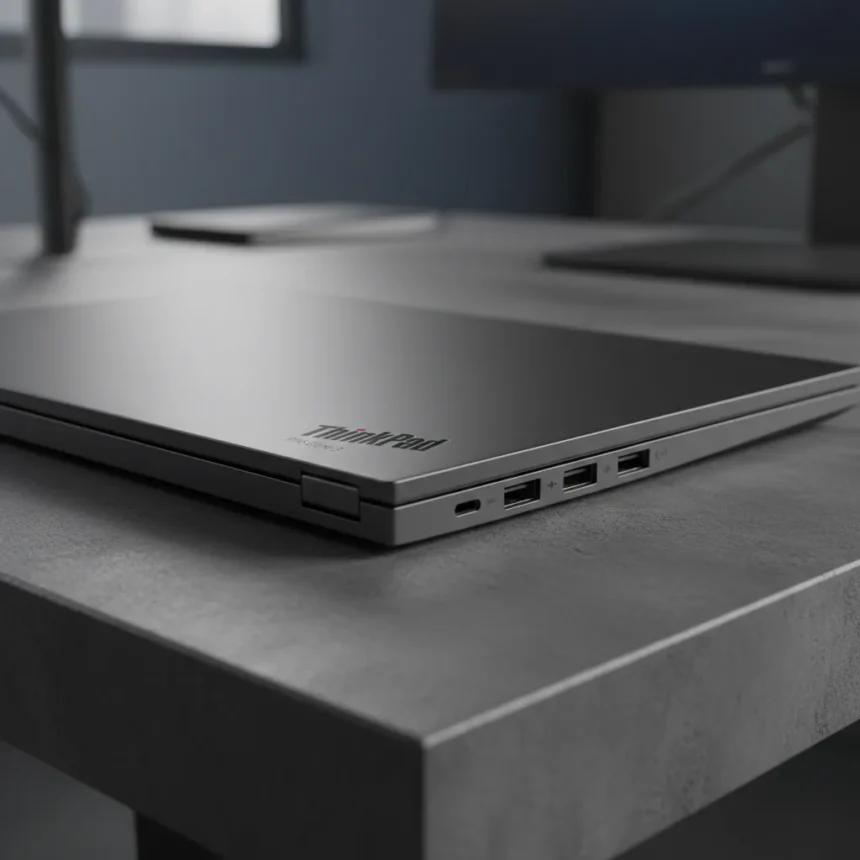
The Lenovo P16 Gen 3 magnesium frame marks the end of a 20-year design tradition. For two decades, Lenovo built ThinkPad workstations around a separate magnesium alloy subframe that provided structural rigidity without adding weight. The P16 Gen 3 (machine types 21RQ, 21RR) abandons this approach entirely, integrating magnesium directly into the outer shell instead. The shift prioritizes thinness and portability over the modular durability that defined the ThinkPad brand.
Key Takeaways
- Lenovo P16 Gen 3 removes the separate magnesium subframe used since ThinkPad T60 in 2006
- Magnesium material now embedded in outer shell design for lighter, thinner chassis
- 20-year design feature ends to meet modern portable workstation demands
- Earlier models like T540p and W540 featured removable magnesium frames as field replaceable units
- Disassembly guides for P16 Gen 3 show no separate frame component
Why Lenovo ditched the Lenovo P16 Gen 3 magnesium frame
Thinness wins over modularity in 2025. Lenovo’s separate magnesium subframe was introduced in the ThinkPad T60 back in 2006 to provide rigid structure in portable workstations. For two decades, this design remained virtually unchanged—a testament to its engineering. But modern workstation buyers demand machines that travel without compromise. Integrating magnesium into the outer shell eliminates the internal frame’s bulk, allowing Lenovo to reduce overall thickness while maintaining structural integrity. The tradeoff is clear: you gain portability and lose the modularity that made earlier ThinkPads easier to repair.
The Lenovo P16 Gen 3 magnesium frame decision reflects a broader industry shift away from field-replaceable components toward integrated designs. Historical models like the ThinkPad T540p and W540 featured magnesium structure frames as removable field replaceable units (FRUs). Technicians could swap them out independently. The P16 Gen 3 disassembly guides mention battery frames and thermal assemblies, but conspicuously omit any reference to a separate magnesium frame. This is not accidental—it signals a permanent architectural change.
How the Lenovo P16 Gen 3 magnesium frame change affects repairability
Repairability takes a hit, but not catastrophically. With magnesium integrated into the shell, users cannot replace the frame independently if damage occurs. Earlier ThinkPad workstations offered this flexibility; damage to the magnesium structure meant a simple FRU swap. The P16 Gen 3 requires shell replacement if the integrated magnesium cracks or bends, a more invasive repair that demands complete disassembly. For users who keep laptops for five years or longer, this matters. For those on two-to-three-year upgrade cycles, the practical impact is minimal.


Lenovo offset this by simplifying internal access elsewhere. The P16 Gen 3 disassembly process shows straightforward SSD and battery access without navigating around a separate internal frame. The keyboard removal and top-edge access are direct. Technicians no longer need to remove a magnesium subframe to reach core components. It is a different approach to serviceability—less modular, more streamlined—but not necessarily worse for everyday maintenance tasks.
Lenovo P16 Gen 3 magnesium frame and the broader workstation market
Lenovo’s move reflects workstation market priorities shifting toward weight and thickness over internal modularity. Professional users care about portability; a lighter machine means fewer aches on travel days. Competitors in the mobile workstation space have already moved toward integrated chassis designs. Lenovo’s 20-year commitment to separate magnesium frames was unusual—most manufacturers abandoned modular internal structures years ago. The Lenovo P16 Gen 3 magnesium frame decision finally aligns the company with market expectations, even if it disappoints long-time ThinkPad loyalists who valued the engineering elegance of a replaceable subframe.



Is the Lenovo P16 Gen 3 magnesium frame change a deal-breaker?
Only if you repair your own equipment or expect to keep the machine for a decade-plus. For most professionals, the Lenovo P16 Gen 3 magnesium frame removal is a minor trade-off for a thinner, lighter workstation. The integrated magnesium shell still provides the rigidity and durability that ThinkPad users expect. It just cannot be swapped out as a single component anymore. If you drop the machine hard enough to damage the chassis, you are looking at a more expensive repair than you would have faced in 2015. But that scenario is rare.
What happened to the magnesium frame in other ThinkPad models?
Related ThinkPad models like the P16s Gen 3 (21KS, 21KT) and T16 Gen 3 (21V5, 21V6) also omit the separate magnesium frame in their disassembly documentation. This is not a P16-specific decision—it is a platform-wide shift. Lenovo is retiring the separate magnesium subframe across its workstation and mainstream ThinkPad lines. The company has decided that integrated shell construction better serves modern portable computing than the modular approach that defined ThinkPads from 2006 to 2025.
FAQ
Did Lenovo remove the magnesium frame to cut costs?
Possibly, but the primary driver is design simplification and weight reduction. Integrating magnesium into the shell eliminates redundant internal structure, allowing Lenovo to shave thickness and grams. Cost savings are a secondary benefit, not the main motivation. The P16 Gen 3 is still a premium workstation, not a budget machine.
Can you replace the magnesium shell if it cracks?
Not as a simple FRU swap like in older ThinkPads. Damage to the integrated magnesium shell requires full chassis replacement, which demands complete disassembly and is a service-center repair, not a field replacement.



Are other manufacturers still using separate magnesium frames?
Most premium laptop makers abandoned modular internal frames years ago. Lenovo’s 20-year commitment to the separate magnesium subframe was the exception, not the norm. The Lenovo P16 Gen 3 magnesium frame removal brings the company in line with industry practice.
The Lenovo P16 Gen 3 magnesium frame decision closes a remarkable chapter in ThinkPad history. For two decades, a separate magnesium subframe was the skeleton of Lenovo’s most durable machines. That era is over. The new integrated approach trades modularity for portability, a calculus that favors modern workstation users who value thinness and weight over internal replaceability. If you are buying a P16 Gen 3, you are getting a more portable machine than its predecessors. You are just not getting the engineering flexibility that made earlier ThinkPads legendary among repair enthusiasts.
This article was written with AI assistance and editorially reviewed.
Source: Tom's Hardware