



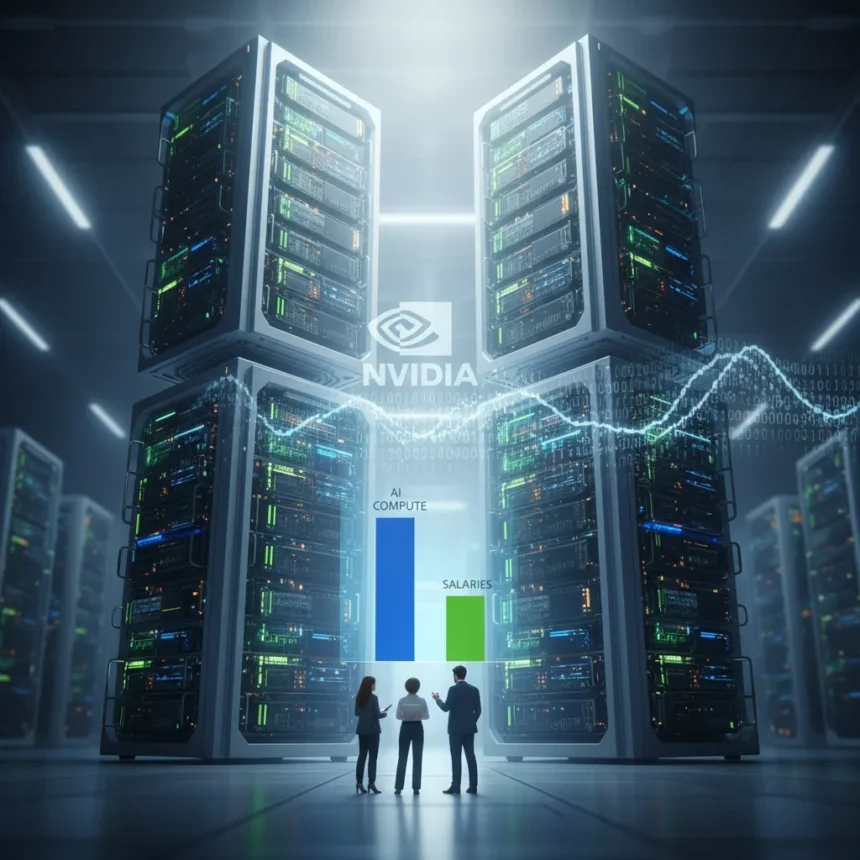
AI compute costs currently dwarf what companies spend on human workers, according to Nvidia executives—a reality that underscores both the present economics of AI development and the existential tension lurking beneath them. The company’s public emphasis on human workers’ ongoing value, despite this cost disparity, suggests Nvidia recognizes a fundamental problem: if compute remains expensive today, that will not be true forever.
Key Takeaways
- Nvidia states compute costs currently far exceed employee salaries in AI projects.
- The disparity highlights tensions between current economics and future automation potential.
- Nvidia publicly stresses human workers’ importance despite the cost gap.
- Sustainability of this dynamic remains uncertain as technology advances.
- The messaging reflects both present reality and future anxiety in tech.
The Current Economics of AI: Why Compute Dominates
Right now, training and deploying large AI models costs far more than paying human teams. This is not a minor difference—it is the defining economic reality of modern AI development. An Nvidia executive stated plainly: “the cost of compute is far beyond the costs of the employees.” This gap exists because GPU clusters, data centers, and the infrastructure required to run foundation models represent enormous capital and operational expenses. A single training run for a large language model can consume millions of dollars in compute resources alone.
This inverts the historical relationship between automation and labor. Usually, companies automate to replace expensive workers with cheaper machines. In AI today, the machines are so expensive that keeping humans around remains economically rational. The paradox is uncomfortable but clear: you cannot yet afford to fully automate away the people who build and maintain your AI systems.
Nvidia’s Messaging: Reassurance or Realism?
Nvidia’s continued public stress on human workers’ value reads as both reassurance and admission. The company is signaling to engineers, researchers, and the broader tech workforce that their skills remain essential. But the subtext is harder to ignore: executives are essentially saying “we need you right now because the alternative is too expensive.” That is not a long-term promise. It is a temporary reprieve.


This messaging strategy serves Nvidia’s interests in multiple ways. It maintains goodwill with the talent that builds AI systems. It counters narratives of mass displacement that could trigger regulatory backlash. And it acknowledges a genuine current truth: human expertise in AI development, from research to deployment to safety, remains irreplaceable at today’s price points. Yet the qualifier “at today’s price points” is everything. Moore’s Law may be slowing, but compute efficiency continues to improve. What costs millions today could cost thousands in five years.
The Unsustainable Tension
The real story here is not that Nvidia values humans—it is that Nvidia executives recognize the current equilibrium cannot last. If compute costs eventually fall relative to human salaries, the economic logic inverts again. Automation becomes cheaper than employment. The question is not whether this will happen, but when, and whether the transition will be gradual enough for affected workers to adapt.



Nvidia’s public emphasis on human importance, then, reads as a hedge. The company is documenting, for the record, that it understands humans matter. But it is also preparing the ground for a future in which economic forces, not sentiment, determine workforce composition. This is the tension at the heart of the AI industry right now: genuine dependence on human talent coexisting with genuine uncertainty about how long that dependence will remain economically necessary.
What Does This Mean for Workers and Companies?
For workers in AI development, the message is mixed. Your skills are needed now, and your cost relative to compute is favorable right now. But “now” is the operative word. Companies building AI systems should recognize this window as temporary and plan accordingly—both in terms of workforce investment and in terms of which roles are likely to remain human-dependent long-term. Research, safety, and creative problem-solving may prove more resilient to automation than routine engineering or data work.
For companies not yet deeply invested in AI, the lesson is different. The high cost of compute today creates an opportunity to hire experienced humans who can navigate this expensive technology. But that opportunity has an expiration date. As compute costs fall and AI systems become easier to operate, the advantage of human expertise diminishes. The companies that will thrive are those that use this window to build institutional knowledge and culture that remains valuable even as the technology becomes cheaper and more commoditized.
Can this dynamic actually survive?
No, not indefinitely. Compute costs will fall. Efficiency will improve. At some point, the economic logic that currently favors human workers will flip. Nvidia knows this. That is why the company is saying it out loud now—not to promise eternal job security, but to acknowledge the present reality while it lasts.



How much longer will human workers remain economically competitive in AI?
There is no fixed timeline, but the trend is clear: as compute infrastructure becomes cheaper and AI systems become more autonomous, the window closes. Nvidia’s messaging suggests the company expects this shift to be measured in years, not decades. Workers and companies should plan accordingly.
What skills will remain valuable as compute costs fall?
Roles requiring judgment, creativity, safety oversight, and strategic decision-making are likely to remain human-dependent longer than routine technical work. Nvidia’s emphasis on human importance hints at this reality—the company needs people who can think, not just people who can execute.
The uncomfortable truth Nvidia is dancing around is this: humans are useful right now because the technology is still expensive. That is not a ringing endorsement of human value. It is a temporary economic fact. The companies and workers who prepare for the next chapter—when compute is cheap and humans must compete on other grounds—will be the ones who thrive.
This article was written with AI assistance and editorially reviewed.
Source: TechRadar