




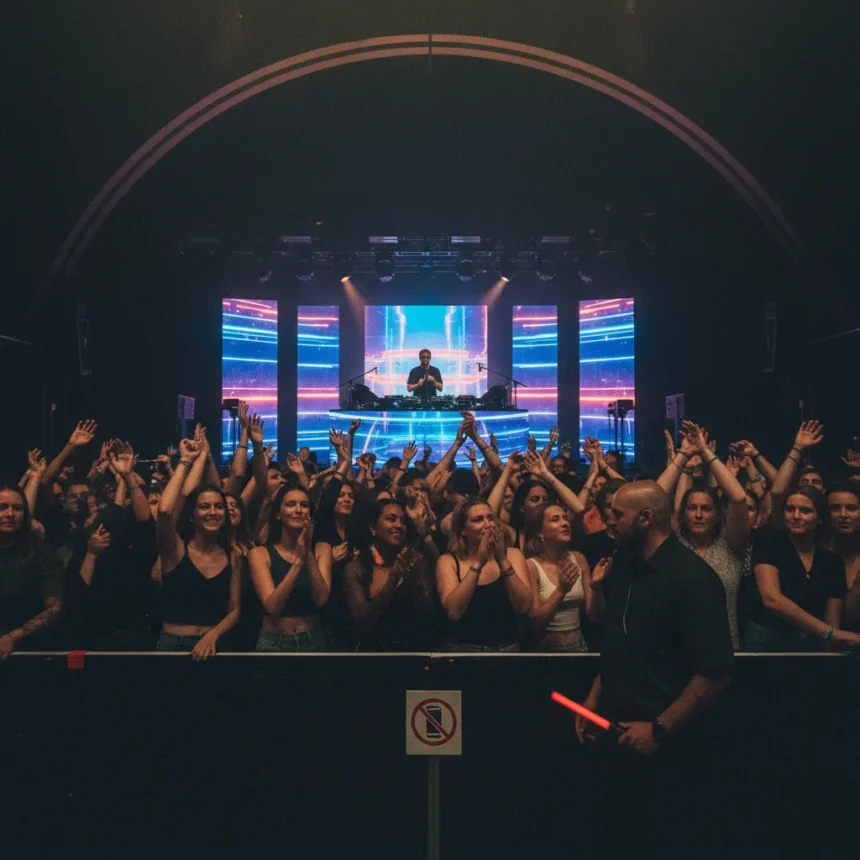
Phone bans at concerts represent a fundamental shift in how artists and venues think about live experiences. A global movement to unplug at events has grown 567% according to new data, with artists like Fred Again leading the charge by requiring attendees to cover their phone cameras with stickers. This trend raises a critical question: should removing phones from concerts become the norm?
Key Takeaways
- Fred Again’s USB002 tour implemented phone-free policies at sold-out shows, including the 10,250-person Alexandra Palace gig in London.
- Global interest in phone bans at events has surged 567%, reflecting broader demand for unplugged experiences.
- Attendees with covered cameras moved and danced differently compared to typical phone-heavy gigs, according to reviewers.
- Berlin club practices inspired the sticker-over-camera approach, which some artists now adopt.
- Some attendees still used phones despite artist reminders and sticker policies, highlighting enforcement challenges.
Why Phone Bans at Concerts Are Gaining Momentum
Phone bans at concerts are no longer fringe experiments—they are becoming a defining feature of how certain artists connect with audiences. Fred Again’s USB002 tour tapped into this movement by requiring attendees to place stickers over their back phone cameras upon entry, a practice borrowed from Berlin club culture. At the Alexandra Palace in London, 10,250 people attended the penultimate sold-out show, and the policy visibly altered crowd behavior. According to an Evening Standard reviewer, the entire mood shifted: the crowd moved in a fundamentally different way when phones were not held aloft. Fred Again himself reinforced the message during the show, reminding attendees that the gig was being professionally filmed, so there was no need for them to record.
The appeal is straightforward. When attendees focus on experiencing the moment rather than capturing it, they engage differently with the music and the artist. This creates a feedback loop that benefits both sides—artists get more responsive crowds, and audiences get more immersive experiences. The 567% growth in global interest around unplugging at events signals that this is not a niche preference but a genuine shift in what audiences want.
The Reality: Enforcement Challenges and Resistance
The promise of phone-free concerts runs into a hard wall when attendees ignore the policy. Despite Fred Again’s direct plea from the stage and the sticker system, some people still used their phones. One Evening Standard reviewer was blunt about non-compliance: anyone who ignored the artist’s explicit direction was, in their view, missing the entire point. This friction reveals the core tension—phone bans work only if attendees buy into the philosophy, and not everyone does.



Enforcement is messy. Venues cannot police every phone in a crowd of thousands. Artists can appeal to the audience’s better instincts, as Fred Again did, but compliance remains voluntary. This suggests that phone-free policies work best at venues and events where the audience is already predisposed to the concept, rather than as a universal mandate imposed on unwilling crowds.
Which Artists and Venues Benefit Most From Phone Bans
Not every artist is equally suited to a no-phone policy. Artists who need the least exposure—those already established, with dedicated fanbases—are the best candidates for phone bans. They have less to lose from reduced social media clips and more to gain from deeper fan engagement. Fred Again fits this profile: he is an established electronic artist with a loyal following, making his audience more likely to respect the no-phone request. Kaytranada, another artist critical of phone use at gigs, observed that when crowds hold up phones to film, they stop moving and dancing. The contrast is stark—phone-free crowds become dancing crowds, while phone-heavy crowds become still crowds.


This dynamic suggests that phone bans are most effective at mid-to-large venues where the artist has enough cultural capital to enforce the rule without losing the audience’s goodwill. For emerging artists relying on viral clips and social media buzz, the calculus is different—they may need phones in the crowd more than they need a perfect live experience.
Could Phone Bans Reshape Live Music Culture?
The broader question is whether phone bans could become standard practice across the industry. If phone-free experiences consistently deliver better crowd energy and artist-audience connection, venues and promoters have an incentive to adopt the policy. Some evidence suggests that phone bans may improve gig experiences, strengthen fan-artist relationships, and even boost future ticket sales. But this remains speculative—the data is limited to anecdotal reports and the 567% growth statistic, which tracks interest rather than proven outcomes.
The movement also reflects a deeper cultural fatigue with constant documentation and performance. Audiences increasingly crave moments that exist only in memory, not on Instagram. Phone bans at concerts tap into this desire. Whether this trend becomes mainstream or remains a niche appeal depends on whether venues and artists can solve the enforcement problem and whether audiences continue to value presence over documentation.
Are phone bans at concerts actually effective?
Phone bans show promise in shifting crowd energy and engagement, as evidenced by Fred Again’s Alexandra Palace show where attendees moved and danced differently. However, effectiveness depends entirely on audience buy-in and compliance. Some attendees ignore the policy despite artist reminders and sticker systems, so phone bans are not foolproof. They work best when the artist and audience share the same philosophy about unplugging.

Should all concerts implement phone bans?
Not necessarily. Phone bans suit established artists with dedicated fanbases more than emerging artists who rely on social media exposure. Venues and promoters should consider their audience’s expectations and the artist’s career stage before mandating a no-phone policy. One-size-fits-all bans could alienate audiences that expect to document and share their experiences.
What inspired Fred Again’s phone ban policy?
Fred Again’s USB002 tour adopted phone-free policies inspired by Berlin club practices, which use stickers placed over phone cameras to discourage filming. The artist reinforced the message during his shows, reminding attendees that the gig was being professionally filmed, eliminating the need for personal recordings.
The phone ban movement at concerts reflects a genuine cultural shift—audiences are hungry for experiences that prioritize presence over documentation. Fred Again’s USB002 tour proved that when executed thoughtfully, phone bans can transform how crowds engage with live music. Whether this becomes the future of concerts depends on whether the industry can balance the appeal of unplugging with the reality that not everyone is ready to leave their phone behind. For now, the 567% surge in interest suggests the movement is far from over.
This article was written with AI assistance and editorially reviewed.
Source: TechRadar