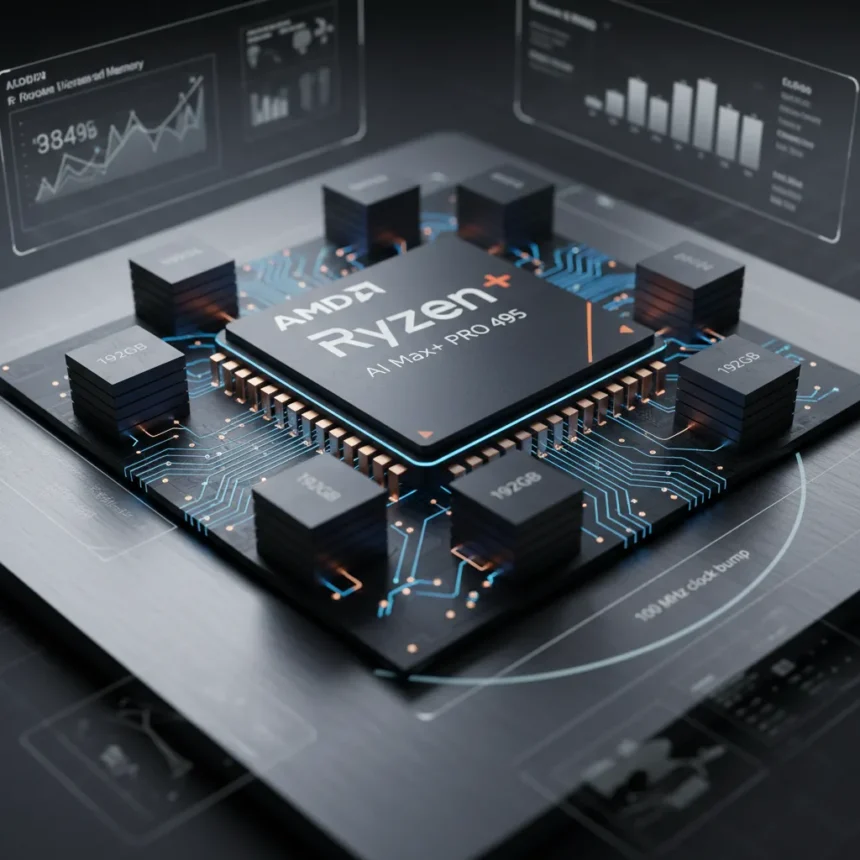
The AMD Ryzen AI Max+ PRO 495 is a laptop APU from AMD, part of the upcoming Gorgon Halo family, with leaked specifications pointing to 16 Zen 5 CPU cores, a 3.1 GHz base clock boosting to 5.2 GHz, and a Radeon 8065S integrated GPU running at up to 3.0 GHz. Unconfirmed reports suggest the chip could support up to 192GB of unified memory — a significant jump over its predecessor — though that figure has not been officially confirmed by AMD.
Key Takeaways
- The AMD Ryzen AI Max+ PRO 495 features 16 Zen 5 cores, 32 threads, and clocks boosted by 100 MHz over the Ryzen AI Max+ 395.
- PassMark benchmarks show 335 Million Primes/Sec and a CPU suite score of 731,477 — useful data points, but from a synthetic test.
- The chip uses the FP11 package, making it a drop-in upgrade path for OEMs already building on Strix Halo designs.
- Up to 192GB of unified memory is speculated but unverified; the predecessor maxes out at 128GB.
- TDP is 55W default with a configurable range of 45W to 120W, offering flexibility across thin-and-light and workstation-class designs.
What the AMD Ryzen AI Max+ PRO 495 Specs Actually Tell Us
The AMD Ryzen AI Max+ PRO 495 delivers 16 Zen 5 CPU cores and 32 threads, with 16 MB of L2 cache and 64 MB of L3 cache. Its CPU clocks — 3.1 GHz base, 5.2 GHz boost — represent a 100 MHz increase over the Ryzen AI Max+ 395’s 3.0 GHz base and 5.1 GHz boost. The integrated GPU follows the same pattern, gaining 100 MHz to reach 3.0 GHz on the Radeon 8065S.
Those gains are real but narrow. This is not a new architecture — it’s a fine-tuning of Strix Halo, built on the same TSMC 4nm FinFET process in a three-die package. The FP11 socket compatibility means OEMs do not need to redesign their platforms to adopt the new chip, which is useful for the enterprise and professional market this PRO-branded part targets. Whether end users will feel the 100 MHz difference in daily workloads is a different question entirely.
PassMark Benchmark Numbers: What the Leaked Data Shows
Leaked PassMark results for the AMD Ryzen AI Max+ PRO 495 show 335 Million Primes per second, 80,571 Thousand Strings per second, 37,077 MBytes per second in memory throughput, and a CPU test suite aggregate of 731,477. These are synthetic scores — they measure specific computational patterns, not real-world application performance. Treat them as directional indicators, not verdicts.


PassMark scores are useful for comparing chips within the same test environment, but the absence of official AMD benchmarks means there’s no authoritative baseline to anchor these numbers. The leaks come from sources including PassMark’s own database and reports from Notebookcheck and Overclock3D, described as reliable but not yet officially confirmed. Until AMD publishes its own data, the picture remains incomplete.
The 192GB Unified Memory Claim: Promising but Unverified
The most attention-grabbing figure in these leaks is the potential for 192GB of unified memory. If accurate, that would represent a 50 percent increase over the Ryzen AI Max+ 395’s maximum of 128GB on 256-bit LPDDR5x-8000. For AI workloads — specifically running large language models locally — that headroom matters. The Strix Halo generation already enabled local inference of models like Llama 3.1 70B-Q8, and more memory would push that capability further.



That said, the 192GB figure appears in the article title as speculation, not in the leaked spec sheets themselves. It’s worth tracking, but worth flagging clearly: this is an unverified claim, and the predecessor’s 128GB ceiling is the only confirmed data point available right now. Don’t make purchasing decisions based on a number that AMD hasn’t validated.
How the AMD Ryzen AI Max+ PRO 495 Compares to Strix Halo and Rivals
Against its direct predecessor, the Ryzen AI Max+ 395, the PRO 495 is a measured step forward rather than a leap. The core count stays the same at 16C/32T. The clock gains are 100 MHz across CPU and GPU. The cache configuration is identical. Within the Gorgon Halo family, the lower-tier Ryzen AI Max 490 drops to 12 cores and 24 threads, with CPU clocks of 3.2 to 5.0 GHz and a GPU running at 2.8 GHz — a different positioning that trades raw thread count for potentially tighter power tuning.
On graphics, the Strix Halo generation’s Radeon 8060S already sits between a discrete RTX 4060 and RTX 4070 at 70–80W, and performs approximately 2.5 to 3 times faster than AMD’s own Radeon 890M and roughly twice the Intel Arc 140T. The PRO 495’s 100 MHz GPU clock gain over that baseline is incremental. It won’t close any gaps that weren’t already closing. What it does offer is a slightly faster ceiling for workloads that can actually saturate the GPU — and in a unified memory architecture, that ceiling matters more than it would in a discrete GPU context.
Is the AMD Ryzen AI Max+ PRO 495 worth waiting for?
If you’re already on a Strix Halo device, probably not. The clock gains are modest and the architecture is unchanged. If you’re evaluating a new professional laptop purchase and the 192GB memory claim is confirmed, that changes the calculus significantly — especially for AI inference and large dataset workflows. Wait for official AMD confirmation before committing.



What is the NPU performance on the Ryzen AI Max+ PRO 495?
The NPU delivers up to 50 TOPS on the PRO 495. Combined with CPU and GPU contributions, total AI performance on the equivalent Strix Halo platform reaches up to 125–126 TOPS. This positions the chip well for on-device AI tasks, though the NPU figure alone does not determine real-world model performance.
Does the Ryzen AI Max+ PRO 495 support PCIe 5.0?
No. Based on leaked specifications, the chip uses PCIe 4.0 with 16 lanes total, along with NVMe support including RAID0 and RAID1 configurations. PCIe 5.0 does not appear in the leaked data for this platform.
The AMD Ryzen AI Max+ PRO 495 looks like exactly what the leaks suggest: a calculated, conservative refresh of a platform that was already strong. The 100 MHz clock gains won’t move the needle for most users, but the potential 192GB memory ceiling — if confirmed — could make this the most capable unified-memory laptop chip available. That’s the number to watch. Everything else is incremental.
Edited by the All Things Geek team.
Source: Tom's Hardware