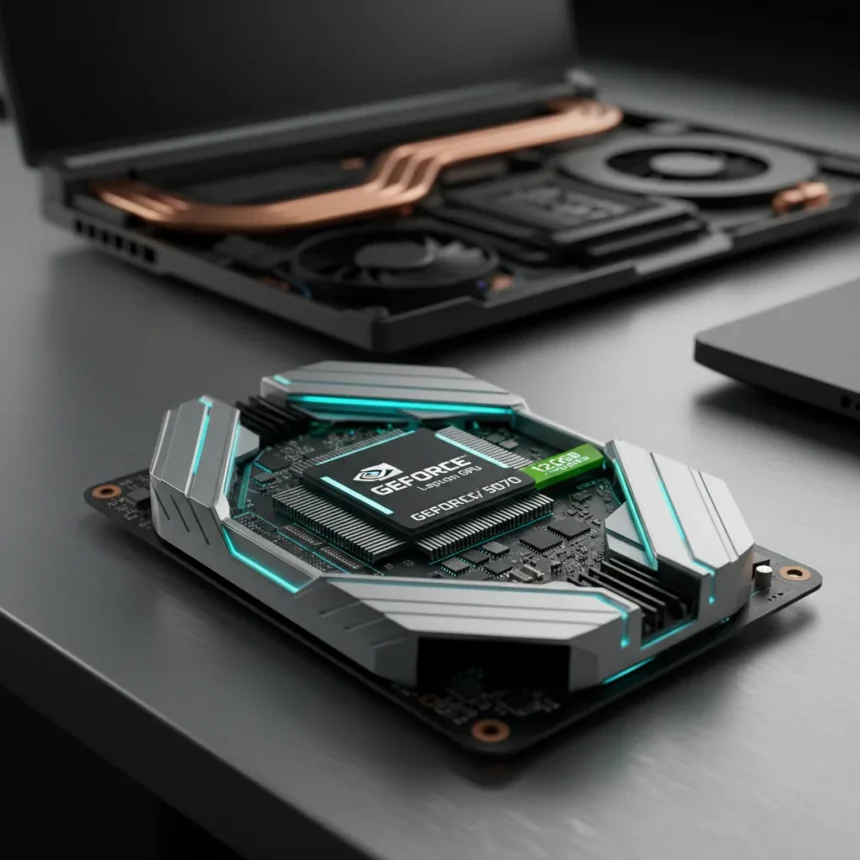
The Nvidia RTX 5070 laptop GPU officially arrives with 12GB of VRAM, marking a significant shift in how the company approaches entry-level gaming GPU memory configurations. This upgrade addresses a genuine pain point: 8GB of VRAM throttles performance in modern games at high settings and high resolutions, particularly on the high-resolution screens now standard in gaming laptops.
Key Takeaways
- The RTX 5070 12GB variant delivers 672 GB/s memory bandwidth, nearly double the 8GB model’s 384 GB/s
- 12GB configuration directly solves VRAM bottlenecks at high resolutions and maximum graphics settings
- MSI’s Crosshair 16 Max HX E2WGXK was the first laptop to feature this configuration before official announcement
- Memory bandwidth increase enables smoother performance in demanding AAA titles and content creation workloads
- 12GB standard addresses industry trend toward higher VRAM in mid-range GPUs
Why the Nvidia RTX 5070 laptop GPU needed 12GB
The gap between 8GB and 12GB matters far more than the raw megabyte count suggests. Modern games increasingly demand texture streaming at high resolutions—4K gaming on a laptop display forces the GPU to juggle massive texture sets, ray-traced effects, and frame buffers simultaneously. Eight gigabytes becomes a cramped workspace. The Nvidia RTX 5070 laptop GPU with 8GB would have struggled to maintain smooth frame rates in titles like Cyberpunk 2077 or Alan Wake 2 at ultra settings, forcing gamers to compromise on visual fidelity or resolution. The 12GB variant eliminates that compromise.
Memory bandwidth tells the real story. The 12GB configuration supplies 672 GB/s of bandwidth compared to 384 GB/s for the 8GB version. That 75 percent increase in memory throughput means the GPU spends less time waiting for data and more time rendering. For gaming laptops with high-refresh-rate displays—common on premium models—this bandwidth advantage translates directly to higher frame rates without thermal throttling.
How the Nvidia RTX 5070 laptop GPU compares to predecessors
Nvidia has historically shipped entry-level laptop GPUs with conservative memory allocations. The RTX 4070 mobile arrived with 8GB, as did the RTX 4060. The company seemed to treat 8GB as sufficient for the segment. That philosophy no longer holds. The Nvidia RTX 5070 laptop GPU’s 12GB standard reflects a market reality: games and creative software have outpaced 8GB’s capabilities. Competitors pushing similar configurations underscore that 12GB is now table stakes, not a luxury feature.


The memory bandwidth jump is equally important. Previous generations relied on narrower memory buses; the RTX 5070’s architecture supports fatter pipes. This architectural improvement compounds with the additional VRAM, creating a GPU that handles demanding workloads without the memory-related stuttering that plagued earlier models at high resolutions.
What this means for gaming laptop buyers
The Nvidia RTX 5070 laptop GPU with 12GB removes a major decision point from laptop shopping. Buyers no longer need to hunt for 16GB VRAM configurations or worry that a 12GB system will choke on modern titles. The base configuration itself is future-proofed for at least two to three years of AAA releases. For content creators—video editors, 3D modelers, AI researchers—the extra VRAM provides breathing room for larger projects without constant GPU memory overflow errors.



Gaming laptops built around the Nvidia RTX 5070 laptop GPU will compete effectively against desktop systems in the same price bracket. The memory bandwidth advantage means these mobile GPUs can sustain performance that would have required significantly more power consumption in previous generations. Thermal budgets tighten on laptops; the RTX 5070’s efficiency gains matter more than raw TFLOPS.
Frequently asked questions
Does the RTX 5070 12GB version cost more than the 8GB model?
The research brief does not specify pricing differences between the 12GB and 8GB configurations. Availability and pricing vary by manufacturer and region, so check directly with laptop makers for current costs.
Can the Nvidia RTX 5070 laptop GPU handle 4K gaming?
Yes. The 12GB VRAM and 672 GB/s memory bandwidth support 4K gaming at high settings in most modern titles, though frame rates depend on the specific game and graphics settings chosen. The extra VRAM prevents stuttering from texture streaming at high resolutions.
Is 12GB VRAM enough for AI and machine learning on laptops?
Twelve gigabytes is a reasonable starting point for smaller models and inference tasks, though large language model training still benefits from 24GB or more. The Nvidia RTX 5070 laptop GPU excels at inference and fine-tuning smaller models.



The Nvidia RTX 5070 laptop GPU’s 12GB standard is not a marketing gimmick—it is a necessary correction to GPU memory allocations that fell behind game and software demands. For anyone shopping for a gaming or creative laptop in 2025, the 12GB configuration should be the baseline expectation, not a premium option.
Edited by the All Things Geek team.
Source: Tom's Guide