






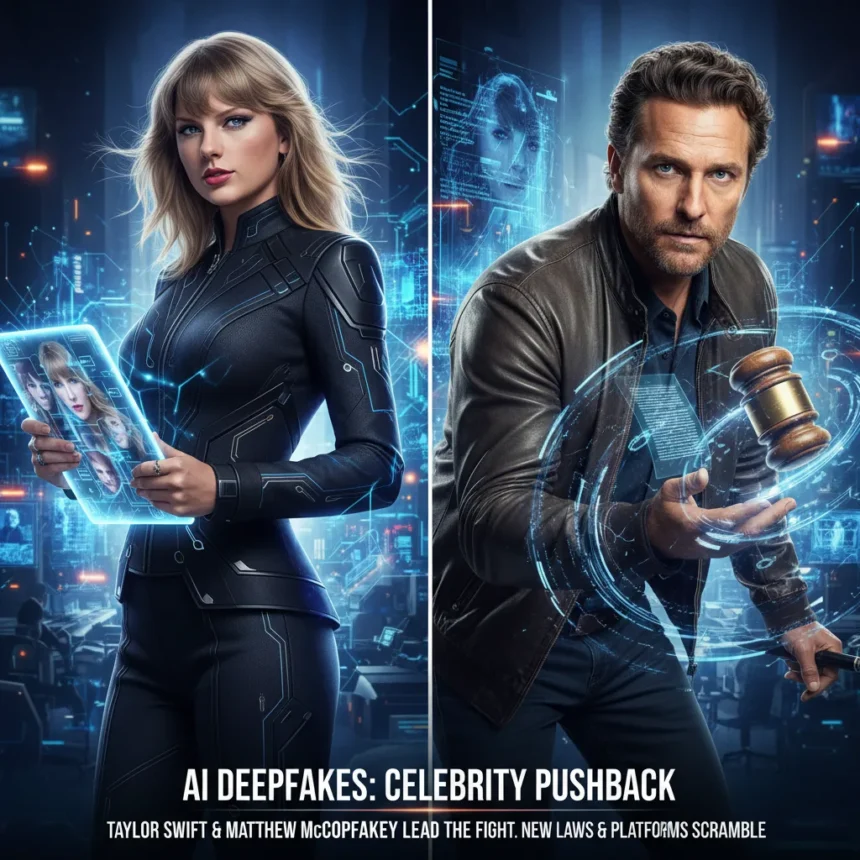
AI deepfakes celebrity protection is shifting from a niche concern to a mainstream battleground. Taylor Swift has joined Matthew McConaughey in opposing AI deepfakes, marking what industry observers are calling a landmark moment for high-profile figures fighting unauthorized AI-generated content.
Key Takeaways
- Taylor Swift and Matthew McConaughey are collaborating on likeness protection against AI deepfakes.
- The Take It Down Act allows victims of explicit deepfakes to request removal from platforms.
- The proposed DEEP FAKES Accountability Act requires watermarks and disclaimers on deepfakes.
- Instagram treats deepfakes as misinformation but relies on fact-checker flagging to filter content.
- Deepfakes use GANs technology where generators create fakes and discriminators detect them via feedback loops.
Why celebrities are finally taking action against AI deepfakes
For years, deepfake technology existed in the shadows—amateur hobbyists and bad actors creating crude fakes that were often easy to spot. But generative AI has changed that equation entirely. Deepfakes now use Generative Adversarial Networks (GANs), where a generator creates increasingly realistic fake content while a discriminator learns to detect flaws, creating a feedback loop that produces frighteningly convincing results. Swift and McConaughey’s public stance signals that A-list celebrities can no longer ignore the threat.
The timing matters. Deepfakes have evolved from novelty to weapon. When a fake video of Mark Zuckerberg circulated on Instagram, the platform initially did not remove it—a policy failure that exposed how unprepared major social networks are to police synthetic media. Swift’s involvement suggests celebrities are done waiting for platforms to solve the problem themselves. They are now demanding legal protections and technological safeguards.
What laws are actually trying to stop AI deepfakes
The legislative response to AI deepfakes has accelerated dramatically. The Take It Down Act gives victims of explicit deepfakes a legal pathway to demand removal, though it focuses narrowly on non-consensual intimate imagery. Broader protection comes from the proposed DEEP FAKES Accountability Act, which requires watermarks and disclaimers on deepfake content to make it illegal without them. These are not yet universal standards, but they represent the first serious attempt to create enforceable rules around synthetic media.



California’s approach has triggered real-world conflict. A creator of a Kamala Harris deepfake is suing the state over AI safety regulations, arguing that proposed laws overreach. This legal clash illustrates the core tension: how do you protect public figures from deepfakes without infringing on free speech or stifling legitimate AI development? Swift and McConaughey’s push suggests celebrities believe the answer is stricter rules, even if enforcement proves messy.
How platforms are failing at deepfake detection
Instagram’s approach to deepfakes is reactive rather than preventive. The platform treats deepfakes as misinformation but only filters them if fact-checkers flag them with a #deepfake hashtag. This places the burden on external moderators rather than building detection into the platform itself. For a celebrity like Swift, whose image is worth billions in brand equity, waiting for a fact-checker to notice a deepfake is unacceptable.


Other celebrities are watching Swift’s move closely. Paris Hilton and Alexandria Ocasio-Cortez have already called for stronger anti-deepfake laws, but Swift’s involvement raises the stakes—she commands a global platform and the resources to pursue legal action. When A-list figures with that much influence align on an issue, policy tends to follow.
What happens next in the deepfake arms race
The next frontier is enforcement. Laws mean little without teeth, and watermarking requirements or disclosure rules only work if platforms actually check for them. Swift’s collaboration with McConaughey suggests celebrities will push for stronger platform accountability, not just better laws. Expect demands for real-time detection systems, liability for platforms that host deepfakes, and faster takedown procedures.
The deepfake problem will not disappear. Generative AI is too accessible, too powerful, and too profitable for bad actors to stop using it. But Swift’s public stand signals that the era of celebrities accepting deepfakes as an inevitable cost of fame is over. The next phase will be messier—legal battles, platform policy changes, and a constant technological cat-and-mouse game between creators and detectors.
Can watermarks and disclaimers actually stop deepfakes?
Watermarking and disclaimer requirements sound simple but face a critical flaw: determined bad actors can remove or obscure watermarks. The DEEP FAKES Accountability Act assumes platforms will enforce these rules, but enforcement depends on detection, which remains inconsistent. A watermark only works if people actually look for it before sharing.



What is the difference between deepfakes and regular AI-generated content?
Deepfakes specifically target real people’s faces and voices using GANs technology, creating synthetic media that impersonates an actual person. Regular AI-generated content (like text or generic images) does not necessarily impersonate anyone. The harm of deepfakes lies in their ability to deceive—they exploit our trust in visual evidence to spread misinformation or create non-consensual intimate imagery.
Why are celebrities like Taylor Swift speaking out now?
Swift and McConaughey’s public stance reflects a tipping point: deepfake technology has become sophisticated enough to pose real financial and reputational threats. Waiting for platforms to self-regulate has failed. By aligning with each other and pushing for legislation, they are signaling that celebrities will use their political capital to demand legal protections rather than rely on technology companies to solve the problem voluntarily.
The deepfake crisis is no longer theoretical. Swift’s landmark stand against AI deepfakes, alongside McConaughey and other public figures, marks the moment when celebrity influence collides with AI regulation. Expect aggressive legislative pushes, platform policy overhauls, and a new era of legal battles over synthetic media. The outcome will shape how all public figures—and eventually ordinary people—protect their identity in an age of perfect fakes.
This article was written with AI assistance and editorially reviewed.
Source: Creativebloq