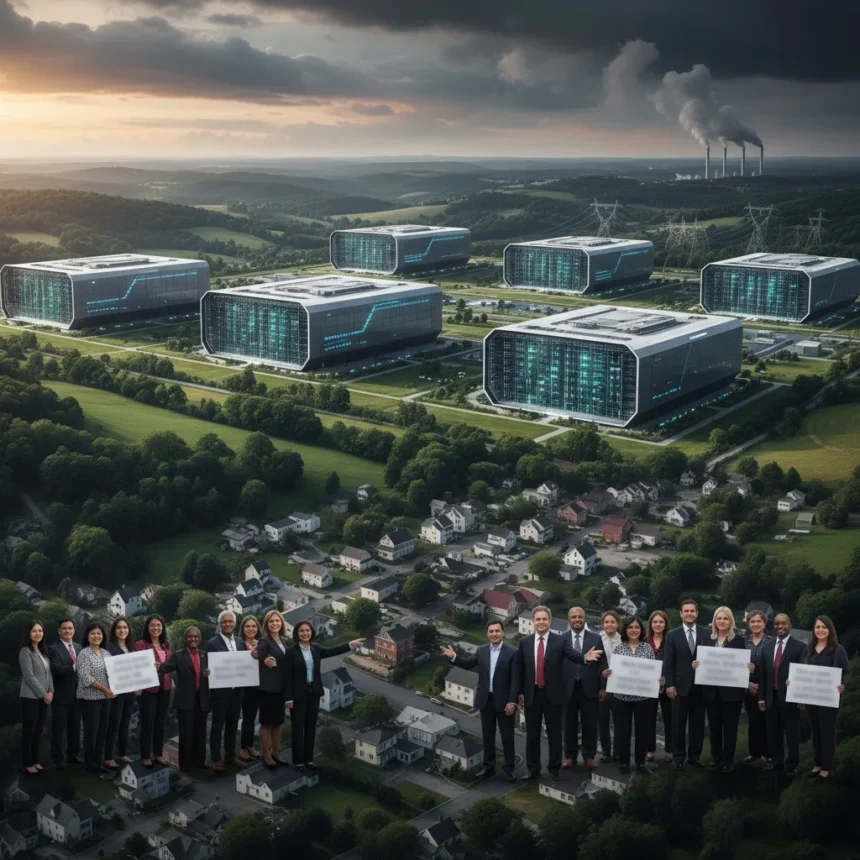
The AI data center boom is hitting small-town America harder than anyone anticipated. In Archbald, Pennsylvania—a municipality of 7,000 residents covering just 17 square miles—six massive data center campuses are proposed, equivalent to 51 Walmart Supercenters crammed into the same footprint. The scale is staggering. The power demand alone from one campus would exceed the region’s largest power plant.
Key Takeaways
- Six AI data centers proposed for Archbald would cover 14% of the town’s 17-square-mile area
- One campus expected to consume more power than the region’s largest power plant
- 51 buildings total across five developers; Project Scott denied 5-0 by borough council on March 27, 2026
- Over 200 residents attended council hearing; Pennsylvania has 50+ data center campuses in development statewide
- No co-location with renewable or nuclear plants allowed; hundreds of diesel backup generators pose pollution and health risks
Why the AI Data Center Boom Is Hitting Archbald Hardest
Archbald is not unique. Pennsylvania is experiencing an unprecedented data center surge, with over 50 campuses in development statewide and 11 clustered in Lackawanna County alone. But Archbald bears the heaviest concentration. The six proposed projects represent the largest concentration of AI infrastructure in any Pennsylvania municipality, and the town is buckling under the weight.
The sheer footprint tells the story. Project Gravity alone spans more than 186 acres with six two-story buildings totaling approximately 1.62 million square feet. Project Scott, the most controversial, originally proposed 18 buildings across more than 400 acres directly adjacent to Ed Staback Memorial Park. These are not modest facilities. They are industrial-scale complexes that dwarf the town’s existing infrastructure and residential character.
The power demand is the most alarming metric. All six data centers would pull directly from the grid with no allowance for co-location with oil, gas, or nuclear plants per local zoning. The region’s electrical infrastructure was never designed for this load. When one campus alone would exceed the output of the largest regional power plant, the grid collapses—not literally, but functionally, straining capacity and raising costs for every other consumer in the area.



The Environmental and Health Toll of AI Data Center Boom Projects
Power consumption is only part of the problem. The AI data center boom in Archbald would bring hundreds of diesel backup generators scattered across the campuses. Diesel generators emit nitrogen oxides, particulate matter, and volatile organic compounds linked to respiratory disease, heart disease, and cancer. For a town of 7,000, this is not an abstract environmental concern—it is a direct threat to public health.
The projects would also force the eviction of a trailer park and border residential properties along Eynon-Jermyn Road. Residents are not abstract stakeholders in some growth narrative. They are neighbors who will live with the noise, air quality degradation, and constant industrial activity. The Pennsylvania data center boom has created a pattern: rural and semi-rural communities absorb the environmental cost while distant investors capture the profit.



The state is watching. Pennsylvania State Senator Katie Muth circulated a memo in February 2026 proposing a potential statewide moratorium on new data center development. This is not regulatory theater—it is a recognition that the current pace of development is unsustainable and that communities lack the tools to manage it.
How Archbald Council Pushed Back Against the AI Data Center Boom
On March 27, 2026, Archbald Borough Council voted 5-0 to deny Project Scott, the largest of the six proposed campuses. Over 200 residents attended the hearing and cheered the decision. Council members Erin Owen, Joseph Altier, Louis Rapoch, Marie Andreoli, and Tom Aniska voted to reject the 18-building complex. The action was swift and decisive—the council moved before the 45-day deadline under Pennsylvania Municipal Code that would have resulted in automatic approval.
The developer is not conceding. Archbald I, through lawyer James McCombie, objected to the denial and claimed the hearing remains open due to procedural errors by the borough and newspaper. This is where the real fight begins. Denial is one thing; defending that denial in court against a developer with resources and legal firepower is another.
The political cost is real. Four of the seven town council members have reportedly resigned from their positions, according to reporting on the council’s response to the AI data center boom. The pressure—from developers, from residents, from the state—is fracturing local governance. A town of 7,000 is not equipped to wage a prolonged legal battle against multiple developers backed by venture capital and data center operators with billions in assets.



What the Tax Revenue Actually Means
Borough officials have pitched the financial upside. According to borough official Farris, the data centers would generate approximately $20 million per year in property taxes for Archbald, $50 million for Lackawanna County, and $100 million for the Valley View School District. These are substantial numbers for a small municipality. But they come with hidden costs that tax revenue does not offset: grid upgrades, water infrastructure expansion, emergency services strain, and long-term environmental remediation.
Many Pennsylvania municipalities offer tax breaks to data center developers. The actual tax benefit may be lower than projected. And once the infrastructure is built, the community is locked into managing the consequences for decades. Tax revenue is a one-time political argument; environmental and health costs are permanent.
Is the AI data center boom slowing down?
Not yet. Over 50 data center campuses are in development across Pennsylvania, with nine proposals clustered around Archbald Borough alone. The infrastructure investment is too attractive for developers and the financial incentives too powerful for states competing for tax revenue. Unless a statewide moratorium passes or federal policy changes, the boom will continue.
What happens if Archbald loses the legal fight against Project Scott?
The developer could proceed with the 18-building campus, setting a precedent for approving the remaining five proposals. Archbald would become a data center hub, fundamentally transforming the town’s character and straining its resources. The council’s March 27 denial would be overturned, and future resistance would face the argument that precedent has already been set.
Why don’t data center developers choose industrial zones instead of small towns?
Industrial zones in cities and established industrial parks have higher land costs, existing competition, and stricter environmental oversight. Small towns like Archbald have cheap land, minimal local opposition infrastructure, and desperate municipal officials seeking tax revenue. The economics favor sprawl into rural areas, even though the environmental and health costs are externalized onto residents who had no say in the decision.
The AI data center boom is not a local problem anymore—it is a regional crisis. Archbald’s fight matters because it is a test case for whether small communities can resist the pressure of capital and infrastructure expansion. So far, the town has held the line with one denial. But the developers are still in court, and five more campuses remain proposed. The real battle is just beginning.
Edited by the All Things Geek team.
Source: Tom's Hardware