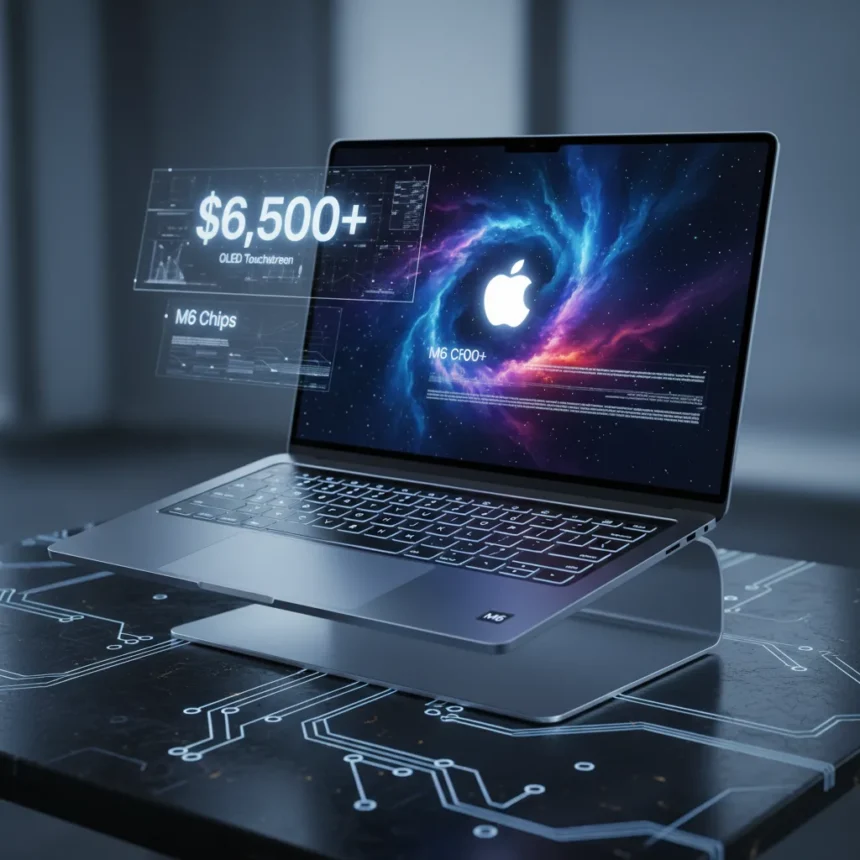
Apple’s rumored MacBook Ultra pricing could shatter expectations for what users are willing to spend on a laptop. According to Bloomberg’s Mark Gurman, Apple is planning a new top-tier MacBook model featuring an OLED display, touchscreen capability, and M6-series chips that would sit above the current MacBook Pro lineup. The catch? It will cost significantly more than the models it sits above.
Key Takeaways
- MacBook Ultra expected to launch in Q4 2026 or early 2027 with OLED and touchscreen features
- Apple’s rumored MacBook Ultra pricing could reach $6,500 base for M6 Max, up to $8,000 with upgrades
- Historical precedent: iPhone X OLED (2017) raised prices to $899; iPad Pro OLED (2024) increased by roughly 20%
- 16-inch MacBook Ultra could cost around $3,239 to $4,679, compared to current 16-inch M5 Max at $3,900
- Positioned as premium workstation above MacBook Pro, not a replacement for existing models
What Apple’s MacBook Ultra pricing could look like
Apple’s MacBook Ultra pricing strategy mirrors the company’s historical approach to premium display technology. When Apple introduced OLED to the iPhone X in 2017, the base price jumped to $899, a significant leap from the iPhone 8’s $699 starting point. The iPad Pro OLED transition in 2024 followed a similar pattern, with prices climbing roughly 20 percent above the previous generation. Applying this precedent to the MacBook line suggests aggressive pricing for the Ultra model.
Rumored configurations place the 14-inch MacBook Ultra with M6 Pro at approximately $2,639 and the M6 Max variant around $4,319. The 16-inch model could range from $3,239 to $4,679 depending on configuration. These numbers assume a 20 percent premium over current MacBook Pro pricing, which is conservative compared to some leaks. Higher-end speculation from YouTube channels suggests the M6 Max base model could reach $4,300 to $4,500, with fully loaded M6 Ultra configurations potentially hitting $6,000 to $6,500 as a starting point, climbing to $7,000 to $8,000 with memory and storage upgrades. Forum discussions have floated even more ambitious figures, with some users predicting a 14-inch model at $2,499 and 16-inch at $2,999, though these remain unconfirmed speculation.
Why Apple’s MacBook Ultra pricing will jump so dramatically
The price increase stems from three converging factors: display technology, processor power, and positioning strategy. The tandem OLED display represents Apple’s first touchscreen MacBook, a departure from the company’s traditional keyboard-and-trackpad design philosophy. OLED panels are significantly more expensive to manufacture than LCD alternatives, particularly in the larger sizes rumored for the Ultra—potentially 18 to 19 inches. This alone justifies a meaningful premium.


The M6-series chips, built on TSMC’s advanced 2-nanometer process, will introduce the M6 Pro, M6 Max, and M6 Ultra variants. These represent a generational leap from current M5 chips, with enhanced performance for professional workloads. The M6 Ultra variant, in particular, positions the MacBook Ultra as the ultimate workstation for creative professionals and developers—a market segment Apple has historically been willing to charge premium prices for. Additional features like vapor chamber cooling and a redesigned chassis add manufacturing costs that trickle down to the retail price.
Critically, the MacBook Ultra will not replace the existing MacBook Pro lineup. Apple plans to keep the M5 Pro and M5 Max models on sale alongside the new Ultra, creating a tiered ecosystem. This strategy mirrors Apple’s approach with the iPhone, where multiple generations and tiers coexist at different price points. The Ultra becomes the aspirational top tier, while the Pro remains the practical choice for most professionals.



How Apple’s MacBook Ultra compares to current MacBook Pro models
The current 16-inch MacBook Pro with M5 Max starts at approximately $3,900 to $4,000 before taxes. Even conservative estimates place the 16-inch MacBook Ultra with M6 Max at $3,239 to $4,679, which overlaps or exceeds current Pro pricing depending on configuration. This positioning creates an interesting market dynamic: the Ultra becomes the premium option for users who demand the latest technology and are willing to pay for it, while the Pro serves users whose workloads don’t require the absolute cutting edge.
The MacBook Pro has remained largely unchanged in its core positioning for over a decade, with incremental processor upgrades and modest design tweaks. The MacBook Ultra represents Apple’s first major shake-up in professional laptop strategy, introducing features like touchscreen and OLED that have been absent from MacBooks entirely. This represents a genuine product differentiation, not merely a faster version of an existing model. Windows alternatives like the Dell XPS or Lenovo ThinkPad X1 Extreme offer premium builds and powerful processors, but none have matched Apple’s integration of hardware, software, and ecosystem—a factor that historically justifies Apple’s premium pricing.
When will the MacBook Ultra actually launch?
Apple’s MacBook Ultra is expected to arrive in the fourth quarter of 2026, though some leaks suggest a possible slip into early 2027 due to OLED panel production constraints and memory chip availability. The timing aligns with Apple’s broader product strategy refresh, which includes the anticipated launch of a folding iPhone and the lower-end MacBook Neo at $599. This expansion of the MacBook lineup—adding both a budget model and an ultra-premium tier—suggests Apple is deliberately targeting multiple market segments with distinct pricing tiers.
The OLED transition for MacBooks has been delayed by manufacturing challenges. OLED panel suppliers must scale production to meet demand for laptop-sized displays, a process that takes time and capital investment. Memory chip constraints from the broader semiconductor industry have also contributed to timeline uncertainty. These manufacturing realities mean that even if Apple announces the MacBook Ultra in late 2026, actual availability could stretch into 2027.



Is the MacBook Ultra pricing justified?
Whether Apple’s rumored MacBook Ultra pricing is justified depends entirely on what features and performance the M6 Ultra actually delivers. If the touchscreen OLED display proves genuinely useful for creative workflows—not merely a novelty—and the M6 Ultra chips offer substantial performance gains over the M5 Max, then a $6,000 to $8,000 asking price becomes defensible for professionals. Designers, video editors, and software engineers working on demanding projects have historically accepted premium pricing for tools that accelerate their work and increase output quality.
However, if the MacBook Ultra merely repackages existing MacBook Pro performance in a slightly thinner chassis with a touchscreen gimmick, the pricing becomes harder to justify. Apple’s track record with touchscreen interfaces on non-iPad devices has been mixed at best. The Touch Bar, introduced in 2016, was controversial and has been gradually de-emphasized in recent MacBook generations. A full touchscreen MacBook could either reshape how professionals interact with their machines or become another feature that sounds good in marketing materials but sees limited real-world adoption.
What happens to the MacBook Pro after the Ultra launches?
The MacBook Pro won’t disappear. Apple will continue selling M5 Pro and M5 Max models alongside the new Ultra, likely at reduced prices. This creates a three-tier professional laptop ecosystem: the MacBook Pro for mainstream professionals, the MacBook Ultra for power users and creative specialists, and eventually the MacBook Neo for budget-conscious consumers and students. This tiered approach maximizes Apple’s addressable market by offering options across a wide price range while maintaining premium margins on the Ultra.
The Pro models may eventually receive M6 Pro and M6 Max chips in a future update, but they would likely retain traditional LCD displays and omit the touchscreen, keeping them positioned below the Ultra. This strategy has worked well for iPad, where the iPad Pro commands premium pricing with OLED and advanced features, while the regular iPad serves the mass market with proven technology at lower cost.
FAQ
Will the MacBook Ultra replace the MacBook Pro?
No. Apple plans to keep the MacBook Pro lineup on sale alongside the new MacBook Ultra. The Ultra is positioned as a new top-tier option above the Pro, not as a replacement. This allows Apple to offer options at different price points for different customer segments.
Why will the MacBook Ultra cost so much more than current MacBook Pro models?
The combination of OLED display technology, touchscreen capability, M6-series chips on advanced 2-nanometer process, vapor chamber cooling, and Apple’s historical pricing precedent for OLED devices all contribute to the higher cost. OLED displays are significantly more expensive to manufacture than LCD alternatives, particularly in laptop sizes.
When can I actually buy a MacBook Ultra?
The MacBook Ultra is expected to launch in Q4 2026 or possibly early 2027, according to Bloomberg’s Mark Gurman and various leaks. Manufacturing constraints on OLED panels and memory chips have created uncertainty around the exact launch window, so availability could shift into 2027.
Apple’s MacBook Ultra represents a genuine inflection point for the professional laptop market. If the company executes on the rumored features and justifies the pricing with real performance and usability gains, it could set a new standard for premium laptops. If it stumbles, the high price tag becomes a liability that undermines the entire product tier. Either way, the MacBook Ultra signals that Apple isn’t content with incremental updates to the Pro line—the company is ready to push boundaries and test how much professionals will pay for the absolute best. For users who demand the latest technology and have the budget to match, that ambition may prove irresistible.
Edited by the All Things Geek team.
Source: TechRadar