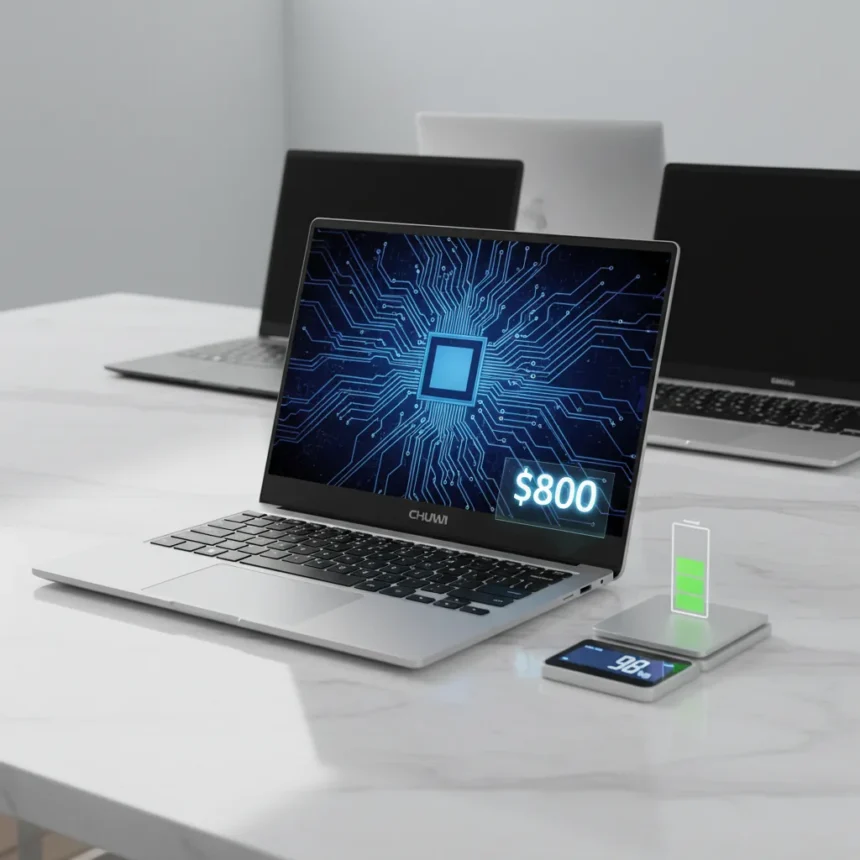
The Chuwi Lunar Lake laptop is a sub-1kg ultraportable device powered by Intel’s latest Lunar Lake processors, designed to challenge the ultrabook market at a $800 price point. This Chinese manufacturer’s entry into the premium portable segment arrives with ambitious claims: all-day battery life, a 2.8K display, and a surprisingly capable 2-megapixel camera. But can Chuwi’s pricing strategy overcome the dominance of Apple, Dell, and Lenovo in this space?
Key Takeaways
- Chuwi Lunar Lake laptop weighs under 1kg, targeting ultraportable segment
- Intel Core i5 processor powers the device with claimed all-day battery endurance
- 2.8K display and 2-megapixel camera included in base configuration
- $800 price tag positions it below premium ultrabooks from established brands
- Market acceptance uncertain given Chuwi’s limited brand recognition outside Asia
Chuwi Lunar Lake Laptop Specs and Design
The Chuwi Lunar Lake laptop delivers impressive portability for its price class. At under 1 kilogram, it ranks among the lightest laptops available, making it genuinely pocketable for frequent travelers. The 2.8K display resolution sits above the 1080p standard found on many budget ultrabooks, offering sharper text and more screen real estate without the power drain of 4K. The 2-megapixel camera is modest but functional for video calls—adequate but not exceptional when compared to the higher-resolution cameras in MacBook Air or Dell XPS models.
The Intel Core i5 processor represents a meaningful step up from entry-level Celeron or Pentium chips, suggesting this device targets users who need genuine productivity performance, not just web browsing. The all-day battery life claim is critical for an ultraportable; if genuine, it solves one of the major pain points of thin-and-light laptops that often struggle to survive a full workday without charging.
Pricing and Market Positioning
At $800, the Chuwi Lunar Lake laptop sits in a crowded segment. This price undercuts the MacBook Air M3, which starts at $1,099, and competes directly with mid-range Dell XPS 13 and Lenovo ThinkPad X1 Carbon models. However, Chuwi’s brand recognition remains a significant obstacle. Western consumers typically associate Chuwi with budget tablets and convertibles, not premium ultrabooks. This perception gap may prove more damaging than any specification shortfall.


The real question is whether buyers will trust an unfamiliar brand with an $800 investment when they could spend $100-200 more and receive the warranty backing and retail support of Dell or Lenovo. Chuwi has built a reputation for value, but value alone does not guarantee market adoption in the premium segment.
Battery Life and Portability Trade-Offs
All-day battery life on a sub-1kg laptop is genuinely rare. Most ultraportables under 1kg sacrifice battery capacity to hit weight targets, resulting in 6-8 hour real-world endurance. If Chuwi’s claim holds up in independent testing, this becomes the device’s strongest differentiator. However, claims require verification—marketing departments frequently optimize battery benchmarks using minimal brightness and idle scenarios that do not reflect actual work.



The sub-1kg weight is undeniably valuable for road warriors, but it typically comes with compromises: thinner keyboards, limited port selection, or thermal throttling under sustained loads. Without hands-on testing, it remains unclear which corners Chuwi cut to achieve both lightness and claimed battery performance.
Display Quality and Camera Capabilities
The 2.8K display resolution is a genuine strength at this price. It exceeds the 1920×1200 standard on many $800 laptops, though it still falls short of the 3840×2400 resolution on premium ultrabooks. The practical benefit is noticeable sharper text and more comfortable window management without the battery penalty of 4K.
The 2-megapixel camera is where Chuwi’s cost-cutting becomes visible. Modern laptops in this price range typically include 5MP or higher sensors. For video conferencing, 2MP is functional but produces softer detail and struggles in low light. This is a clear area where competitors offer better value, though it may not matter for users who rarely use the built-in camera.
Is the Chuwi Lunar Lake laptop worth $800?
The Chuwi Lunar Lake laptop delivers solid specifications for the price, but brand trust and market positioning are real obstacles. If battery life claims prove accurate and the keyboard and trackpad feel premium, it represents genuine value. However, buyers should verify performance and reliability independently before committing—Chuwi’s warranty and support infrastructure in Western markets remains underdeveloped compared to Dell or Lenovo.



How does Chuwi’s Lunar Lake laptop compare to the MacBook Air?
The MacBook Air M3 costs $300 more but includes Apple’s ecosystem integration, superior trackpad, and longer-term software support. The Chuwi offers better raw specifications at a lower price but lacks the brand assurance and resale value of Apple hardware. For budget-conscious professionals, Chuwi wins on specs; for those valuing ecosystem and longevity, MacBook Air remains the safer choice.
What makes the sub-1kg weight significant for ultraportable laptops?
A sub-1kg laptop is genuinely pocketable and eliminates shoulder strain during long commutes. Most ultrabooks weigh 1.2-1.5kg, making the weight reduction meaningful for frequent travelers. However, achieving this weight while maintaining all-day battery life and thermal performance is rare, which is why Chuwi’s claims warrant independent verification before purchase.
The Chuwi Lunar Lake laptop represents an intriguing value proposition, but it asks buyers to take a leap of faith on an unfamiliar brand at a non-trivial price point. If the hardware delivers on its promises—particularly battery life and build quality—it could genuinely disrupt the ultraportable market. If it falls short, it becomes another cautionary tale about chasing specs over brand reliability. Potential buyers should demand independent reviews before deciding.
Edited by the All Things Geek team.
Source: TechRadar