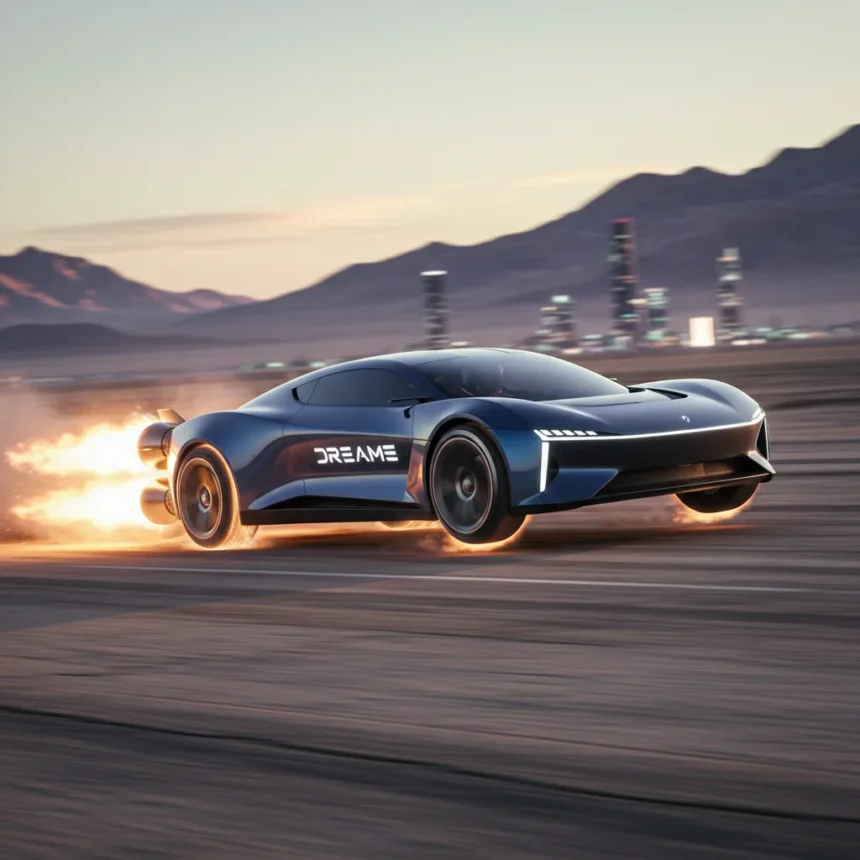
Dreame, a Chinese consumer electronics brand best known for robot vacuums, just unveiled a rocket-powered EV concept that makes most hypercars look tame by comparison. The Dreame Nebula NEXT 01 Jet Edition features dual solid-fuel rocket boosters mounted at the rear, capable of producing up to 100 kilo-Newtons of thrust and activating in just 150 milliseconds. The claimed acceleration: 0-60 mph in 0.9 seconds, which would make it one of the fastest-accelerating vehicles ever built—if it actually works.
Key Takeaways
- Dreame unveiled the Nebula NEXT 01 Jet Edition concept with dual solid-fuel rocket boosters at rear
- Claimed 0-60 acceleration in 0.9 seconds using 100 kN of thrust
- Based on the earlier Nebula 1 supercar concept with 1,876 hp and solid-state batteries
- Manufacturing to begin in 2027; rockets not expected in production models
- Partnered with BNP Paribas to build a factory outside Berlin for EV production
A Robovac Maker’s Wild EV Ambition
Dreame is not a household name in automotive circles, but the company has been quietly building its EV credentials. The rocket-powered EV concept builds on the earlier Dreame Nebula 1, a four-door electric supercar sedan unveiled at CES with 1,876 horsepower and a sleek sedan design. The Jet Edition simply adds rockets to the rear—literally. This is not a subtle upgrade. The company is partnering with BNP Paribas to construct a factory outside Berlin, where it plans to manufacture both the Nebula NEXT 01 and a Rolls Royce Cullinan-like SUV, with production starting in 2027.
The rocket-powered EV concept sits firmly in the realm of eye-catching marketing. Dreame’s goal is explicit: make the world’s fastest car. That ambition requires theater, and what better theater than actual rockets? The dual solid-fuel boosters activate in 150 milliseconds, delivering 100 kN of combined thrust to push the vehicle from 0 to 60 mph in 0.9 seconds. For context, the current production speed record holder, the Rimac Nevera, does 0-60 in approximately 1.85 seconds. A 0.9-second time would be genuinely historic—if achievable.
The Tech Behind the Hype
Beyond the rockets, the Nebula NEXT 01 Jet Edition packs autonomous driving hardware and battery technology that Dreame claims is nearing production readiness. The vehicle uses steer-by-wire and brake-by-wire systems for direct electronic control, eliminating traditional mechanical linkages. Its solid-state batteries promise energy density above 450 Wh/kg, a figure that would put them among the most advanced in development. For autonomous navigation, the car features high-resolution LiDAR effective up to 600 meters, enabling long-range environmental sensing.

These specifications are genuinely ambitious, but they also highlight the gap between concept and production. Dreame has not built a production car yet. The company’s first vehicles are not expected to reach customers before 2027 at the earliest, and the rockets almost certainly will not make it to the final design. Solid-fuel rocket boosters are difficult to refuel, generate extreme heat, and present obvious safety and regulatory challenges. Tesla explored a similar idea with the 2017 Roadster concept, which proposed compressed air boosts instead of rockets—a simpler solution that avoids the logistical nightmare of managing solid fuel.
Why This Matters (and Why It Probably Won’t)
Dreame’s rocket-powered EV concept is a statement. A robovac company announcing it will build the world’s fastest car, with actual rockets, is audacious enough to grab attention in a crowded EV market saturated with incremental improvements and familiar names. The concept also hints at Dreame’s broader vision: integrating vehicles into a smart home ecosystem where your car’s AI could theoretically communicate with your robot vacuum.



But here is the reality check. Dreame is not Tesla, Rimac, or Lotus. The company has zero production cars on the road. The 0.9-second 0-60 claim is unverified and likely unachievable in a street-legal vehicle without severe engineering compromises. The rockets are almost certainly not coming to production. And a factory partnership outside Berlin is a long way from delivering finished vehicles to paying customers.
What Dreame is actually building—the non-rocket version—could still be interesting. A 1,876 hp four-door sedan with solid-state batteries and advanced autonomous driving hardware would be a legitimate competitor to Tesla’s Model S Plaid and upcoming hypercars from established makers. But that story is less flashy than rockets, so expect more theatrical announcements before Dreame ships its first car in 2027.
Is the 0.9-second 0-60 claim realistic?
No. The 0.9-second acceleration would require perfect conditions, ideal traction, and optimal rocket thrust delivery—none of which are guaranteed in real-world driving. Even with rockets, achieving sub-1.0 second 0-60 is an engineering problem that has never been solved in a street-legal production vehicle. Expect the production version to be significantly slower, if rockets appear at all.
Will the production Dreame EV have rocket boosters?
Dreame has stated that rockets are not expected in production models. The Jet Edition is a concept vehicle designed to generate headlines. The actual car you might buy in 2027 will rely on electric motors, batteries, and conventional acceleration—no solid fuel required.



When will Dreame start manufacturing EVs?
Manufacturing is scheduled to begin in 2027 at a factory outside Berlin, built in partnership with BNP Paribas. However, this timeline is not guaranteed, and Dreame has not yet delivered its first production vehicle to customers.
Dreame’s rocket-powered EV concept is a masterclass in automotive marketing—bold, memorable, and completely impractical. The real story is whether the company can deliver a competitive electric sedan and SUV by 2027. The rockets are just the sizzle. The steak—a production EV with solid-state batteries, advanced autonomous driving, and genuine performance—is what actually matters. Until Dreame ships real cars to real customers, the Nebula NEXT 01 Jet Edition remains what it is: a spectacular concept that will never touch a public road.
Where to Buy
194 Amazon customer reviews | £23.49
Edited by the All Things Geek team.
Source: T3