



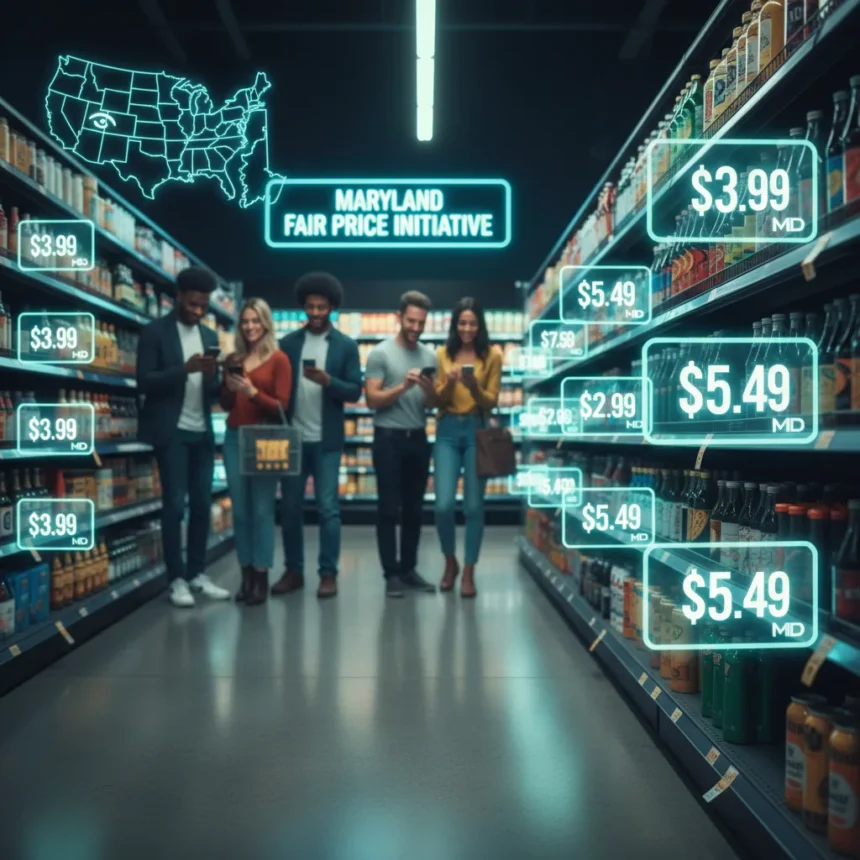
Maryland has become the first US state to ban surveillance pricing in grocery stores, a landmark move that could reshape how retailers set prices across the nation. Governor Wes Moore signed the Protection from Predatory Pricing Act (HB 895) into law on April 28, 2026, with enforcement beginning October 1, 2026. The law targets a practice where companies use shopping history, inferred income, ethnicity, family size, and neighborhood data to charge different customers different prices for identical products.
Key Takeaways
- Maryland’s surveillance pricing ban takes effect October 1, 2026, the first such law in the US
- Retailers must keep prices fixed for at least one full business day, preventing hourly demand-based spikes
- Fines reach $10,000 for first violations and $25,000 for repeat offenses
- Loyalty program prices remain exempt, allowing stores to offer member discounts
- Enforcement falls to Maryland Attorney General; consumers cannot sue directly
What the surveillance pricing ban actually prohibits
The law prevents retailers from using personal data asymmetries to extract maximum willingness-to-pay from individual shoppers. Surveillance pricing allows companies to take advantage of information imbalances and charge customers as much as they think each person will individually pay. Maryland’s law blocks this by requiring prices to remain fixed for at least one full business day, eliminating hourly fluctuations tied to demand spikes or algorithmic customer profiling. Grocery stores and certain grocery delivery platforms fall under the restriction.
The enforcement mechanism offers retailers a grace period. The Maryland Attorney General must provide written notice and allow 45 days for correction before imposing fines. First violations carry penalties up to $10,000; repeat offenses jump to $25,000. This phased approach signals intent to educate rather than immediately punish, though serious repeat violations face substantial financial consequences.
Why Maryland’s ban leaves loopholes wide open
The law’s exemptions undercut its protective reach. Loyalty program prices remain legal, allowing stores to offer members lower prices while charging non-members full retail. This creates a two-tier system where data-driven discounting persists—just rebranded as membership benefits. Additionally, the law contains no clear definition of baseline or standard price, enabling retailers to market frequent fluctuations as promotional discounts rather than surveillance-driven hikes.

Consumers also lack direct legal recourse. Only the Maryland Attorney General can enforce the law, meaning shoppers cannot sue retailers for violations. This limits accountability to government action, which typically moves slower than market demand for justice. The combination of exemptions and limited enforcement channels suggests the law, while symbolically significant, may not fully eliminate the data-driven pricing practices it targets.
What other states are watching
Maryland’s move spotlights broader national momentum to curb surveillance pricing, though the state remains the first to implement a comprehensive retail restriction. Other states are monitoring the law’s rollout and enforcement outcomes to determine whether similar legislation is politically and practically viable. The Maryland Retail Alliance advocated for exemptions during the legislative process, signaling that business resistance will shape how other states approach this issue.



The law’s success or failure will likely influence whether other jurisdictions adopt comparable bans or opt for weaker voluntary standards. If Maryland’s Attorney General actively enforces penalties and retailers adapt without major disruption, other states may follow. If enforcement proves toothless or retailers find workarounds through the loyalty loophole, momentum could stall.
Why shoppers are pushing back against dynamic pricing
Consumer frustration with dynamic pricing has reached a tipping point. Shoppers increasingly resent the idea that their personal data enables retailers to extract more money from them than from other customers buying identical items. The practice feels predatory because it exploits information asymmetry—retailers know customer profiles; customers do not know they are being charged different prices. Maryland’s law responds to this anger by forcing transparency and consistency at the register.
Does Maryland’s law apply to online grocery delivery?
Yes, the surveillance pricing ban applies to certain grocery delivery platforms alongside physical retail stores. However, the law’s exemption for loyalty programs complicates enforcement for digital channels, where membership benefits and personalized discounts are standard business models. Delivery platforms may argue that app-based pricing tiers constitute membership perks rather than surveillance-driven discrimination.
What happens if a retailer violates the surveillance pricing ban?
The Maryland Attorney General enforces the law through a structured process. Retailers receive written notice of violations and have 45 days to correct their practices before facing fines. First violations carry penalties up to $10,000; repeat offenses escalate to $25,000. Consumers cannot sue directly, so enforcement depends entirely on government action and retailer compliance.



Maryland’s surveillance pricing ban marks the opening move in a broader reckoning with data-driven retail practices. The law is imperfect—loyalty exemptions and enforcement limits leave room for workarounds—but it establishes a principle that US shoppers deserve transparent, consistent pricing. Whether other states adopt similar laws, tighten the loopholes, and strengthen enforcement mechanisms will determine whether this becomes a turning point or a cautionary tale about regulation that looks stronger than it actually is.
Where to Buy
Google Pixel 10 Pro | Samsung Galaxy S26 Ultra | Apple iPhone 17 Pro
This article was written with AI assistance and editorially reviewed.
Source: TechRadar