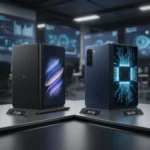
The Samsung Galaxy Z Flip 8 arrives in Q3 2026 as Samsung’s answer to Motorola’s foldable dominance, but it copies more than it innovates. After years of stubbornly compact cover displays, Samsung finally embraced what Motorola proved works: a sprawling 4.1-inch front screen that wraps around the camera lenses. That design shift matters. Yet Motorola’s Razr Ultra 2026 still outpaces Samsung in the specs that drive real-world satisfaction—battery capacity, charging speed, and display refresh rates.
Key Takeaways
- Samsung Galaxy Z Flip 8 features a larger 4.1-inch cover display, matching Motorola’s edge-to-edge design philosophy
- Motorola Razr Ultra 2026 packs a bigger 4700mAh battery versus Samsung’s 4300mAh
- Motorola charges at 68W versus Samsung’s unspecified charging speed
- Samsung uses a proprietary 2nm Exynos 2600 processor; Motorola uses Snapdragon 8 Elite on 3nm
- Both devices run Android 16 with integrated AI features from Google and their respective manufacturers
Samsung Galaxy Z Flip 8: Design Evolution, Not Revolution
The Samsung Galaxy Z Flip 8 represents a humbling admission: Motorola’s 2025 Razr Ultra was right about cover screens. Samsung’s previous Z Flip models shipped with cramped 3.4-inch displays that forced users to unfold the device for almost any task. The Z Flip 8 corrects this mistake with a 4.1-inch, 1048×948 pixel Super AMOLED panel running at 120Hz, protected by Corning Gorilla Glass Victus 2. It wraps around the rear camera lenses, maximizing screen real estate in a closed state.
Closing thickness remains impressively slim at 13.7mm, a genuine engineering achievement when you cram a larger display into the same form factor. The main 6.9-inch, 2520×1080 display unfolds to reveal Samsung’s One UI 8 ecosystem, now integrated with Galaxy AI and Google’s Gemini. The 12GB RAM and 256GB storage configuration feels adequate for 2026, though Motorola‘s 16GB/512GB setup exposes Samsung’s conservative memory allocation.
Battery capacity sits at 4300mAh—a respectable jump from the Z Flip 7, but Motorola’s 4700mAh in the Razr Ultra 2026 delivers roughly 8% more runtime potential. Samsung hasn’t disclosed charging speeds for the Z Flip 8, a notable omission given that Motorola’s 68W fast charging has become table stakes in premium foldables.


Motorola Razr Ultra 2026: Where Spec Sheets Still Matter
Motorola’s Razr Ultra 2026 hasn’t been officially announced, yet leaked specifications suggest the company is refining rather than revolutionizing its winning formula. The main display grows to 7.0 inches at 2640×1080 pixels, edging out Samsung’s 6.9-inch panel. The cover screen measures 4.0 inches with 1272×1080 resolution on a P-OLED panel, and critically, it supports 165Hz refresh rates—a specification Samsung has yet to match.
The Snapdragon 8 Elite SM8750-AB processor on 3nm process and Adreno 830 GPU represent a clear generational leap over Samsung’s Exynos 2600. Qualcomm’s flagship silicon historically outperforms Samsung’s proprietary chips in real-world gaming and multitasking scenarios, though neither device has been subjected to independent benchmarking yet. Motorola’s 16GB of RAM and 512GB storage dwarf Samsung’s allocation, and the 68W charging speed remains unmatched in Samsung’s lineup.


The 4700mAh battery gives Motorola a tangible advantage. In the 2025 generation, this capacity translated to noticeably longer daily runtime compared to Samsung‘s smaller cells. Motorola’s integration of Gemini AI and moto AI also positions it as a stronger choice for users who prioritize AI-driven productivity over pure processing power.
Design and Build: Samsung Catches Up, Motorola Stays Ahead
Samsung’s willingness to copy Motorola’s edge-to-edge cover screen design is pragmatic. The Z Flip 8’s 4.1-inch front panel finally makes the device usable without unfolding—you can reply to messages, check notifications, and control music without touching the main hinge. This was always Motorola’s advantage, and Samsung’s adoption validates the approach.
Motorola’s Razr Ultra 2026 maintains a 0.1-inch screen size advantage on the cover display and supports substantially faster refresh rates. For scrolling through feeds, gaming, or video playback on the front screen, the 165Hz panel delivers noticeably smoother motion than Samsung’s 120Hz offering. Both devices use inside-folding mechanisms with HDR support, eliminating the crease visibility issues that plagued earlier foldables.
Material quality remains unconfirmed for the Z Flip 8, but Motorola’s 2025 Razr Ultra introduced premium options including Alcantara leather and wood finishes. If Motorola repeats this strategy for the 2026 model, it gains a meaningful luxury positioning edge over Samsung’s likely glass-and-aluminum construction.


Processor and Performance: Snapdragon Dominance
Samsung’s decision to use its proprietary Exynos 2600 (2nm) instead of Qualcomm’s Snapdragon 8 Elite represents a cost-cutting measure that undermines the Z Flip 8’s premium positioning. The Exynos 2600 with Xclipse 960 GPU will handle everyday tasks competently, but Motorola’s Snapdragon 8 Elite (3nm) and Adreno 830 pull ahead in demanding workloads. Qualcomm’s architecture scales better for gaming, video encoding, and AI inference tasks—precisely the use cases Samsung emphasizes with Galaxy AI integration.
Neither device has undergone independent benchmarking at this writing, making direct performance claims speculative. However, historical trends show Snapdragon consistently outperforms Exynos in sustained multithreaded performance. For users who plan to keep their flip phone for three years, Motorola’s processor choice offers better future-proofing.
Battery Life and Charging: Motorola’s Practical Edge
The 400mAh battery advantage sounds modest, but real-world usage patterns amplify it. Foldable phones consume power faster than traditional slabs due to dual displays and more complex power management. Motorola’s 4700mAh translates to roughly one additional hour of mixed usage compared to Samsung’s 4300mAh, a meaningful difference for power users.
Charging speed is where Motorola’s lead becomes undeniable. The 68W fast charging on the Razr Ultra 2026 fills the battery in approximately 25-30 minutes, while Samsung’s unspecified charging approach likely trails by 15-20 minutes. For professionals who depend on quick top-ups between meetings, this gap matters.
Software and AI Integration
Both devices ship with Android 16 and integrated AI features, but their approaches diverge. Samsung’s One UI 8 bundles Galaxy AI alongside Google’s Gemini, offering dual AI assistants within the same ecosystem. Motorola pairs Gemini with moto AI, emphasizing Google’s foundation while adding Motorola-specific optimizations. Neither approach is objectively superior—it depends on whether users prefer Samsung’s ecosystem depth or Motorola’s streamlined integration.
Which Should You Actually Buy?
If you prioritize design familiarity and Samsung’s ecosystem lock-in, the Galaxy Z Flip 8 delivers a credible flagship. The larger cover screen finally addresses the Z Flip 7’s biggest weakness, and the slimmer profile when closed feels premium. However, you’re paying flagship pricing for a processor that trails Motorola’s by a generation and a battery that underperforms.
The Motorola Razr Ultra 2026 remains the smarter choice if raw specifications and real-world performance matter more than brand loyalty. Larger battery, faster charging, superior processor, and higher refresh rates on the cover display add up to a more compelling daily experience. Motorola’s willingness to offer premium material finishes also appeals to buyers seeking differentiation.
The deciding factor: Samsung’s Z Flip 8 is confirmed for Q3 2026, while Motorola hasn’t announced the Razr Ultra 2026’s availability. If you need a foldable before late summer 2026, Samsung’s device is your only option.
How much bigger is the Samsung Galaxy Z Flip 8’s cover screen compared to previous models?
The Z Flip 8’s 4.1-inch cover display represents a significant jump from the Z Flip 7’s 3.4-inch panel. This expansion brings Samsung’s design in line with Motorola’s edge-to-edge philosophy, making the phone far more usable without unfolding.
Does the Motorola Razr Ultra 2026 support wireless charging?
The research brief does not confirm wireless charging support for the Motorola Razr Ultra 2026. Only the 68W wired fast charging specification has been documented.
Which processor is faster: Exynos 2600 or Snapdragon 8 Elite?
Snapdragon 8 Elite historically outperforms Exynos in multithreaded tasks and sustained performance, though neither device has undergone independent testing yet. Qualcomm’s 3nm process also provides a manufacturing advantage over Samsung’s 2nm Exynos 2600.
The 2026 flip phone battle hinges on a simple truth: Motorola learned from its 2025 success and refined the formula, while Samsung finally admitted Motorola was right about cover screens. That’s progress, but it’s not leadership. If specs and charging speed drive your decision, Motorola wins. If ecosystem integration and design familiarity matter more, Samsung’s Z Flip 8 is the safer bet—assuming you can wait until Q3 2026 for availability.
Edited by the All Things Geek team.
Source: Android Central