





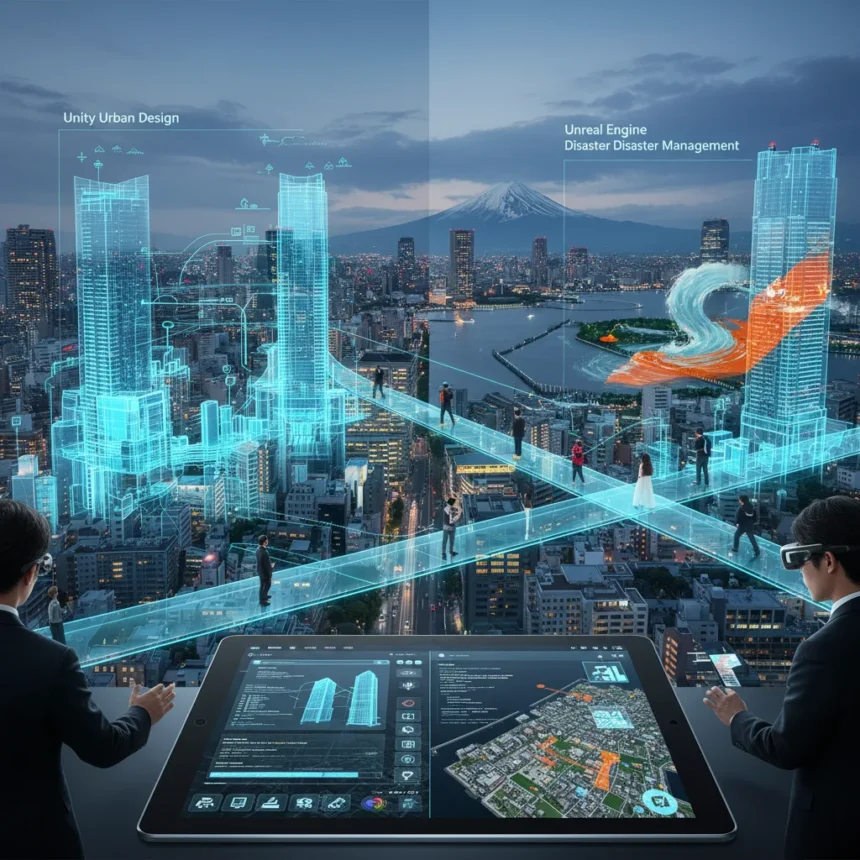
Game engines urban planning represents a significant shift in how Japanese cities approach design, disaster preparedness, and even cultural commerce. What began as software designed to render interactive 3D environments for video games has evolved into a critical tool for architects, urban planners, and disaster management officials across Japan.
Key Takeaways
- Game development engines like Unity and Unreal Engine are being repurposed for urban design and disaster simulation in Japan.
- These tools enable real-time visualization of city layouts and emergency response scenarios before physical implementation.
- Applications extend beyond traditional urban planning to include cultural heritage sales and community engagement.
- Game engines provide cost-effective alternatives to specialized architectural visualization software.
- The approach reflects a broader trend of leveraging gaming technology for practical, non-entertainment purposes.
How Game Engines Urban Planning Is Transforming Japanese Cities
Japanese urban planners and architects have discovered that game engines offer unprecedented flexibility for visualizing complex city systems in real time. Unlike static architectural renderings or expensive specialized software, engines like Unreal Engine and Unity allow teams to iterate rapidly, test multiple design scenarios, and communicate visions to stakeholders through interactive environments rather than static images. This capability proves especially valuable in a country where dense urban centers demand careful coordination between transportation, utilities, green space, and disaster resilience.
The shift reflects pragmatic innovation rather than technological novelty. Game engines were built to handle thousands of interactive objects, dynamic lighting, physics simulation, and real-time rendering—capabilities that translate directly to urban modeling. A planner can now adjust building heights, test traffic flow patterns, or simulate pedestrian movement through a district in ways that traditional CAD software cannot easily replicate. The tools are also more accessible than enterprise-grade architectural platforms, lowering barriers for smaller municipalities and community-driven planning initiatives.
Disaster Management and Emergency Response Simulation
One of the most critical applications has emerged in disaster preparedness. Japanese cities face typhoons, earthquakes, and flooding, and game engines enable officials to simulate emergency scenarios with a level of detail previously impossible. Teams can model evacuation routes, test emergency shelter capacity, visualize water flow during floods, and assess structural vulnerability across entire districts before a crisis occurs.


This approach transforms disaster planning from theoretical exercises into tangible, testable simulations. Emergency responders can practice navigation through a virtual city, identify bottlenecks in evacuation routes, and adjust infrastructure accordingly. The real-time nature of these simulations means that officials can make informed decisions based on dynamic data rather than static maps. For a densely populated nation where disaster preparedness directly affects public safety, this capability represents a meaningful advance in how cities prepare for the unexpected.
Beyond Urban Design: Cultural Commerce and Kimono Sales
The application of game engines extends into unexpected territory—specifically, the visualization and sales of traditional kimono. By creating detailed 3D environments and avatars within game engines, retailers and craftspeople can showcase garments in realistic contexts, allowing customers to see how fabrics drape, how colors interact with different lighting, and how traditional designs appear when worn. This represents a creative solution to the challenge of selling high-value, culturally significant items in an increasingly digital marketplace.



This use case demonstrates how game engines are becoming general-purpose visualization platforms rather than niche gaming tools. The same technology that renders a fantasy battlefield can display a traditional Japanese garden or a customer avatar wearing a handcrafted kimono. The scalability and real-time interactivity of these engines make them more versatile—and often more cost-effective—than purpose-built e-commerce platforms for luxury goods.
Technical Advantages Over Traditional Planning Software
Game engines offer several concrete advantages that explain their adoption across such diverse applications. First, they are significantly cheaper than specialized architectural visualization tools, with free or low-cost versions available for educational and non-commercial use. Second, they support real-time collaboration, allowing teams in different locations to explore a virtual city simultaneously. Third, they integrate physics engines, lighting systems, and animation tools that would otherwise require separate software licenses.
The learning curve, while steep for traditional game development, proves manageable for planners and architects who focus on the visualization and simulation aspects rather than coding. Many Japanese institutions have begun offering training programs to familiarize urban design professionals with these tools, creating a pipeline of practitioners who understand both city planning and game engine workflows.
Is game engines urban planning just a trend in Japan?
While the applications are particularly visible in Japan, the underlying principle—using interactive 3D visualization for non-entertainment purposes—has global relevance. Other countries are experimenting with similar approaches, though Japan’s combination of dense urban centers, advanced tech adoption, and cultural emphasis on disaster preparedness has accelerated the trend locally.


What makes game engines more effective than CAD software for urban planning?
Game engines excel at real-time rendering, physics simulation, and interactive exploration. CAD software is precise for technical drawings but slower for visualization and iteration. Game engines sacrifice some technical precision for speed and interactivity—a trade-off that favors rapid prototyping and stakeholder communication over final construction documents.
Can smaller Japanese cities afford to implement game engine planning tools?
Yes. Free versions of Unity and Unreal Engine remove the cost barrier that would exclude smaller municipalities. The primary investment is in training staff and allocating time for modeling existing infrastructure, not purchasing expensive software licenses.
Game engines urban planning represents a pragmatic reimagining of what technology designed for entertainment can accomplish in the service of public safety, cultural commerce, and civic design. Japan’s willingness to experiment with these tools across disaster management, urban design, and even traditional crafts suggests that the boundary between gaming and practical infrastructure planning will continue to blur. As more cities recognize the value of real-time, interactive visualization, expect this approach to spread beyond Japan’s borders.
Edited by the All Things Geek team.
Source: Tom's Hardware




