





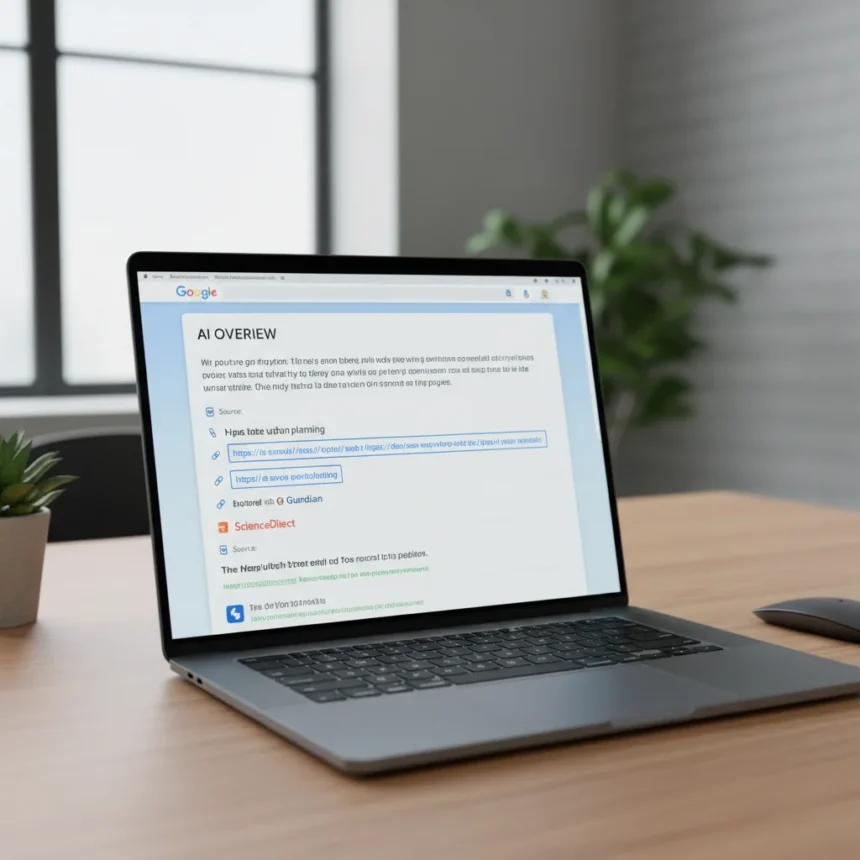
Google AI Overviews are finally doing something publishers have demanded for over a year: linking back to the sources that trained them. The search giant has updated its AI-powered summaries to display source links as expandable cards directly beneath the AI summary text, with clear labels for content type like “Article,” “Forum,” and “Subscription.” This marks a sharp reversal from the May 2024 rollout, when AI Overviews faced fierce backlash for burying links and funneling search traffic away from news sites, blogs, and independent publishers.
Key Takeaways
- Google AI Overviews now display source links prominently as expandable cards with content-type labels beneath summaries.
- The update addresses publisher complaints about “zero-click searches” where users never visit original sites.
- Powered by updated Gemini 1.5 models, improving source selection and reducing hallucinations.
- Rolling out to U.S. English searches initially, with global expansion planned but no confirmed timeline.
- Available free to all Google Search users on desktop, Android, and iOS apps.
Why Google AI Overviews Needed a Fix
When Google rolled out AI Overviews to all U.S. users in May 2024 following the Google I/O announcement, the response from publishers was immediate and brutal. News organizations, independent bloggers, and content creators watched their traffic plummet as users got complete answers without ever clicking through to the original source. Reddit threads were summarized without attribution. Paywalled articles were condensed into free snippets. The feature became a textbook example of “zero-click searches”—a phenomenon where Google’s own products cannibalize traffic from the web properties that feed them. Lawsuits followed, including antitrust scrutiny from the DOJ targeting Google’s search monopoly and its impact on the broader content ecosystem.
The problem was structural. Earlier versions of AI Overviews buried source links below the fold or presented them as plain text, making them easy to ignore. A user scrolling through a search result would see the AI summary first, get their answer, and leave without ever seeing where that information came from. Publishers weren’t just losing clicks—they were losing the economic foundation of digital publishing. Google’s own training data relies on content from these publishers, creating a perverse dynamic where the company was profiting from summarizing material while starving the creators who produced it.
Google AI Overviews Now Make Sources Harder to Ignore
The redesigned Google AI Overviews place source attribution front and center. Instead of burying links at the bottom of the summary, they now appear as clickable cards or chips immediately below the AI-generated text. Each source is labeled with its content type—distinguishing between news articles, forum discussions, Reddit threads, and subscription-based content. This design change makes it visually harder for users to miss where the information originated.



The update also improves attribution accuracy for community-driven sources like Reddit. Previously, AI Overviews might cite “Reddit discussions” vaguely; now they point to specific threads and credit individual users more accurately. This matters because Reddit and other forums are increasingly where people find unfiltered, real-world advice—exactly the kind of content users are searching for when they ask “fix iPhone battery drain” or “best budget laptops.” By crediting these sources explicitly, Google is acknowledging that forums deserve the same visibility as traditional news outlets.
Under the hood, the improvements run on updated Gemini 1.5 models, which Google says better select relevant sources and reduce hallucinations—a persistent problem where AI systems invent facts or misattribute information. Better source selection means the links that appear are more likely to be genuinely useful, not just algorithmically ranked. Fewer hallucinations mean fewer cases where AI Overviews confidently state something false, then link to sources that never said it.



Will This Actually Send Traffic Back to Publishers?
Here’s where optimism meets reality. Google’s changes are a step toward fairness, but they don’t guarantee publishers will see their traffic recover. Making links more visible helps, but it doesn’t solve the core issue: many users will still read the AI summary and leave satisfied, never clicking through. The update addresses the visibility problem—links are no longer buried—but not the behavioral problem. A user who gets a complete answer to “best portable chargers” from the AI summary has little incentive to click deeper, even if the source links are right there.
Larger publishers with brand recognition and paywall-protected content may benefit most. If a user sees a source labeled “Subscription” with a recognizable outlet name, they might click out of curiosity or loyalty. But independent creators, niche bloggers, and smaller outlets without household-name recognition face a steeper challenge. Their links sit alongside established brands, competing for attention in a list of expandable cards. The playing field is slightly more level, but it’s not level.
Comparatively, competitors like Perplexity AI and ChatGPT Search have long provided direct, prominent links as a core feature—though they lack Google’s search scale and user base. Bing Copilot faced similar publisher complaints but addressed them faster. Google’s update brings it closer to parity with these alternatives, but the company’s dominance in search means the stakes are higher. When Google changes how it surfaces sources, the entire web publishing ecosystem feels the tremor.
Rollout Timeline and Global Availability
The updated Google AI Overviews are rolling out to U.S. English searches starting in late April or early May 2026, available immediately on desktop, Android, and iOS apps without any premium tier required. Global expansion is planned but Google has not announced specific dates or regional timelines. This phased approach is typical for Google—test extensively in the U.S. market, gather feedback, then expand internationally. Publishers outside the U.S. will have to wait to see how the changes affect their traffic.


The timing is significant. This rollout comes as AI ethics scrutiny intensifies across the industry and as publishers face ongoing revenue crises. By visibly improving source attribution, Google is signaling that it takes publisher concerns seriously—a move that could soften regulatory pressure and potentially head off further lawsuits. Whether the changes actually stabilize the content ecosystem Google depends on for training data remains an open question.
Does Google AI Overviews reduce hallucinations?
Google says the updated Gemini 1.5 models powering the new AI Overviews improve source selection and reduce hallucinations. However, no AI system is perfect. Hallucinations—where the AI invents facts or misattributes information—still occur, but less frequently with the newer models. The visibility of sources helps users verify claims themselves, adding a layer of accountability that earlier versions lacked.
Will AI Overviews replace traditional search results?
AI Overviews appear at the top of Google Search results, but they don’t replace the traditional blue-link list below. Users still see both the AI summary and the ranked search results. This dual-layer approach gives users options: read the quick AI answer or dive deeper into the full results. Over time, as users grow accustomed to AI summaries, traditional search results may become secondary for many queries, but that transition is still in progress.
How much traffic will publishers actually recover?
The research brief does not provide official traffic recovery data from Google. Early testing by Android Central showed 20-30% more prominent link visibility compared to prior versions, but this measures visibility, not actual clicks. Whether increased visibility translates to meaningful traffic recovery depends on user behavior—something only Google’s internal analytics can definitively answer. Publishers will likely see modest gains, but the zero-click problem is not fully solved.
Google AI Overviews are now better citizens of the web, but they’re still competing for user attention against the summaries they provide. The new design acknowledges that sources matter and deserve visibility. Whether that acknowledgment translates into sustainable traffic for publishers—especially smaller ones—remains the real test. For now, this update is a win for transparency and a step back from the worst excesses of AI-driven zero-click searches. But it’s a step, not a solution.
Edited by the All Things Geek team.
Source: Android Central




