





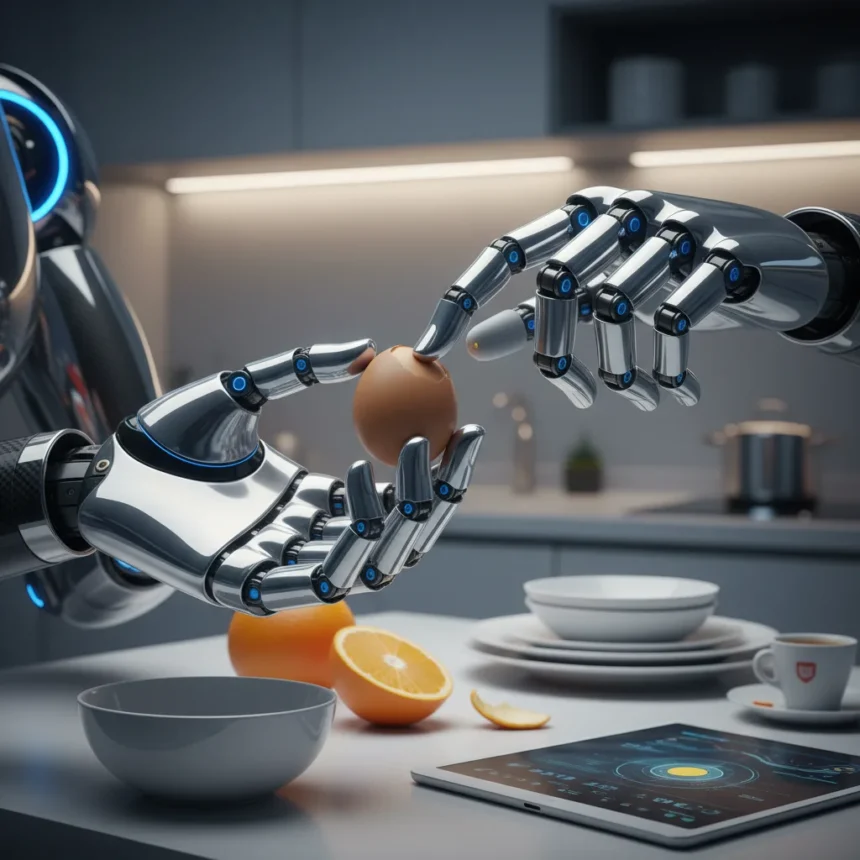
Genesis AI robot hands represent a significant leap in robotic dexterity, moving beyond laboratory benchmarks into territory that feels genuinely unsettling in its humanity. The most striking demonstration? A robot hand casually wiping egg residue from its fingers with a towel—a gesture so ordinary it becomes extraordinary when performed by a machine.
Key Takeaways
- Genesis AI robot hands can perform everyday kitchen tasks including making eggs and preparing smoothies.
- The robots have demonstrated advanced problem-solving by solving a Rubik’s Cube.
- Training is the critical factor enabling these capabilities, not just raw hardware.
- The technology shows robots moving beyond specialized industrial tasks into general household activities.
- Human-like behaviors such as self-cleaning represent a new frontier in robotic interaction design.
What Makes Genesis AI Robot Hands Different
The Genesis AI robot hands stand apart because they do not rely on pre-programmed routines for every motion. Instead, training enables them to adapt and learn tasks in ways that mimic human problem-solving. This approach allows the hands to tackle activities that require judgment, fine motor control, and real-time adjustment—precisely the skills that have eluded robots for decades.
The difference between Genesis AI robot hands and traditional industrial robots is fundamental. Industrial arms excel at repetitive precision: welding the same seam 10,000 times, assembling identical components on a factory line. Genesis AI robot hands operate differently. They learn. They generalize. They handle variation. When a robot hand wipes egg off its fingers, it is not executing a pre-recorded sequence—it is applying learned understanding of texture, pressure, and object interaction to a novel situation.
Tasks That Reveal Hidden Capability
The demonstrations of Genesis AI robot hands include making eggs, preparing smoothies, and solving a Rubik’s Cube. Each task reveals something distinct about what the hands can achieve. Making eggs requires temperature sensitivity, timing, and understanding how ingredients behave under heat. Smoothies demand sequencing and the ability to work with liquid without spilling. A Rubik’s Cube tests spatial reasoning, pattern recognition, and dexterous manipulation simultaneously.



What ties these tasks together is that none of them are trivial. A human child learns to crack an egg over years of practice. Solving a Rubik’s Cube requires cognitive effort even for humans. Yet Genesis AI robot hands accomplish these without the embodied experience humans accumulate. They do it through training—algorithms that allow the hands to learn from examples, mistakes, and feedback rather than from explicit instruction for every micro-movement.
Why Training Is Everything
The research brief emphasizes training as the key to Genesis AI robot hands’ capabilities. This is not marketing language—it is the actual constraint that determines what these hands can and cannot do. Without sufficient training data and optimization, the hands would fail at most of these tasks. With it, they succeed in ways that surprise observers accustomed to robots that are either highly specialized or entirely rigid.



Training enables generalization. A hand trained on multiple egg-cooking scenarios can adapt when the pan is a different size, the heat varies, or the eggs are at different temperatures. A hand trained on Rubik’s Cube solving learns the underlying logic, not just one solution sequence. This is why Genesis AI robot hands represent progress beyond previous generations of robotic systems—they move closer to the flexible, adaptive behavior that defines human manual skill.
The Uncanny Element: Why Finger-Wiping Matters
The image of a Genesis AI robot hand wiping egg off its fingers with a towel has resonated because it crosses a psychological threshold. It is not a task humans find impressive—we wipe our hands without thinking. But when a robot does it, something shifts. The gesture reads as self-aware, almost vain. It suggests the hand understands not just how to manipulate objects, but how to care for itself.
This is where Genesis AI robot hands move beyond engineering into design philosophy. The developers chose to demonstrate not just capability but comportment. The hand does not simply complete a task and stop. It cleans up after itself. It performs a gesture that, while functionally unnecessary, communicates something about the robot’s relationship to its environment and itself. Whether intentional or emergent from training, this behavior signals a new era in how robots interact with human spaces.
What Genesis AI Robot Hands Mean for the Future
Genesis AI robot hands are not yet ubiquitous. They are demonstrations of what becomes possible when training replaces rigid programming. The implications are significant: robots that can learn household tasks, adapt to new environments, and perform work that currently requires human dexterity and judgment. Kitchen automation, care work, assembly tasks with high variability—all become potential applications once the training framework matures.



The challenge ahead is not whether Genesis AI robot hands can perform isolated tasks. They have proven that. The challenge is scaling that capability—training hands to work reliably across dozens of tasks, in diverse environments, with the same consistency humans expect from tools. It is also understanding the limits of training: what tasks remain too complex, too context-dependent, or too physically demanding even for well-trained robotic hands.
How Do Genesis AI Robot Hands Compare to Other Robotic Systems?
Traditional industrial robots excel at single, repetitive tasks but struggle with variation and adaptation. Humanoid robots attempt to replicate human form but often sacrifice specialization. Genesis AI robot hands occupy a middle ground: they are specialized enough to be practical, but flexible enough to learn new behaviors. This hybrid approach makes them potentially more useful in real-world settings than either extreme.
The training-first philosophy also differs from approaches that prioritize raw processing power or sensor density. Genesis AI robot hands prove that intelligent learning can compensate for hardware that is merely adequate rather than extraordinary. A hand with good sensors and smart training outperforms a hand with exceptional sensors but no learning capability.
Can Genesis AI robot hands work in any kitchen environment?
The research brief does not specify the environments where Genesis AI robot hands have been tested or their performance across different kitchen setups. The demonstrations show capability in controlled conditions, but real-world deployment in diverse kitchens—with different stove types, pan sizes, and ingredient variations—remains an open question. Training on diverse data is essential before claiming broad applicability.
How long does it take to train Genesis AI robot hands for a new task?
The research brief emphasizes that training is critical but does not specify training timelines. The speed at which Genesis AI robot hands can learn new tasks compared to traditional programming or human training is not detailed in the available information.
What happens if Genesis AI robot hands encounter something they have never been trained on?
Genesis AI robot hands demonstrate learning and adaptation, but the boundaries of their generalization are not defined in the research brief. Whether they can successfully handle novel situations or require retraining for significant variations remains unclear.
Genesis AI robot hands represent a genuine inflection point in robotics. They have moved past the stage of impressive-but-narrow demonstrations into a space where robots learn, adapt, and perform tasks that require judgment and dexterity. The image of a robot hand wiping its fingers clean is not just a cute visual—it is evidence of a training approach that produces behavior indistinguishable from conscious care. Whether that behavior is conscious or emergent, the practical result is the same: robots that behave more like capable assistants and less like programmed machines. That shift changes everything about what robots can do next.
Edited by the All Things Geek team.
Source: TechRadar




