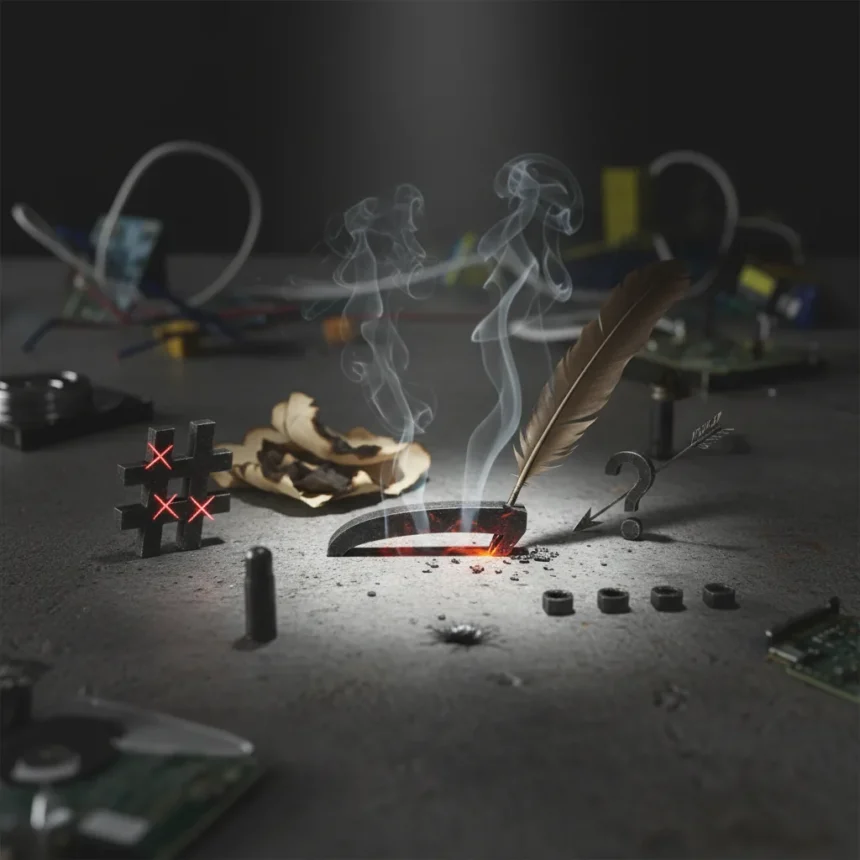
The AI writing backlash has become a cultural fixation, transforming how readers evaluate authenticity and suspicion. What started as legitimate concern about machine-generated content has evolved into something far more problematic: a hunt for stylistic tells that treats punctuation as proof of guilt.
Key Takeaways
- The AI writing backlash increasingly relies on punctuation patterns as evidence of machine authorship.
- The em dash has become a flashpoint in debates over what constitutes “AI writing.”
- Policing specific punctuation marks penalizes human writers who naturally use those marks.
- Stylistic suspicion conflates correlation with causation, assuming certain writing patterns only machines produce.
- The backlash risks normalizing a culture of textual distrust where any writing can be questioned.
How Punctuation Became the New AI Smoking Gun
Writers and readers have begun weaponizing punctuation as a detection method, with the em dash emerging as the primary suspect. The logic seems simple: AI models produce certain stylistic patterns, therefore any text exhibiting those patterns must be machine-generated. But this reasoning collapses under scrutiny. Human writers have used em dashes for centuries—they are a legitimate stylistic choice, not a machine fingerprint. When readers see an em dash, they increasingly assume artificial authorship, creating a chilling effect on writers who rely on this punctuation for clarity and rhythm.
The problem deepens because punctuation preferences vary wildly among human writers. Some favor em dashes for parenthetical asides. Others prefer parentheses or commas. Neither choice proves anything about the author’s nature. Yet the AI writing backlash treats these stylistic decisions as algorithmic breadcrumbs, turning grammar into an accusation. This conflates correlation with causation—the fact that some AI systems might use em dashes frequently does not mean all em dash usage indicates AI authorship.
The Broader Danger of Stylistic Suspicion
The AI writing backlash extends beyond the em dash. Readers now scrutinize sentence length, word choice, paragraph structure, and tone, searching for patterns they believe signal machine origin. This creates an impossible standard: human writers are expected to prove their humanity through their punctuation and phrasing, a burden no writer should bear. The result is a culture of textual distrust where authenticity must be defended rather than assumed.



What makes this particularly corrosive is that it assumes machines and humans produce fundamentally different writing. In reality, AI systems train on human text. They learn patterns from millions of human writers. Accusing someone of AI authorship based on their em dash usage is like accusing someone of plagiarism because they use common words. It mistakes statistical likelihood for proof. It mistakes similarity for guilt.
Why the Em Dash Specifically Deserves Protection
The em dash has become a cultural lightning rod in the AI writing backlash, singled out as somehow more suspicious than other punctuation. This is unfair and absurd. The em dash serves genuine rhetorical purposes—it creates emphasis, sets apart asides, and adds rhythm to prose. Professional writers, journalists, and literary authors have relied on it for generations. Treating it as a machine tell is like treating the word “the” as evidence of artificial origin simply because it appears frequently in AI text.



The em dash debate reveals how the AI writing backlash has lost perspective. Instead of focusing on whether writing serves its intended purpose, readers now obsess over whether punctuation choices align with their preconceived notions of human authenticity. This is not literary criticism. It is suspicion masquerading as analysis. It is a way of dismissing writing without engaging with its actual content or merit.
What Happens When the Backlash Becomes the Norm
If the AI writing backlash continues unchecked, writers face a troubling future. They will self-censor their natural stylistic choices to avoid suspicion. They will avoid em dashes not because the punctuation is wrong, but because readers have been trained to treat them as red flags. This is a loss for writing itself—it narrows the acceptable range of human expression in the name of AI detection.
The real danger is not that AI writing exists. The real danger is that the backlash creates a culture where all writing is guilty until proven human. Where stylistic choices must be justified. Where readers approach text not with openness but with forensic suspicion. This is a world poorer for writers and readers alike.
Is the em dash really a sign of AI writing?
No. The em dash is a legitimate punctuation mark used by human writers for centuries. Its presence in a text does not indicate machine authorship. Treating it as evidence of AI generation conflates a stylistic choice with proof of origin, which is logically flawed.


What should readers look for instead of punctuation patterns?
Instead of obsessing over em dashes and sentence length, readers should evaluate whether writing is clear, accurate, and serves its purpose. Does the argument hold together? Are the claims supported? Is the voice consistent? These questions matter far more than whether the author favored dashes over parentheses.
Can human writers and AI coexist without this backlash?
Yes, but only if readers move past stylistic suspicion. AI writing has legitimate concerns—plagiarism, attribution, authenticity in journalism. Those are real issues worth addressing. Policing punctuation is not. The AI writing backlash needs to mature beyond treating grammar as a guilt detector and focus instead on the actual ethical questions AI writing raises.
The em dash does not need to be defended. Writing does. The AI writing backlash has gone too far when it punishes human writers for their natural stylistic choices and transforms punctuation into an accusation. It is time to reclaim the em dash from the culture of suspicion and remember that good writing—human or otherwise—serves clarity and purpose, not algorithmic patterns.
Edited by the All Things Geek team.
Source: Creativebloq