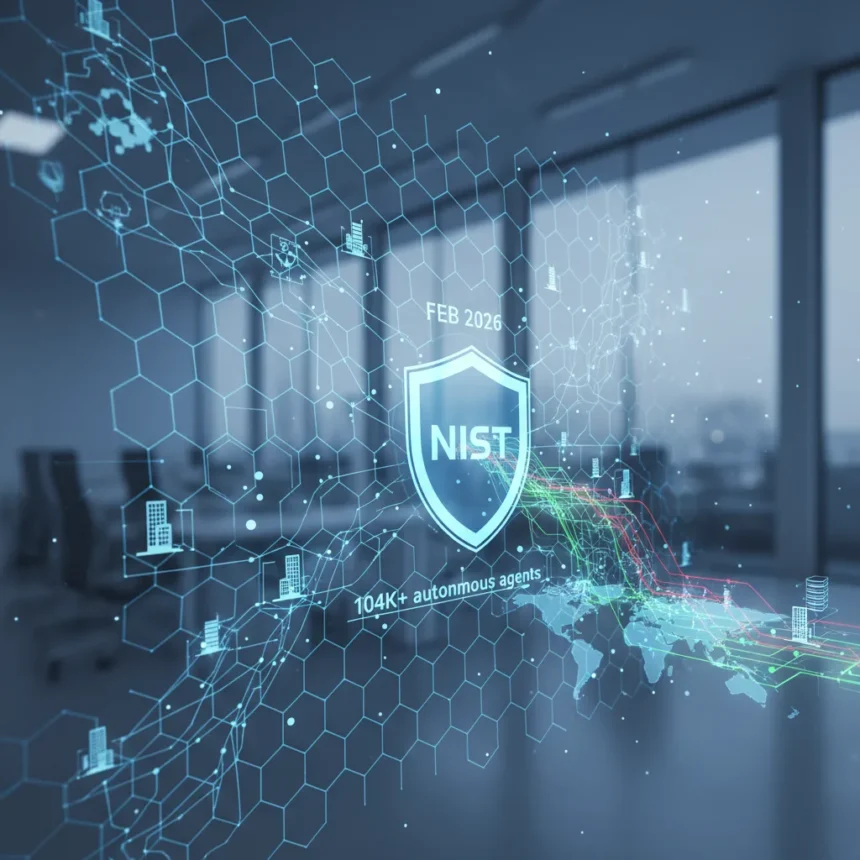
NIST’s AI agent standards initiative represents a watershed moment for enterprise AI security. Launched February 17, 2026, by the National Institute of Standards and Technology’s Center for AI Standards and Innovation (CAISI), the initiative tackles a critical gap: over 104,504 AI agents are already active worldwide, yet no agreed-upon security standards, identity verification protocols, or interoperability frameworks exist. Without these safeguards, enterprises face mounting risks as autonomous agents handle communications, debug code, and interact with external services on their behalf.
Key Takeaways
- NIST’s AI agent standards initiative launched February 17, 2026, coordinating federal partners and industry stakeholders
- Over 104,504 AI agents currently active globally with no unified security or interoperability standards
- Three strategic pillars drive the initiative: industry-led standards, open-source protocol development, and security research
- Public input mechanisms include Request for Information (RFI) on AI Agent Security due March 9, 2026
- Initiative aims to enable secure enterprise adoption while cementing U.S. leadership in international standards bodies
Why the AI agent standards initiative matters now
The timing is urgent. Autonomous AI agents capable of taking independent actions are proliferating faster than governance frameworks can address them. The AI agent standards initiative fills this void by establishing a coordinated path forward. Unlike ad-hoc security measures that vary across vendors, standardized protocols create a level playing field where enterprises can confidently deploy agents knowing they meet baseline security requirements and can communicate smoothly across platforms. This is not theoretical—it directly impacts whether organizations adopt AI agents with confidence or delay deployment pending regulatory clarity.
NIST’s approach mirrors its proven track record with the Cybersecurity Framework (CSF), which evolved from voluntary guidelines into industry standards and eventually regulatory expectations. The AI agent standards initiative follows the same trajectory: establish consensus now, codify best practices later, and create enforceable requirements as the technology matures. This staged approach gives industry time to shape standards before mandates arrive.
Three pillars driving the AI agent standards initiative
The initiative rests on three interconnected strategic pillars. First, facilitating industry-led standards development and U.S. leadership in international standards bodies like ISO, IEC, and ITU ensures American vendors influence global rules rather than react to them. Second, fostering community-led open-source protocol development—exemplified by emerging protocols like MCP—creates interoperability pathways that prevent vendor lock-in. Third, advancing research in AI agent security, identity, authentication, and authorization addresses the technical foundations that standards must rest upon.



This three-pronged structure acknowledges that standards alone are insufficient. Industry needs both formal standards bodies and grassroots open-source communities working in parallel. NeuralTrust has already positioned itself as a collaborator in defining security and trust standards alongside NIST, signaling how vendors plan to engage with the initiative. The combination of top-down standards development and bottom-up protocol innovation creates redundancy—if one pathway stalls, others keep momentum alive.
What enterprises need to prepare for
The AI agent standards initiative will reshape how organizations architect, deploy, and govern autonomous agents. Current governance and risk management (GRC) tools were not designed with AI agent requirements in mind, creating a compliance blind spot. Enterprises should anticipate that future standards will demand agent identity verification, transparent authorization logs, and interoperability testing—capabilities many existing systems lack. Organizations beginning AI agent pilots now should design with these requirements in mind rather than retrofitting later.



NIST has opened multiple channels for public input. A Request for Information (RFI) on AI Agent Security closes March 9, 2026, and the Information Technology Laboratory is releasing an AI Agent Identity and Authorization Concept Paper by April 2, 2026. These are not bureaucratic formalities—they shape the technical direction of standards. Vendors and enterprises with perspectives on security priorities, interoperability needs, or implementation challenges should submit feedback rather than wait for finalized standards to appear.
How this shifts the competitive landscape
The AI agent standards initiative levels an uneven playing field. Today, large cloud vendors can dictate proprietary agent architectures because no standards exist. Once interoperability protocols mature, smaller vendors and open-source communities gain footing to compete on security and innovation rather than ecosystem lock-in. This benefits enterprises by increasing choice and reducing switching costs. It also raises the bar for security—vendors cannot hide behind proprietary black boxes once standards demand transparent identity and authorization mechanisms.
The international dimension matters. By coordinating with NSF and federal partners while engaging ISO, IEC, and ITU, NIST is positioning the U.S. to shape global AI governance before China, the EU, or other blocs impose competing standards. A fragmented world where different regions enforce incompatible agent standards would fragment the AI ecosystem and raise costs for global enterprises. The AI agent standards initiative aims to prevent that outcome.
What happens next
NIST plans to announce research findings, guidelines, and deliverables in the coming months. These will likely begin with foundational security research and identity frameworks, progressing toward formal standards proposals. Enterprises should monitor NIST announcements and contribute to public comment periods—standards shaped by diverse stakeholder input tend to be more robust and adoptable than those designed in isolation.



The AI agent standards initiative is not a regulatory mandate imposed from above. It is a collaborative effort to establish consensus before mandatory rules arrive. Organizations that engage now—by submitting RFI comments, testing draft protocols, and building standards-aligned architectures—will shape the standards rather than scramble to comply with them later. For enterprises deploying AI agents at scale, that distinction is the difference between leading and following.
Will the AI agent standards initiative actually prevent security breaches?
Standards create a baseline, not a guarantee. The AI agent standards initiative will establish minimum requirements for identity verification, authorization, and interoperability, but no standard eliminates all risk. What standards do accomplish is making security failures visible and measurable—organizations that ignore standards or deploy agents that violate them become liable. This shifts incentives toward compliance.
How does the AI agent standards initiative compare to existing AI governance frameworks?
Existing frameworks like the EU AI Act and NIST’s AI Risk Management Framework address broad AI systems governance. The AI agent standards initiative is narrower and deeper—it focuses specifically on autonomous agents and the technical protocols they need to operate securely together. It complements rather than replaces broader governance frameworks.
When will the AI agent standards initiative produce actual standards?
NIST typically releases foundational guidance within months and formal standards within 12-24 months. The RFI and concept papers due in March and April 2026 will inform the roadmap. Early adopters should expect working drafts by mid-2026 and preliminary standards by late 2026 or early 2027.
The AI agent standards initiative arrives at a critical juncture. Autonomous agents are proliferating, enterprises are deploying them, and security risks are escalating—yet no agreed-upon safeguards exist. NIST’s coordinated approach across industry-led standards, open-source protocols, and security research creates the infrastructure for trusted, interoperable agent ecosystems. Organizations that engage with this initiative now will shape the standards that govern AI agents for years to come. Those that wait will inherit rules they did not help write.
Edited by the All Things Geek team.
Source: TechRadar