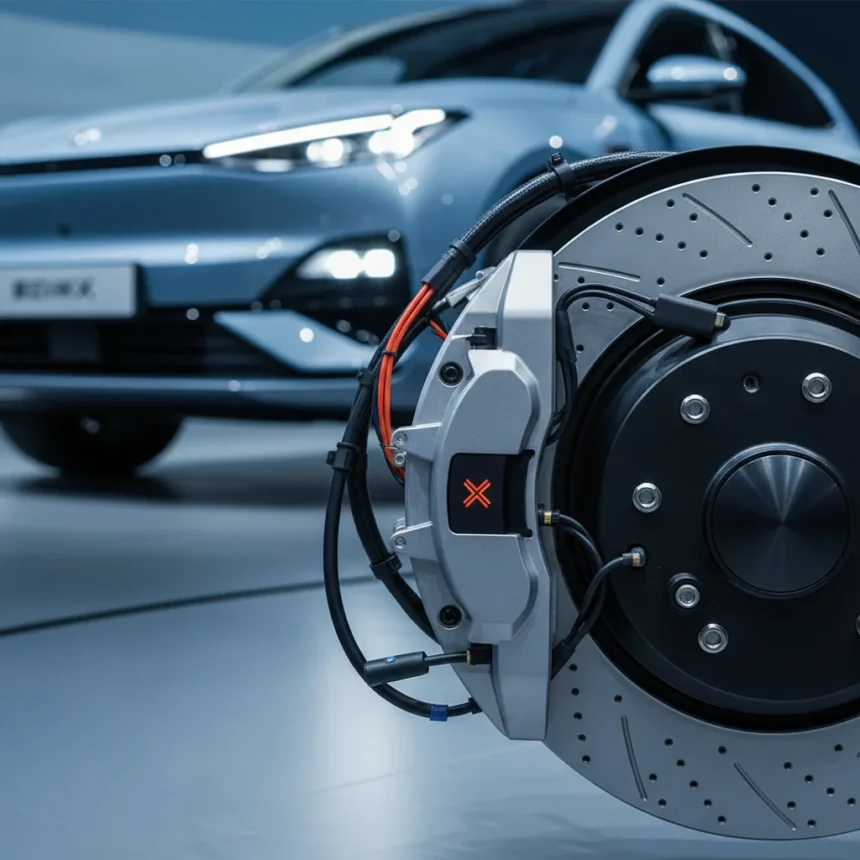
Brake-by-wire technology is entering production vehicles for the first time without a hydraulic safety net. The Zeekr 7X, an electric SUV from Geely’s premium EV brand, launches in China in Q1 2025 with a fully electronic braking system (eBS) that replaces traditional hydraulic lines, master cylinders, and vacuum boosters entirely. No mechanical backup exists. If electronics fail, the car enters a reduced-performance limp mode.
Key Takeaways
- Zeekr 7X is the first production passenger car with fully electronic brake-by-wire technology and no hydraulic backup system.
- The eBS uses electronic signals to control brake calipers via electric motors, eliminating all hydraulic fluid connections.
- Redundancy relies on dual electronic control units (ECUs), multiple power supplies, and fail-safe modes defaulting to 30-50% braking capacity.
- Zeekr claims shorter stopping distances, more precise control, and faster response times versus traditional hydraulic systems.
- The system meets UN ECE R13-H standards for heavy vehicles but requires regulatory extension for passenger cars in Europe and North America.
The shift represents a watershed moment for automotive electronics. For over a century, hydraulic brakes have provided a mechanical guarantee: even with total electrical failure, pressing the pedal moved fluid through lines to stop the wheels. That certainty is gone. Brake-by-wire technology replaces it with redundancy—layers of electronic safeguards designed to fail gracefully rather than catastrophically. But redundancy is not the same as mechanical certainty, and that distinction matters when lives depend on it.
How Brake-by-Wire Technology Actually Works
The Zeekr 7X’s eBS operates without hydraulic fluid. When a driver presses the brake pedal, a sensor reads the input and sends an electronic signal to dual electronic control units. These ECUs process the signal and command electric motors to apply force directly to the brake calipers. The entire transaction happens in milliseconds, with no physical connection between pedal and wheel. Zeekr claims this architecture delivers shorter stopping distances, more precise control, and faster response times compared to traditional hydraulic systems.
The system integrates regenerative braking, recovering energy from deceleration to recharge the battery. Conventional cars waste that energy as heat. An electronic system can blend regenerative and friction braking smoothly, optimizing energy recovery without the driver feeling a transition. On paper, it is more efficient and responsive than anything hydraulics can match.

But efficiency gains mean nothing if the system fails. That is where redundancy enters. The eBS includes dual ECUs, each with independent power supplies and sensor inputs. If the primary control unit fails, the secondary activates automatically. Both units cross-check sensor readings to detect faults. If both ECUs fail—a scenario Bosch engineers claim occurs below 1 in 10 million cycles—the vehicle defaults to a fail-safe mode with electronic braking at roughly 30-50% capacity. The driver must pull over immediately.
The Redundancy Debate: Is Electronic Enough?
Redundancy is not new to automotive safety. Airbags have backup systems. Engine computers have watchdog circuits. But those systems protect against rare, specific failures. Brake-by-wire protects against total electrical collapse in the one system that cannot fail. Dr. Helen Russell, a safety expert at the Transport Research Laboratory, voiced the core tension: removing hydraulics is bold, but without triple redundancy, it is a gamble on electronics in extreme conditions.



Extreme conditions matter. What happens when a car is struck by an electromagnetic pulse? Military-grade EMP events are rare, but solar storms strong enough to disrupt power grids have occurred. Commercial aircraft carry mechanical backups for this reason. The Zeekr 7X does not. What happens in a fire? Hydraulic fluid boils and loses pressure, but the driver can still pump the pedal and generate some braking force through mechanical advantage. An electronic system offers no mechanical advantage. The car simply stops braking.
Bosch, the primary supplier of brake-by-wire technology, has tested similar systems in prototypes since 2019 and claims failure rates are negligible. But self-reported supplier data carries inherent bias. Independent crash-test organizations like Euro NCAP and the US National Highway Traffic Safety Administration are still evaluating how to integrate brake-by-wire into their testing protocols. Regulatory approval for passenger cars remains incomplete. The Zeekr 7X meets UN ECE R13-H standards, which apply to heavy vehicles, but extending those standards to passenger cars is ongoing.
Brake-by-Wire Technology vs. Existing Alternatives
Brake-by-wire is not entirely new to vehicles. The 2019 Infiniti Q50 uses an electro-hydraulic hybrid system, blending electronic control with hydraulic backup. Tesla Model 3 and Model Y employ integrated power braking (IPB), which also retains hydraulics. Lucid Air, Rivian R1T, and other premium EVs follow the same pattern: electronic control with hydraulic fallback. All of these preserve the mechanical guarantee. The Zeekr 7X discards it entirely.
Porsche’s 918 Spyder hybrid supercar uses brake-by-wire, but it is a low-volume specialty vehicle with redundant systems and a target audience of expert drivers. Commercial trucks from Volvo and Scania have adopted brake-by-wire under ECE R13 standards, but they operate in controlled environments with professional drivers and maintenance schedules. A consumer SUV sold to millions of drivers worldwide is a different proposition.



Continental’s MK C2 system and Brembo’s Sensify platform offer alternative approaches: electronic control with adaptive calipers, but hydraulic backup intact. These solutions preserve the mechanical fallback while gaining electronic precision. Zeekr rejected that approach, betting entirely on electronics.
Cybersecurity and the Threat Model
Removing hydraulics simplifies mechanical complexity but multiplies electronic vulnerability. Brake-by-wire systems communicate via CAN bus, the same network that connects infotainment, steering, and powertrain controls. A breach in one system could potentially cascade to brakes. Zeekr has not publicly detailed how the eBS isolates itself from other vehicle networks, though Bosch likely employs encryption and authentication protocols.
The risk is not theoretical. Researchers have demonstrated remote brake disabling in vehicles with networked systems. The Zeekr 7X’s dual-ECU architecture and cross-checking sensors provide defense in depth, but no system is unhackable. As vehicles become more connected—5G integration, over-the-air updates, cloud diagnostics—the attack surface expands. A hydraulic brake system cannot be hacked remotely. An electronic one can.
Weight savings and packaging flexibility are real advantages. Removing hydraulic lines and master cylinders saves roughly 10 kilograms and frees interior space for batteries or cargo. For an EV manufacturer, that matters. But those gains come with a hidden cost: total dependence on electrical infrastructure, software reliability, and cybersecurity. The Zeekr 7X gambles that the engineering is robust enough to justify the trade.
What Happens When You Lose Power?
Battery depletion is unlikely but possible. Modern EVs have battery management systems that prevent complete discharge, but a catastrophic battery fault could theoretically leave the car without power. With traditional brakes, the driver can still stop through mechanical advantage and friction. With eBS, if the battery is dead or the power distribution system fails, the car cannot brake electronically. The fail-safe mode provides reduced braking, but that requires power. A truly dead vehicle is a dead stop, potentially on a highway.
Zeekr addresses this through redundant power supplies and battery isolation circuits designed to preserve brake power even if main propulsion systems fail. But redundancy has limits. A major collision, fire, or electrical short could disable multiple systems simultaneously. The question is not whether failure is possible—it always is—but whether the probability is low enough to justify removing the mechanical guarantee.
Regulatory Status and Global Rollout
The Zeekr 7X launches in China in Q1 2025, where regulatory oversight of new technologies is faster and less prescriptive than in Europe or North America. Global exports to Europe and the Middle East begin mid-2025. US availability remains uncertain due to regulatory hurdles. Euro NCAP and NHTSA are monitoring brake-by-wire integration, but formal crash-test protocols for fully electronic systems are still under development. A car approved in China may not meet European or American safety standards.
This regulatory fragmentation creates a de facto two-tier market. Zeekr can refine the technology in the Chinese market, accumulate real-world reliability data, and adjust designs before facing stricter Western approval processes. It is a smart strategy, but it also means Western buyers will have less field data to evaluate when the car arrives.
Is Brake-by-Wire Technology the Future?
Zeekr and Bosch are betting it is. As vehicles become software-defined and electrified, mechanical systems become liabilities. They add weight, complexity, and cost. Electronic control scales across platforms and integrates with autonomous driving features. A self-driving car needs brake-by-wire to function—a human driver cannot take over an electro-hydraulic system in an emergency if the electronics fail.
But the first production implementation of any critical safety system carries risk. Early adopters of brake-by-wire technology become the test population. If the Zeekr 7X accumulates millions of miles without major incidents, confidence will grow. If failures occur, the entire industry will face backlash. Regulators may impose stricter redundancy requirements or mandate mechanical backups, defeating the purpose of the technology.
Why This Matters Now
The Zeekr 7X announcement signals a shift in automotive philosophy. Traditional manufacturers view brakes as a safety-critical system requiring mechanical fallback. EV startups and Chinese manufacturers view them as just another software-controlled subsystem. That philosophical divide will shape vehicle safety for the next decade. If brake-by-wire proves reliable, hydraulics will disappear from cars entirely. If it fails catastrophically, the industry will retreat to hybrid systems for years.
The 2025 launch also coincides with aggressive regulatory pushes for advanced driver aids and autonomous features in Europe and China. Brake-by-wire is a prerequisite technology for those systems. Zeekr is not just selling an SUV; it is placing a bet on the architecture of future vehicles. Competitors will watch closely.
What could go wrong with brake-by-wire technology?
Multiple failure modes exist. Dual ECU failure, though rare, would trigger limp mode with 30-50% braking capacity. Electrical fire or short circuit could disable both power supplies simultaneously. Software bugs in the control logic could cause erratic braking behavior. Cybersecurity breaches could enable remote brake disabling. Electromagnetic interference from external sources could corrupt sensor signals. None of these are likely, but none are impossible.
How does brake-by-wire technology compare to traditional hydraulic brakes?
Hydraulic brakes offer mechanical fallback even with total electrical failure. Brake-by-wire offers faster response, better integration with regenerative braking, and weight savings. The trade-off is dependence on electronics. Hydraulic systems have been proven for over a century. Brake-by-wire has decades of testing in prototypes and commercial trucks, but no long-term field data in consumer passenger cars.
When will brake-by-wire technology become standard in cars?
Zeekr 7X launches in China Q1 2025 and exports to Europe and Middle East mid-2025. Regulatory approval for North America remains uncertain. If the system proves reliable over the next 2-3 years, other manufacturers will adopt it. If failures occur, adoption will slow significantly. The timeline depends entirely on real-world performance and regulatory acceptance.
Brake-by-wire technology represents a genuine inflection point in automotive engineering. It trades mechanical simplicity for electronic precision, proven reliability for optimized efficiency. For an industry racing toward autonomous vehicles and software-defined platforms, it is a logical step. For safety engineers and conservative regulators, it is a risk that requires extraordinary redundancy and years of field validation. The Zeekr 7X will provide both. Whether that data proves reassuring or alarming depends on how the system performs when millions of drivers depend on it.
Edited by the All Things Geek team.
Source: TechRadar