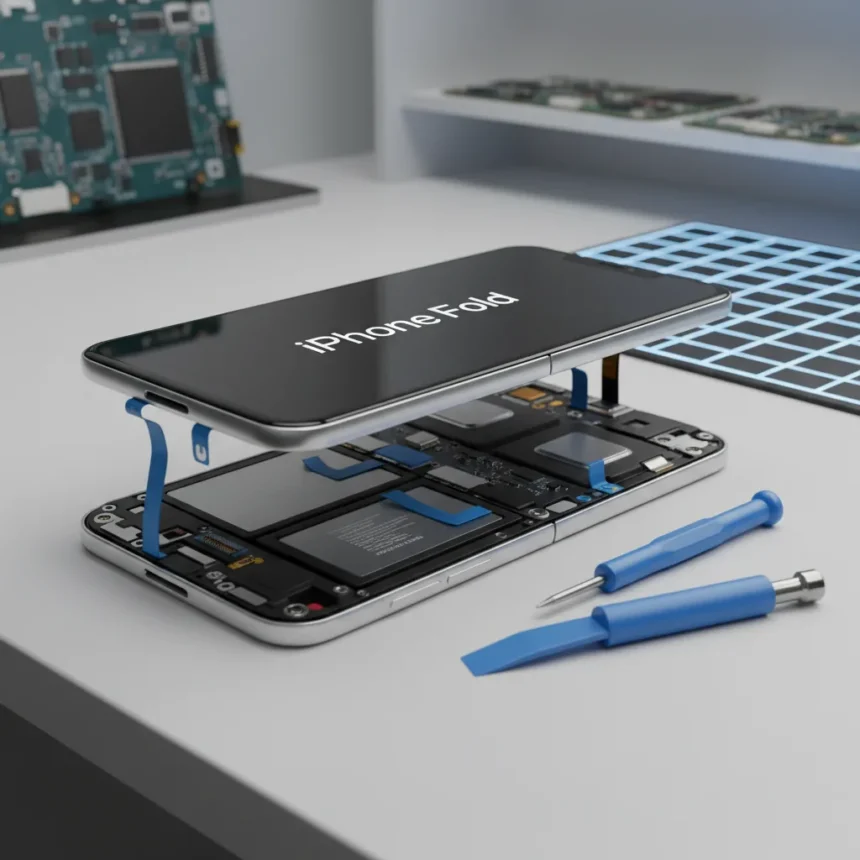
The iPhone Fold repair design has emerged as a potential significant shift for the foldable smartphone market. According to a leaker, Apple’s entry into foldables will feature the easiest foldable screen to disassemble and repair in the industry, positioning the device as a standout in a category notorious for repair complexity.
Key Takeaways
- An unnamed leaker claims the iPhone Fold will have the easiest foldable screen to repair in the industry.
- Apple is addressing the crease problem through 3D-printed hinges, ultra-thin flexible glass, and liquid metal components.
- Current foldables like Samsung models require extensive de-gluing and lack repair documentation.
- Expected launch timeline is 2026, with Foxconn establishing specialized production lines.
- The iPhone Fold repair design could differentiate Apple in a market where foldables are notoriously difficult to fix.
Why iPhone Fold Repair Design Matters Now
Repairability has become a critical differentiator in premium smartphones. Today’s foldables are engineering nightmares to fix. Samsung’s Galaxy Z Fold series requires technicians to de-glue the outer display and back cover, and the company provides no official repair instructions or parts availability to consumers. This approach locks users into expensive manufacturer repairs or forces them toward replacement. Apple’s rumored focus on accessible repair could flip this dynamic entirely, especially as the company has already committed to right-to-repair principles across its product line.
The timing is significant because foldables have matured beyond concept phase. Foxconn has reportedly established a specialized production line for the iPhone Fold, indicating the device has moved past prototype testing into mass production preparation. This suggests Apple’s engineering team has solved enough technical hurdles to prioritize secondary concerns like repair access. The leaker’s claim about disassembly ease aligns with this progression—you do not optimize for repairability on a device still struggling with basic durability.
How iPhone Fold Repair Design Compares to Current Foldables
Most foldable smartphones today treat the display as a sealed, non-serviceable component. If the screen cracks, the entire device often requires replacement because the folding mechanism and display are bonded together with adhesive that destroys surrounding components when removed. Samsung’s approach exemplifies this problem: users cannot access the display without destroying the structural integrity of the frame. By contrast, some devices like HMD’s foldables use screws and straightforward mechanical fasteners for the display, allowing technicians to service the screen without adhesive removal.


Apple’s rumored design reportedly leans toward this mechanical-first philosophy for the iPhone Fold repair design. The company has been testing 3D-printed hinges and ultra-thin flexible glass to solve the infamous crease problem, but these innovations also create opportunities for modular construction. If the hinge can be 3D-printed precisely, it can be designed for disassembly. If the glass is ultra-thin, it can be installed and removed without thermal stress that adhesive-based methods impose. Oppo’s Find N6 uses a Titanium Flexion Hinge with liquid polymer layers to achieve a near-invisible crease, but Apple’s approach appears to prioritize both crease reduction and repair accessibility simultaneously.
The Crease Problem and Apple’s Engineering Solution
The foldable crease is not just an aesthetic issue—it is a structural weakness that leads to cracks over time. Current foldables suffer from stress concentration at the fold line because the display material does not bend uniformly. Apple has reportedly been testing variable-thickness ultra-thin glass with chemical strengthening and hi-tech adhesive formulations to distribute bending stress more evenly across the fold. This engineering approach directly supports better repairability because a display that flexes without cracking is less likely to fail during disassembly.



The leaker’s claim about easy disassembly gains credibility when viewed through this technical lens. If Apple has solved the crease problem through better materials and hinge design, the display no longer needs to be encased in protective adhesive layers. Fewer adhesive layers mean fewer barriers to removal. The iPhone Fold repair design could therefore be a natural consequence of Apple’s materials science advances, not an afterthought bolted onto a design that was already locked down.
What Easy Repair Means for iPhone Fold Longevity
Repairability directly extends product lifespan. A foldable that can be serviced when the screen degrades will remain usable for years longer than one that cannot. This matters because foldable displays degrade faster than traditional screens—the constant flexing accelerates organic material breakdown. If the iPhone Fold repair design allows users to replace the display without replacing the entire device, the total cost of ownership drops significantly. A $200 screen replacement beats a $1,500 device replacement every time.
For Apple, this approach also aligns with environmental commitments and regulatory pressure. The European Union has already begun mandating repairability standards for consumer electronics, and the iPhone Fold repair design would position Apple ahead of compliance curves in major markets. Samsung’s current foldables would likely struggle to meet emerging EU right-to-repair requirements because their sealed architecture requires professional equipment and voids warranties.
Supply Chain Readiness and 2026 Launch Timeline
Foxconn’s establishment of a specialized production line signals that the iPhone Fold is no longer a lab project. Mass production tooling requires final design sign-off, which means Apple’s engineering team has locked in the repair strategy. The expected 2026 launch window gives Apple time to scale manufacturing while building repair infrastructure—training technicians, stockpiling display modules, and integrating repair workflows into Apple’s existing service network.



The leaker’s claim about repairability becomes more plausible in this context. Apple would not tout repair accessibility to supply chain insiders unless the design actually supported it. Leakers typically speak from vantage points within manufacturing or logistics, where they can observe physical design choices. An easy-to-disassemble screen would be immediately obvious to anyone handling prototype units on a production line.
What Remains Unconfirmed
The leaker’s identity and track record remain unknown, so the iPhone Fold repair design claim should be treated as unverified until Apple provides official specifications or independent teardowns are conducted. Display specifications—including the rumored 7.8-inch inner and 5.5-inch outer screens—are also speculative. Pricing, exact launch date, and regional availability have not been announced. Apple has historically been secretive about foldable development, so official details may not emerge until closer to launch.
When will the iPhone Fold launch?
The expected launch timeline is 2026, with mass production reportedly nearing completion. Apple has not confirmed a specific date, so this remains based on supply chain reporting and leaker claims rather than official Apple statements.
How does the iPhone Fold repair design compare to Samsung foldables?
Samsung’s Galaxy Z Fold series requires extensive de-gluing and lacks official repair instructions or parts availability, making repairs expensive and difficult. The iPhone Fold repair design reportedly aims for easier disassembly, potentially allowing users to access and replace components without destroying surrounding parts.
What is Apple doing about the foldable crease problem?
Apple is testing ultra-thin flexible glass, 3D-printed hinges, liquid metal components, and variable-thickness glass with chemical strengthening to reduce or eliminate the visible crease,. These materials science advances also enable the iPhone Fold repair design by reducing the need for protective adhesive layers.
The iPhone Fold repair design represents a fundamental shift in how Apple might approach the foldable market. Rather than chasing raw performance or screen size, the company appears focused on durability and serviceability—the unglamorous engineering that keeps devices functional for years. If the leaker’s claim proves accurate, the iPhone Fold could set a new standard for foldable repairability and force competitors to reconsider their sealed-box approach. Until Apple confirms details, skepticism is warranted, but the engineering trajectory suggests the company is building a foldable designed to last.
Edited by the All Things Geek team.
Source: Tom's Guide