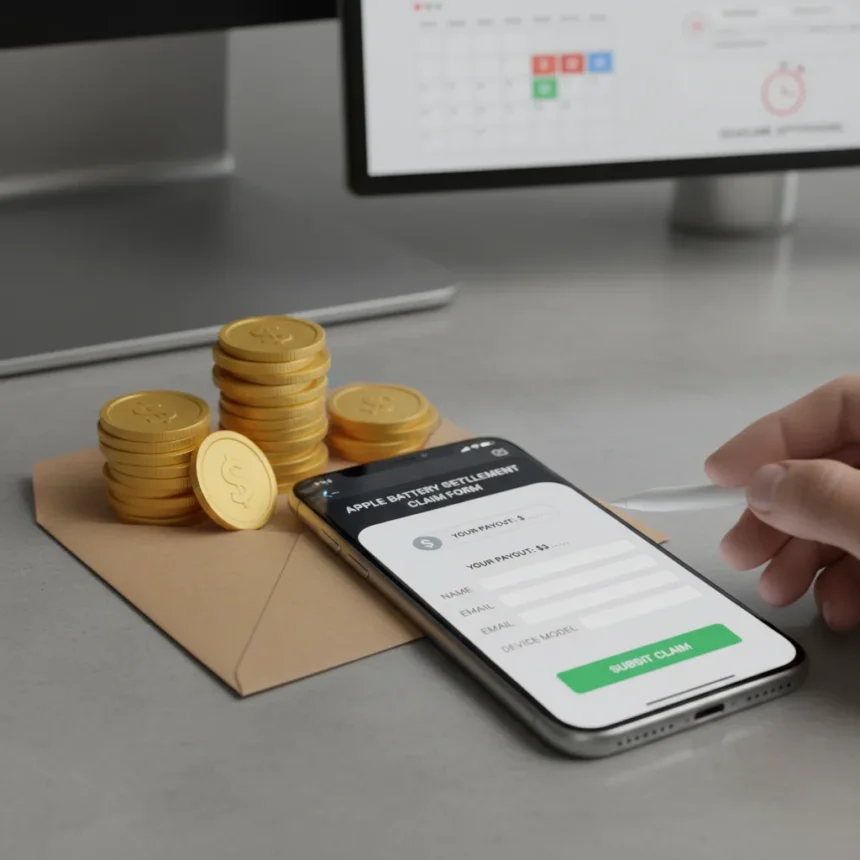
Apple’s iPhone battery settlement is now distributing payments to eligible claimants after the US District Court approved the $250 million class-action settlement on December 20, 2023. The iPhone battery settlement stems from allegations that Apple secretly slowed down older iPhones without user consent—a practice that sparked outrage when revealed in 2017. Payouts began rolling out on February 2, 2025, and eligible US residents can still file claims to receive compensation for affected devices.
Key Takeaways
- Apple agreed to pay $250 million to settle allegations it throttled older iPhone performance without disclosure.
- Eligible devices include iPhone 6, 6 Plus, 6s, 6s Plus, 7, 7 Plus, and SE (1st gen) owned between September 2015 and December 2017 in the US.
- Maximum payout is $95 per device, capped at 5 devices per person ($500 total).
- Over 6.4 million claims have been approved as of early 2025.
- Payments are distributed via PayPal (instant) or check (mailed within 30 days).
Which iPhones qualify for the iPhone battery settlement
The iPhone battery settlement covers seven specific models purchased or owned in the United States during a defined window: September 16, 2015, through December 21, 2017. Eligible devices are the iPhone 6, iPhone 6 Plus, iPhone 6s, iPhone 6s Plus, iPhone 7, iPhone 7 Plus, and the first-generation iPhone SE. You do not need proof of purchase—Apple ID verification or device serial number confirmation suffices. If you owned multiple eligible models during the settlement period, you can claim up to five devices, though the exact payout per device varies based on the total number of approved claims.
The settlement administrator, Angeion Group, manages all claim processing and verification. Owners outside the United States are ineligible, regardless of device model or purchase date. The original claim deadline was April 2024, but it was extended to June 3, 2024, to allow more eligible users to file. If you missed that deadline, you cannot file a new claim, though the settlement website continues to process and distribute payments to those who submitted before the cutoff.
How to file a claim for the iPhone battery settlement
Filing a claim for the iPhone battery settlement is straightforward and free. Visit the official settlement website at iphonebatterysettlement.com and create an account using your email address. You will need to provide your name, mailing address, phone number, and email, then list up to five eligible iPhone models by their serial numbers. Finding your device serial number is simple: go to Settings > General > About on your iPhone, or check the original device box if you still have it.


After submitting your claim, the settlement administrator will verify your eligibility and notify you by email once approved. You can log back into the settlement website using your confirmation ID or email to check your claim status at any time. The entire process typically takes a few weeks, though processing times vary based on claim volume. Do not attempt to file through third-party websites or links—the official site is the only legitimate claim portal, and Apple never asks claimants to pay any fees to participate in the settlement.
Payout amounts and payment methods for the iPhone battery settlement
The iPhone battery settlement distributes payments ranging from $25 to $95 per eligible device. The exact amount depends on how many total claims are approved—as more people file, the per-device payout may decrease due to the fixed $250 million pool. Approved claimants receive payments via their choice of PayPal (instant deposit) or mailed check (arrives within 30 days of claim approval). Payments began on February 2, 2025, and continue as claims are processed and approved.



Be aware that tax implications may apply to your settlement payout. If your total payout exceeds $600, you will receive a 1099 tax form, and the settlement amount may be considered taxable income. Consult a tax professional if you have questions about reporting the payout on your federal return. The settlement website provides regular updates on payment status and claim processing timelines, so check your account periodically if you have submitted a claim.
What happens if your claim is rejected
If your claim is denied or rejected, you have recourse. The settlement website allows you to file an objection or appeal within 30 days of receiving a rejection notice. Common reasons for denial include claiming devices outside the eligible models, providing serial numbers that do not match the settlement window, or submitting duplicate claims for the same device. Review the rejection reason carefully and resubmit with corrected information if applicable.
The original opt-out deadline for the settlement was January 9, 2024, so that window has closed. Anyone who did not opt out by that date is bound by the settlement terms and eligible to claim their payout. If you have questions about your specific claim status, contact Angeion Group directly through the settlement website—they handle all inquiries and appeals.
How does the iPhone battery settlement compare to other Apple settlements
Apple has faced multiple class-action settlements in recent years. The iPhone battery settlement is the largest in scope, affecting millions of users of older iPhone models. A separate Apple Siri settlement paid out up to $20 per device for alleged unauthorized voice recording, though that settlement involved fewer total claims. The Google Chrome privacy settlement, by comparison, distributed $5 billion but involved different privacy violations and a broader audience. Unlike those settlements, the iPhone battery settlement specifically addresses performance throttling—a practice Apple claimed was necessary to prevent unexpected shutdowns on devices with degraded batteries, though the company did not disclose the feature to users.



If you own an older iPhone with a failing battery today, Apple offers official battery replacement service for $49 to $99 depending on the model, or third-party replacements typically cost $50 to $100. However, the settlement compensates users retroactively for the throttling that occurred years ago, separate from any current repair costs.
Can you still claim the iPhone battery settlement in 2025
No, the claim filing deadline for the iPhone battery settlement has passed. The original deadline was April 2024, and Apple extended it to June 3, 2024, to accommodate additional eligible claimants. Anyone who did not file by June 3, 2024, cannot submit a new claim. However, if you filed before the deadline, your claim is still being processed and you can track its status on the settlement website. Payments are being distributed through 2025 and beyond as approved claims are processed.
How long does it take to receive your iPhone battery settlement payout
After you file a claim on the iPhone battery settlement website, processing typically takes a few weeks. Once approved, you receive an email notification and can choose payment by PayPal or check. PayPal deposits are instant upon approval, while checks are mailed and arrive within 30 days. Over 6.4 million claims have been approved as of early 2025, so processing times may vary depending on current claim volume. Check your account status regularly on the settlement website to monitor progress.
The iPhone battery settlement represents a rare win for consumers in a high-profile tech privacy dispute. If you owned one of the eligible iPhone models during the specified timeframe and filed a claim before the deadline, you have money waiting. For those who missed the filing window, the settlement serves as a reminder of the importance of tracking class-action deadlines—and why transparency in device performance matters.
Edited by the All Things Geek team.
Source: Tom's Guide