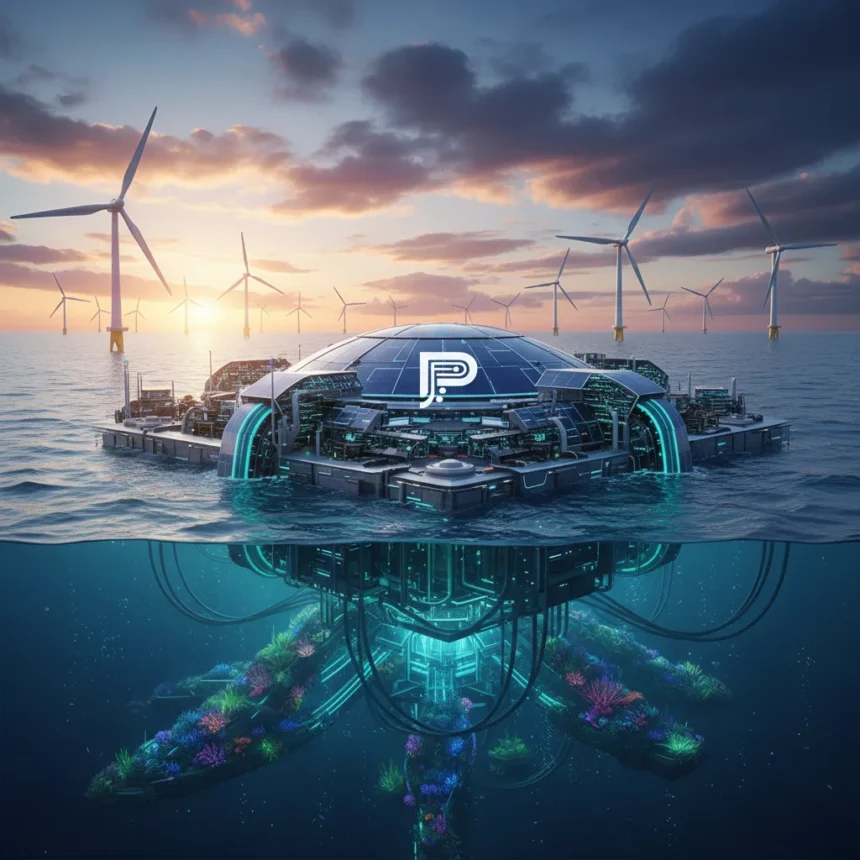
Ocean-powered AI data centers represent a radical departure from land-based server farms, and Panthalassa—a startup backed by PayPal co-founder Peter Thiel—just signaled it is ready to go live. The company announced it has raised $1 billion in total funding, including a recent $140 million round, to deploy floating data centers in the open ocean powered by wave energy.
Key Takeaways
- Panthalassa raised $1 billion to develop and deploy ocean-powered AI data centers using wave energy.
- The startup claims access to tens of terawatts of new energy capacity from ocean waves.
- Ocean deployment bypasses terrestrial power grid constraints that limit land-based data center expansion.
- Peter Thiel’s backing underscores investor confidence in the ocean infrastructure model.
- The company states it is ready for deployment as AI energy demands strain global infrastructure.
Why Ocean Power Matters for AI Right Now
The AI boom is consuming energy at a pace that terrestrial infrastructure cannot match. Land-based data centers face mounting power grid constraints, forcing hyperscalers to negotiate with utilities, invest in nuclear partnerships, or relocate operations. Ocean-powered AI data centers sidestep this bottleneck entirely by tapping wave energy directly at the source. Panthalassa’s model eliminates the need to compete for finite grid capacity in populated regions, opening what the company describes as tens of terawatts of untapped renewable potential.
This is not a theoretical advantage. The sheer scale of AI compute demand—training large language models, running inference at billions of queries per day—now rivals the power consumption of small nations. By moving data centers offshore, operators can scale without waiting for new power plants or grid upgrades. The ocean becomes the infrastructure, not a constraint.
Panthalassa’s Technology and Deployment Strategy
Panthalassa’s ocean-powered AI data centers are designed to float in open water and harvest energy from waves. The company has positioned itself as deployment-ready, stating it is prepared to begin operations. The floating architecture means no land acquisition, no environmental permitting battles over terrestrial real estate, and no reliance on aging power grids.


The competitive advantage against land-based operators is structural. Traditional data centers must negotiate power purchase agreements with utilities, navigate zoning restrictions, and contend with local opposition. Ocean-powered AI data centers eliminate these friction points. A floating facility in international waters or exclusive economic zones can theoretically scale faster and cheaper than building another terrestrial megafacility. Whether that theoretical advantage translates to practice depends on whether Panthalassa’s first deployments actually work and deliver the promised efficiency.
What Panthalassa’s Funding Means for the Industry
A $1 billion raise signals that serious capital believes in the ocean model. Peter Thiel’s involvement carries weight—he has backed infrastructure bets before and has a track record of backing contrarian ideas that reshape industries. The funding round suggests investors see ocean-powered AI data centers not as speculative R&D but as an imminent commercial reality.



This creates pressure on traditional data center operators and cloud providers. If Panthalassa proves the concept works, hyperscalers will face a choice: build more land-based facilities in power-constrained regions, or pivot toward ocean partnerships. The funding also attracts talent and competition—other startups will likely pursue similar models, turning ocean energy into a genuine infrastructure market rather than a curiosity.
The Unresolved Questions
Panthalassa claims access to tens of terawatts of new energy capacity, but the company has not disclosed detailed engineering studies, prototype performance data, or third-party validation of those claims. The gap between readiness and actual deployment remains unclear. How long until the first facility goes live? What are the real-world efficiency numbers? How will marine biology, weather resilience, and maintenance logistics actually work at scale?
These are not rhetorical obstacles—they are engineering realities that will determine whether ocean-powered AI data centers become a transformative infrastructure shift or a well-funded dead end. Panthalassa’s next move is to prove the concept, not just raise capital for it.
Can Ocean Power Solve the AI Energy Crisis?
Ocean-powered AI data centers address a real bottleneck: the mismatch between AI compute demand and available grid power. If Panthalassa’s technology works reliably, it could unlock capacity that land-based expansion cannot provide. But one company, even with $1 billion, cannot solve a global energy crisis alone. The ocean model works best for hyperscalers willing to invest in offshore infrastructure and accept the operational complexity of floating data centers in open water.



For smaller operators or regions without ocean access, land-based solutions—nuclear partnerships, renewable energy contracts, efficiency improvements—remain necessary. Ocean power is not a replacement for terrestrial infrastructure; it is an additional lever for scaling AI compute in regions with ocean access and regulatory permission to operate offshore.
How does Panthalassa’s ocean model compare to land-based data centers?
Land-based data centers depend on terrestrial power grids and face constraints from available grid capacity, real estate costs, and local permitting. Ocean-powered AI data centers eliminate grid dependency, reduce land acquisition friction, and tap renewable energy directly. The tradeoff is operational complexity—floating facilities require specialized maintenance, weather resilience, and maritime regulatory compliance that land-based operators do not face.
When will Panthalassa’s ocean data centers actually deploy?
The company states it is ready for deployment, but no specific timeline or location has been announced. Panthalassa has not disclosed when the first floating data center will go live or where it will operate. Investors and competitors are watching for the announcement that moves the concept from funding stage to operational reality.
What is the real capacity potential of ocean wave energy?
Panthalassa claims access to tens of terawatts of new energy capacity from ocean waves, but the company has not published engineering validation or independent studies supporting that figure. The claim is promotional rather than peer-reviewed, and the actual harvestable capacity will depend on deployment location, technology efficiency, and regulatory constraints that remain unknown.
Panthalassa’s $1 billion raise is a watershed moment for ocean-powered infrastructure, but it is also a beginning, not an ending. The real test arrives when the first floating data center powers on and delivers the efficiency and reliability that justify the hype. Until then, ocean-powered AI data centers remain a high-stakes bet on an unproven model—one that could reshape data center infrastructure or become a cautionary tale about capital chasing speculative infrastructure ideas. The next 18 months will tell.
Edited by the All Things Geek team.
Source: TechRadar